
Dynamics of Influence: Accelerating Collective Decisions via Hierarchical Social Roles
Analyzing Social Roles Based on a Hierarchical Model and Data Mining for Collective Decision-Making Support
The paper proposes a hierarchical social role analysis model and an integrated mechanism to support Collective Decision-Making (CDM). By identifying dynamic social roles across three layers (Content, Profile, and Relation) in both real-world and cyber environments, the method improves consensus efficiency compared to traditional Delphi methods.
TL;DR
Achieving group consensus in social networks is often a slow and disorganized process. This paper introduces a hierarchical social role model that categorizes users across three layers—Content, Profile, and Relation—integrating their status from both the real and cyber worlds. By applying these roles to a weighted negotiation mechanism, the authors reduced the time to reach consensus by nearly 50% compared to the traditional Delphi method.
Problem & Motivation: The "Flat" Decision-Making Trap
Most existing Collective Decision-Making (CDM) systems suffer from a lack of social context. They often assume that every vote carries the same weight or that "active" users are the most influential. However, social science tells us that roles are dynamic: a professor's opinion on a curriculum (Real-world relation) or a "hub user's" influence on a trending topic (Cyber-world behavior) carries different weights depending on the context.
The challenge lies in mapping these multifaceted roles into a mathematical framework that can actually support an automated decision-making process.
Methodology: The Three-Layer Social Architecture
The core innovation is a hierarchical model that views a participant through three distinct lenses, capturing the "Dual-World" (Real vs. Cyber) nature of modern interaction.
1. The Three Layers
- Content Layer: Roles derived from actions (e.g., academic records in the real world vs. frequency of posts in the cyber world).
- Individual Profile Layer: Static or slow-changing attributes (e.g., gender/occupation vs. system experience).
- Relation Layer: The network of influence (e.g., teacher-student dynamics vs. opinion leader-follower relationships).
2. The Support Mechanism
The authors improved the Delphi Method—a systematic, interactive forecasting method—by introducing social role influence parameters ().
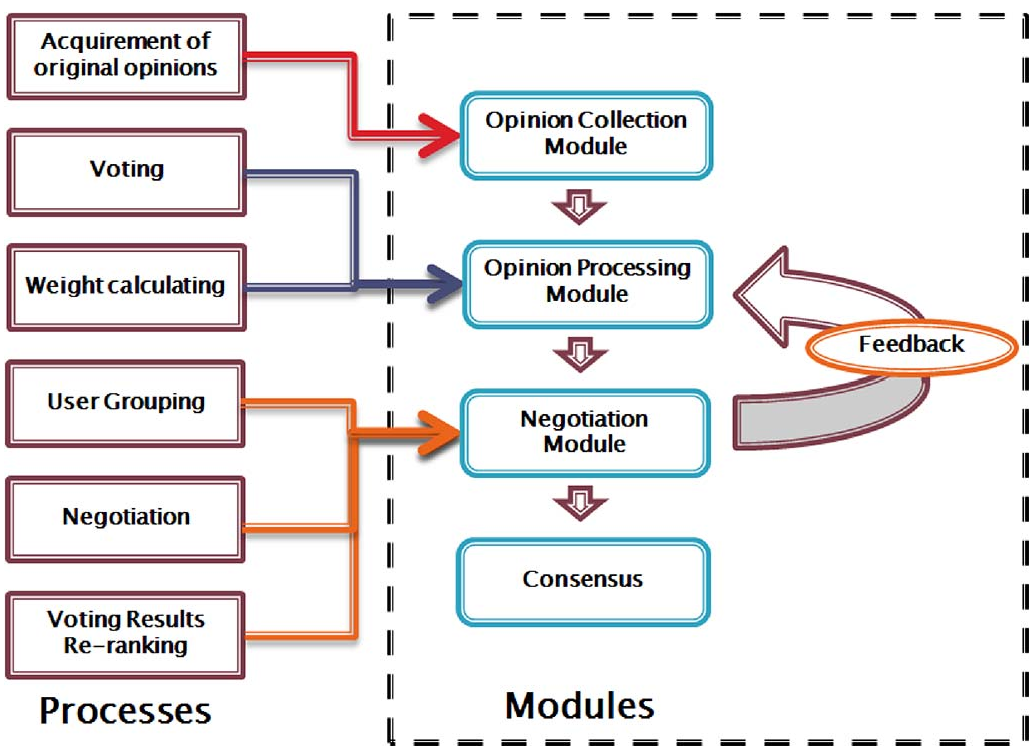
In each round of voting, the evaluation value () is not just a raw score but a function of the user's social role influence. This ensures that expert or highly relevant opinions act as "anchors" to pull the group toward a consensus more rapidly.
Experiments: NetLogo Simulations
To validate the theory, the researchers developed a Course-Offering Determination (COD) simulation using NetLogo. They compared their method against the standard Delphi method across different group sizes and thresholds (stop-settings).
Key Results
- Speed: The social-role-based method consistently required approximately half the negotiation rounds to achieve consensus.
- Scale: The method performed best in "Case 1" (many users, few alternatives), suggesting it is highly effective for large-scale social platform decisions like feature prioritization or community governance.
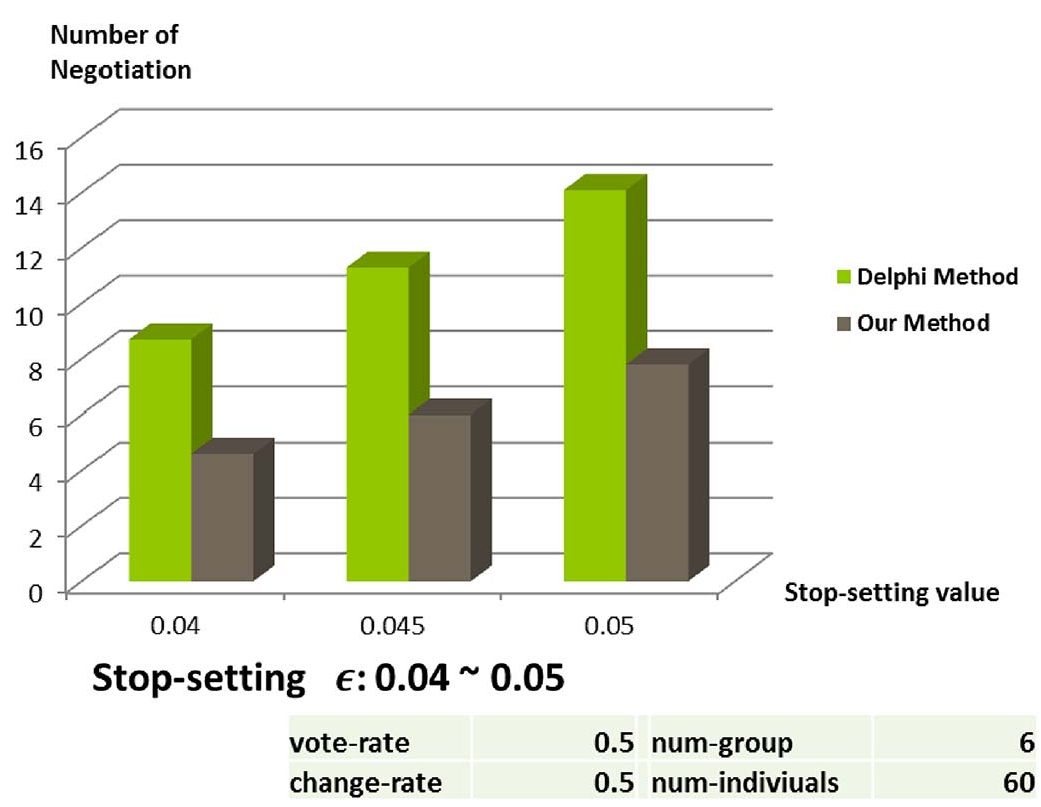 Figure: The NetLogo environment simulates individuals (person icons) gravitating toward plan groups (boxes) as consensus builds.
 Above: The matrix formulation used to track average evaluation values () and variance () across iterations.
Critical Analysis & Conclusion
The Takeaway
The true value of this work lies in its hybrid approach. By formalizing the link between real-world status and cyber-world behavior, the researchers have provided a blueprint for more "intelligent" social networks.
Limitations & Future Work
While the simulation is robust, the weight parameters ( and ) for different roles are currently set manually. Future research could explore Self-Supervised Learning to automatically determine these weights based on successful historical consensus. Furthermore, the model assumes users are honest; the introduction of "adversarial" roles (e.g., trolls or sybil attacks) would be a vital extension for making this applicable to open-web environments.
In an era of decentralized governance, understanding who is speaking is just as important as what they are saying. This hierarchical model brings us one step closer to that realization.