
AncestryAI: Modernizing Genealogy with Probabilistic Record Linkage
AncestryAI: A Tool for Exploring Computationally Inferred Family Trees
AncestryAI is an open-source web-based tool and framework designed to automatically reconstruct large-scale family trees from historical parish records. By employing a probabilistic record-linkage method, it transforms millions of unstructured birth and baptism records into a searchable genealogical graph.
TL;DR
AncestryAI is a sophisticated open-source platform that automates the reconstruction of family trees from massive historical datasets. By shifting from manual "search-and-match" to probabilistic inference, it enables the creation of genealogical graphs spanning millions of nodes, providing a powerful resource for both hobbyist genealogists and computational social scientists.
Problem: The Needle in the Histographic Haystack
Genealogical research has historically been a manual "detective" process. Researchers must sift through parish registers, often dealing with:
- Spelling Noise: Variations like "Paul" vs. "Paulus" or phonetic transcriptions.
- Demographic Overlap: Hundreds of individuals with the same common names living in the same era.
- Fragmentation: Records are often localized, making it nearly impossible to track an ancestor who moved from one province to another without exhaustive searching.
The authors identified that while digitization projects (like Finland's HisKi) have made records accessible, they haven't made them connected.
Methodology: Bayesian Logic Meets Historical Records
The core innovation of AncestryAI lies in how it quantifies the "probability of relatedness." Instead of a binary match/no-match system, it treats record linkage as a probabilistic inference problem.
1. Probabilistic Ranking
Using a modified Fellegi–Sunter model, the tool calculates the likelihood that a specific child's birth record belongs to a set of candidate parent records. It considers three primary attributes:
- String Similarity: Utilizing Jaro-Winkler distance to handle typos.
- Spatial Proximity: Using coordinates of birthplaces to weight the likelihood.
- Temporal Logic: A strict prior that parents must be between 10 and 70 years older than their children.
2. Architecture and Layout
To handle the scale of millions of records, the tool uses blocking. It clusters names and birth years so the algorithm only compares plausible candidates rather than every person in the database.
The visualization is equally innovative. Because family trees are technically Directed Acyclic Graphs (DAGs) (and not simple trees, due to intermarriage), the authors developed a heuristic layout algorithm that fixes Y-coordinates by birth year and dynamically adjusts X-coordinates to minimize edge crossings during exploration.
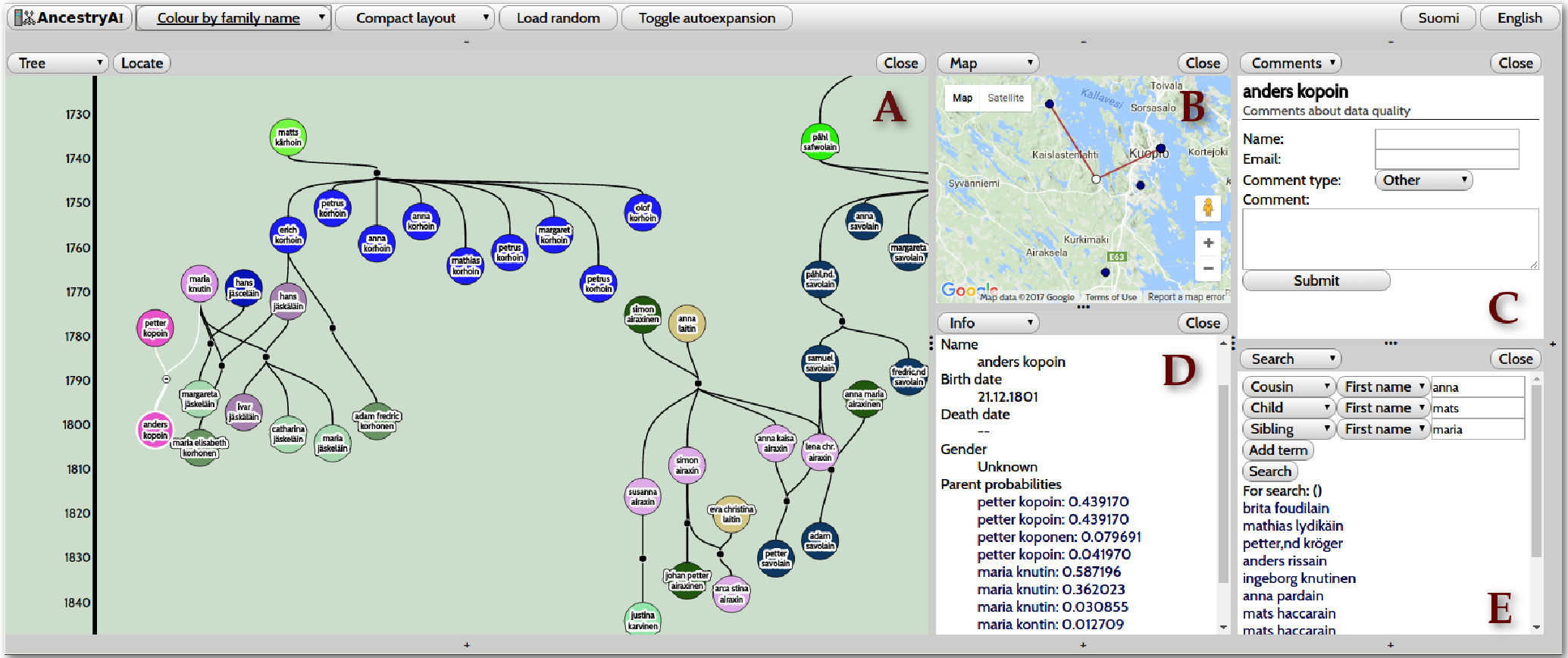 Figure 1: The AncestryAI interface showing the inferred family tree (A), geographic distribution (B), and advanced search options (E).
Experiments and Results: Quantifying Family Connections
The model was validated using a "ground truth" dataset of 64,208 individuals manually verified by a professional genealogist.
The research highlights how sensitive these probabilities are to specific attributes. For example, as seen in the likelihood ratio analysis, an "identical" name match significantly boosts the matching probability, but even a slight drop in Jaro-Winkler similarity (e.g., to 0.85) serves as a strong signal against a match.
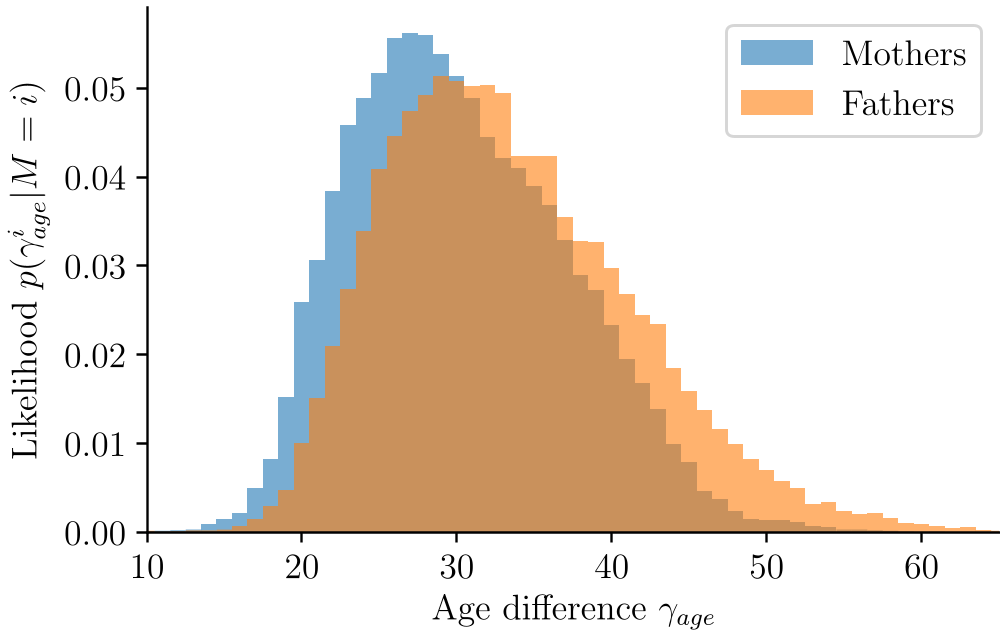 Figure 2: The weight of first-name similarity in determining match probability. Ratios above 1.0 support a match, while below 1.0 suggest the records represent different people.
Critical Insight: Beyond the Tree
The true value of AncestryAI isn't just helping someone find their great-great-grandfather. It is about Computational Social Science. By building a graph of millions of Finnish citizens over 300 years, researchers can now ask:
- How did marriage patterns change during the industrial revolution?
- Can we track the genetic spread of specific diseases through a computationally-verified lineage?
- What were the actual migration patterns of the 18th-century working class?
Limitations & Future Work
Currently, the model treats each match independently. The authors acknowledge this as a limitation—in reality, a couple usually has multiple children together. Future versions will likely explore Collective Entity Resolution, where the existence of siblings reinforces the probability of the parental link, creating a more robust "family-level" inference rather than just "pair-level" matching.
Conclusion
AncestryAI bridges the gap between digital archives and actionable knowledge. It demonstrates that the same probabilistic tools we use for modern data deduplication can unlock the secrets of our biological and social history, turning fragmented church registers into a unified map of human connection.