
Lightweight Shield: Accurate Android Malware Family Detection via Manifest Intelligence
Detection of Android Malicious Family Based on Manifest Information
The paper proposes a lightweight Android malware family detection method that utilizes static analysis of manifest files (AndroidManifest.xml) and machine learning algorithms. By extracting components, permissions, and intent-filters, the authors achieved high-accuracy classification across 10 major malware families using a Logistic Regression (LR) model.
TL;DR
As Android malware grows in volume and complexity, the need for speed and accuracy in detection is paramount. This paper introduces an efficient detection framework that ignores the "heavy" source code and focuses instead on the AndroidManifest.xml. By using Logistic Regression and feature engineering, the authors achieve a 97.98% accuracy in identifying malware families, significantly outpacing traditional static analysis tools like DREBIN in both speed and precision.
Context: Beyond the Rules
In the cat-and-mouse game of mobile security, signature-based detection is failing. Modern malware is often a product of "secondary packaging"—reusing malicious modules in new applications. This study shifts the focus from identifying if a file is viral to identifying which family it belongs to, leveraging the structural similarities of manifest files within the same lineage.
Motivation: The Decompilation Bottleneck
Previous SOTA methods often rely on decompiling classes.dex files to analyze bytecode. However, this process faces two major hurdles:
- Complexity: Decompilation is computationally expensive.
- Hardening: Modern APKs use "hardened" security measures that actively block reverse engineering.
The authors' insight is simple: even if the code is hidden, a malware's requested capabilities (permissions, hardware access, intent filters) are declared openly in the manifest. These declarations serve as a "behavioral fingerprint."
Methodology: High-Dimensional Static Fingerprinting
The workflow is divided into four distinct stages:
1. Feature Extraction (The Fingerprint)
Instead of digging into Java code, the system extracts four categories from the XML:
- App Components: Activities, Services, Content Providers, and Broadcast Receivers.
- Requested Permissions: The specific system accesses requested (e.g., SEND_SMS).
- Hardware Dependencies: Requests for Camera, Bluetooth, or GPS.
- Intent-filters: Messaging objects used for inter-component communication.
2. Vectorization and Reduction
The text features are mapped into an 8923-dimensional vector space using One-Hot encoding. To maintain efficiency, the authors apply dimensionality reduction, removing features with a "support" of 1 (features that appear in only one sample), resulting in a refined 3712-dimensional vector.
 Fig 1: The end-to-step pipeline from APK decompression to family classification.
Experiments: Performance Showdown
The authors tested four model architectures: Logistic Regression (LR), Gradient Boosting (GBDT), Random Forest (RF), and a hybrid GBDT+LR model.
Key Results:
- LR Wins: Contrary to the trend of using complex ensemble models, Logistic Regression achieved the highest Macro F1-score of 0.9851.
- SOTA Comparison: Compared to DREBIN, which typically achieves 93% accuracy, this method reached 97.98% with a significantly lower false-positive rate (0.25%).
- Family Specifics: Families like
FakeDocandKminwere detected with a perfect 1.0000 F1-score.
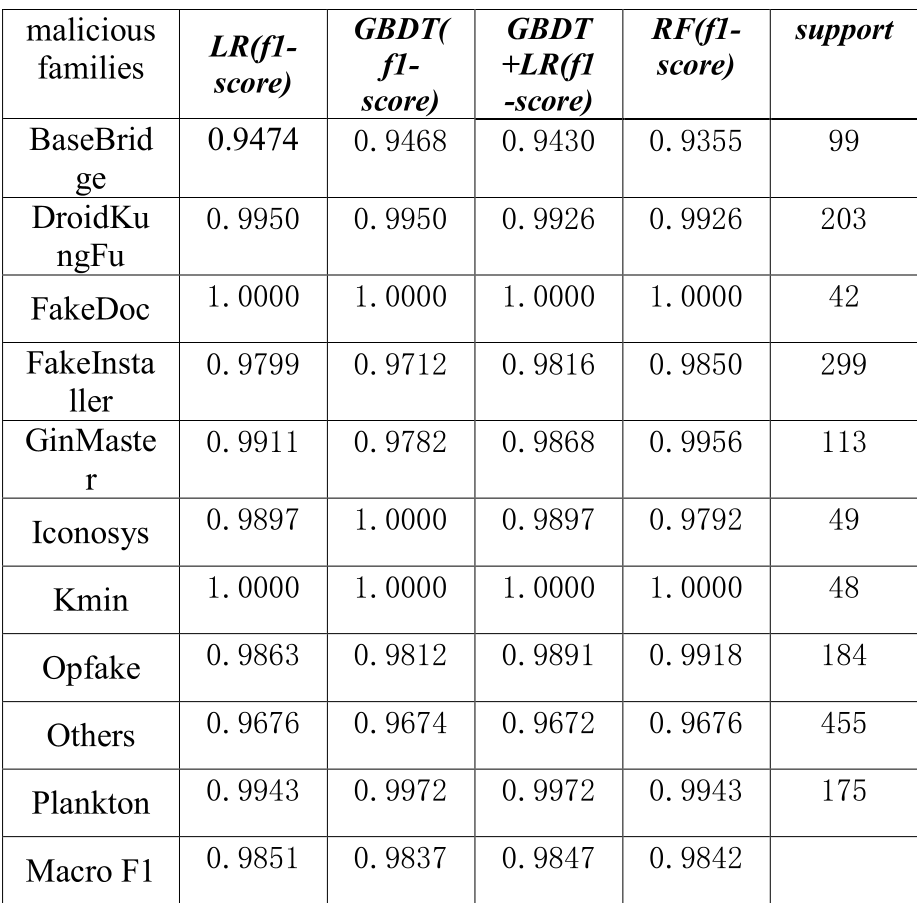 Table 1: Detailed F1-scores across 10 malware families.
Critical Insights
The success of the LR model suggests that the feature vector space generated from manifest files is linearly separable. This means the combination of permissions and components provides a very clear signal for classification without needing the non-linear "heavy lifting" of deep neural networks or complex ensembles.
Limitations & Future Work
While highly effective, manifest analysis has an inherent blind spot: Dynamic Loading. If a malware downloads its malicious payload after installation (and doesn't declare the needed permissions upfront, though this is difficult in the Android sandbox), static analysis may struggle. Future research could integrate this lightweight manifest approach as a "first-pass" filter before more intensive dynamic analysis.
Conclusion
This research proves that "lightweight" doesn't mean "weak." By intelligently selecting features from the AndroidManifest.xml, security researchers can build models that are both faster to execute and more accurate than those relying on full source code analysis.