
DroidNet: Harnessing the "Expert Crowd" to Solve the Android Privacy Paradox
Android User Privacy Preserving Through Crowdsourcing
This paper introduces DroidNet, a crowdsourcing-based Android permission control framework designed to protect user privacy. By leveraging a transitive Bayesian inference model to rank user expertise and aggregating decisions from expert peers, DroidNet provides real-time, high-accuracy recommendations for permission requests.
TL;DR
DroidNet is a novel framework that transforms Android's passive permission system into an active, crowdsourced defense mechanism. By identifying expert users through a Transitive Bayesian Inference Model, it provides novice users with high-confidence recommendations on whether to grant or deny sensitive permission requests (e.g., GPS, SMS, Contacts), achieving an accuracy of over 80%.
Background: The Failure of the "Check-Box" Security Model
For years, Android's security has relied on a flawed assumption: that the user is the best judge of an app's intent. Statistics show that 70% of apps request data irrelevant to their function, yet only 3% of users actually pay attention to these warnings. This "transparency without protection" has left millions vulnerable to data leaks and financial loss.
Existing solutions often resort to simple majority voting. However, in a sea of inexperienced users, a majority vote is a "blind leading the blind" scenario. This is where DroidNet differs—it seeks the signal of the expert within the noise of the crowd.
Methodology: Who Do You Trust?
The core innovation of DroidNet is its Expertise Ranking Algorithm. It recognizes that expertise is not a binary state but a probability that can be propagated across a network.
1. Transitive Bayesian Inference
DroidNet starts with a tiny group of Seed Experts (e.g., security researchers). Since these experts can't review 2.2 million apps, DroidNet tracks the overlap between seed responses and regular user responses.
- Direct Overlap: If User A agrees with a Seed Expert consistently, User A is assigned a high expertise rating.
- Transitive Overlap: If User B agrees with User A (who is already deemed reliable), User B’s rating increases too.
2. The Math of Expertise
The system uses Beta Distributions () to model the likelihood of a user making a correct decision. Every consistent response increments (correctness), while inconsistencies increment (error).
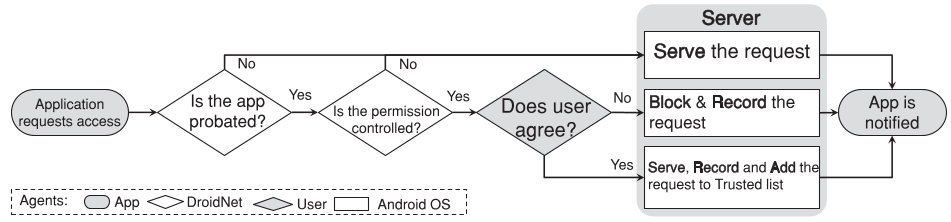 Figure 1: Overall Architecture of the DroidNet system showing the interaction between the Android Client and the Expertise Ranking Server.
System Design: Introducing "Probation Mode"
DroidNet introduces a Probation Mode for new apps. Instead of granting permissions upfront, the app is sandboxed. When it attempts a sensitive system call (e.g., checkPermission), DroidNet intercepts the request and checks its global database for recommendations.
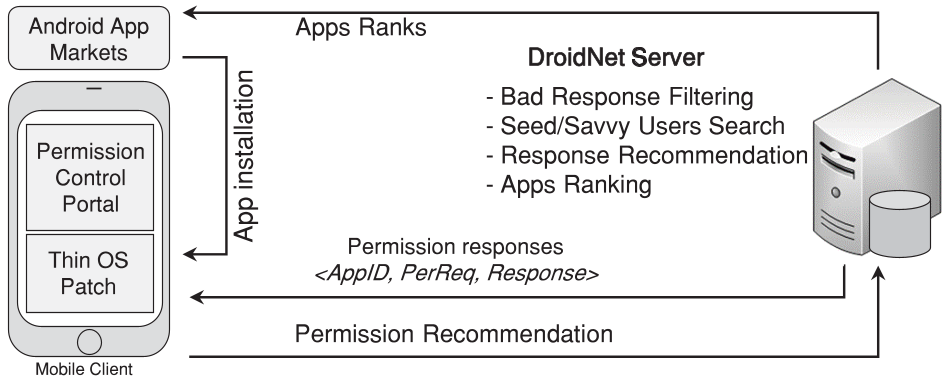 Figure 2: The DroidNet permission request flow, illustrating real-time interception and recommendation injection.
Experiments and Results
The authors validated DroidNet through massive simulations and a 100-user real-world study using customized Android ROMs.
- Accuracy Boost: DroidNet reached 80%+ accuracy in identifying malicious permission requests, compared to 57% for prior-gen crowdsourcing (PMP).
- Expert Conductivity: Simulations showed that high-expertise nodes have high "conductivity," meaning they can effectively pass their "trustworthiness" to others in the network, ensuring the system scales efficiently.
- Demographic Insights: The study confirmed that users with Computer Science backgrounds or higher education degrees naturally clustered at higher expertise levels ().
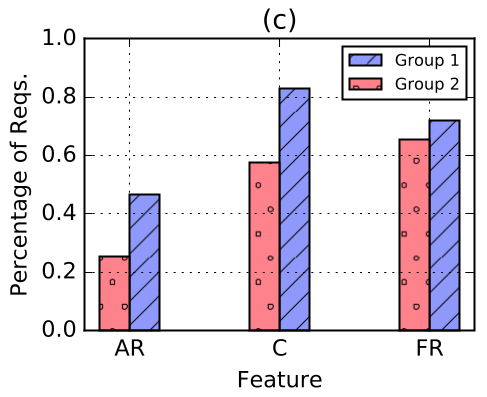 Figure 3: Distribution of expertise ratings across different user education levels. Note the higher concentration of experts in Graduate-level populations.
Critical Analysis & Takeaways
Why it Works: DroidNet effectively creates a "Web of Trust." It solves the scalability problem of manual app review by using expert-led propagation. The "Probation Mode" is a clever UX intervention that forces the user to engage with security only when it matters.
Limitations:
- Deployment: Currently requires an OS patch or root access, though the authors suggest a "Boxify" approach using isolated processes for future non-root deployment.
- Strategic Attacks: Sophisticated attackers could "play the long game," building high reputations by being honest on millions of requests only to flip and approve their own malicious payload.
Conclusion
DroidNet signifies a shift from individual responsibility to community-driven protection. By mathematically distilling the "wisdom of the experts," it offers a scalable, low-friction path to fixing the long-standing privacy failures of the Android ecosystem.