
ANNM: Harmonizing Privacy and Utility in Social Networks via Intelligent Noise Injection
ANNM: A New Method for Adding Noise Nodes Which are Used Recently in Anonymization Methods in Social Networks
This paper introduces ANNM (A New Method for Adding Noise Nodes), a privacy-preserving technique designed to achieve k-degree anonymity in social networks. By leveraging betweenness centrality to prioritize node augmentation, the method ensures structural privacy against structural attacks with minimal impact on the network's inherent graph properties.
TL;DR
Researchers have developed a new algorithm, ANNM, that protects social network privacy by adding "noise nodes" rather than deleting existing connections. By targeting nodes with low Betweenness Centrality, the method achieves k-degree anonymity—ensuring no user has a unique "fingerprint"—while keeping the network's structural integrity (like Average Path Length) virtually unchanged.
The Problem: The "Unique Degree" Vulnerability
When social network data is shared for research, simply removing names isn't enough. Attackers can use Structural Attacks: if they know a target has exactly 127 friends, and only one node in the "anonymized" graph has a degree of 127, the target is compromised.
Existing solutions usually involve:
- Edge Editing: Adding or deleting edges between real users.
- Clustering: Grouping nodes into "super-nodes."
The fatal flaw? These methods mutilate the graph. Deleting a "bridge" edge can significantly increase the distance between nodes, destroying the value of the dataset for social analysis.
Methodology: The Betweenness Centrality Insight
The core innovation of ANNM is shifting the focus from what to change to where to change it.
Why Betweenness Centrality (BC)?
Betweenness Centrality measures how often a node acts as a bridge along the shortest path between two other nodes.
- High BC Nodes: Vital for network communication. Changing their degree ripples through the entire network.
- Low BC Nodes: Located on the periphery or in redundant clusters. Adding a node here has a "localized" impact.
The ANNM Workflow
- Grouping: Nodes are categorized by their degrees.
- Security Check: Groups with fewer than k nodes are flagged as "insecure."
- Prioritization: Insecure groups are prioritized based on how many nodes they need to reach k-anonymity.
- Smart Noise Addition: Noise nodes are attached to real nodes starting with the lowest BC.
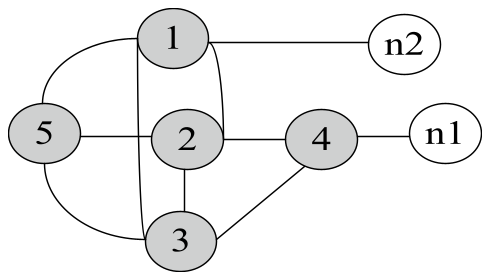 Figure: Achieving 2-degree anonymity by adding noise nodes (n1, n2) to ensure no single node has a unique degree.
Experimental Results: Precision Privacy
The authors tested ANNM against the Facebook dataset and compared it with prominent methods like KDLD and Alpha-anonymization.
1. Superior Utility Preservation
ANNM maintains the Average Path Length (APL) at a near-constant level. While edge-editing methods saw APL drop sharply (from 2.9 to 1.6), ANNM's variation was negligible.
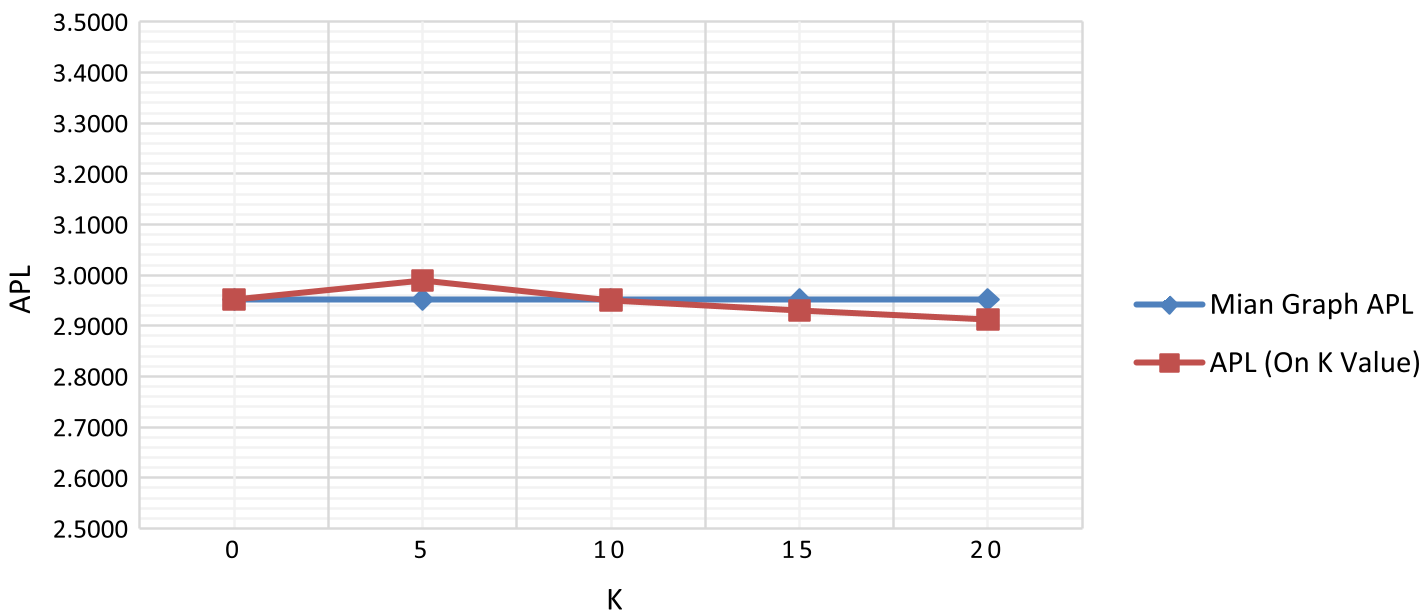 Figure: The APL for the anonymous graph remains almost identical to the original graph across different values of k.
2. Zero Edge Deletions
Unlike many SOTA methods, ANNM has a zero-deletion policy. It never removes a relationship. This ensures that every "real" friendship in the original data remains intact in the published version.
3. Efficiency in Noise
At k=20, ANNM required only 45 noise nodes, while KDLD required 79. Fewer noise nodes mean less overhead and a cleaner dataset for researchers.
Deep Insight & Conclusion
The brilliance of ANNM lies in its preservation-first philosophy. In the world of data privacy, we often trade utility for security. ANNM challenges this trade-off by demonstrating that if you understand the topology of the network (via Centrality), you can hide users in plain sight without breaking the "Small World" phenomenon that defines social networks.
Takeaway for Practitioners: When anonymizing graph data, focus on the "peripheral" nodes (Low BC) to absorb the noise. It is the most surgical way to provide k-degree protection while keeping global graph metrics like Radius and Diameter stable.
Limitations: While ANNM excels at structural preservation, the addition of noise nodes increases the total node count. For extremely large networks, the cumulative overhead of these extra nodes must be managed to avoid inflating storage requirements.