
Crowdsourcing Critical Thinking: Can Non-Experts Generate Professional-Grade Counter-Arguments?
An Annotation Protocol for Collecting User-Generated Counter-Arguments Using Crowdsourcing
The paper introduces a novel annotation protocol for crowdsourcing high-quality, user-generated counter-arguments to support automatic constructive feedback systems. By comparing direct generation against a fallacy-conditioned generation task, the researchers established a method to collect diverse argumentative data from non-experts.
Executive Summary
TL;DR: This paper investigates whether non-expert crowdworkers can produce the "constructive feedback" typically reserved for teachers. The researchers found that while direct generation is hit-or-miss, forcing workers to identify a logical fallacy first acts as a catalyst, resulting in significantly higher-quality, more useful counter-arguments.
Background Positioning: This work sits at the intersection of Argument Mining and Computer-Aided Learning. It refines the "data collection" phase of the pipeline, moving beyond mere scoring toward active, generative feedback.
Problem & Motivation: The Gap in Automated Grading
Current AI graders (like Grammarly or eRater) are excellent at flagging "what" is wrong—be it a dangling modifier or a weak thesis statement. However, they struggle with the "why" and "how." To help a student improve their critical thinking, an AI needs to provide a Counter-Argument (CA): a logical pivot that exposes a flaw in the student's reasoning.
The bottleneck isn't just the AI model; it's the data. Constructive feedback is nuanced. Training a model requires thousands of examples where a claim is met with a logically sound rebuttal. Relying on professional educators to write these is unscalable. The authors ask: Can we use the "wisdom of the crowd" to build this dataset without sacrificing logical rigor?
Methodology: Scaffolding the Human Mind
The study utilized the Argument Reasoning Comprehension (ARC) corpus as a foundation. They tested two distinct protocols:
- CAG (Direct Generation): Workers were shown a claim and premise (e.g., "Unpaid internships exploit students because they replace employees") and asked to write a counter-argument.
- CAG-F (Fallacy-Conditioned Generation): Workers were first asked to identify if a specific fallacy (like Hasty Generalization or Red Herring) existed. If yes, they then wrote the counter-argument.
Cognitive Anchoring via Fallacies
The "Insight" here is that by labeling a fallacy first, the worker is forced into a critical mindset. They aren't just "disagreeing"; they are identifying a structural weakness in the logic, which focuses their counter-argument on the most vulnerable part of the original claim.
Experiments & Results: Quality Matters
The researchers evaluated the quality based on two criteria:
- Does the CA actually attack the claim/premise?
- Could this CA be used to make the original argument better?
Key Findings:
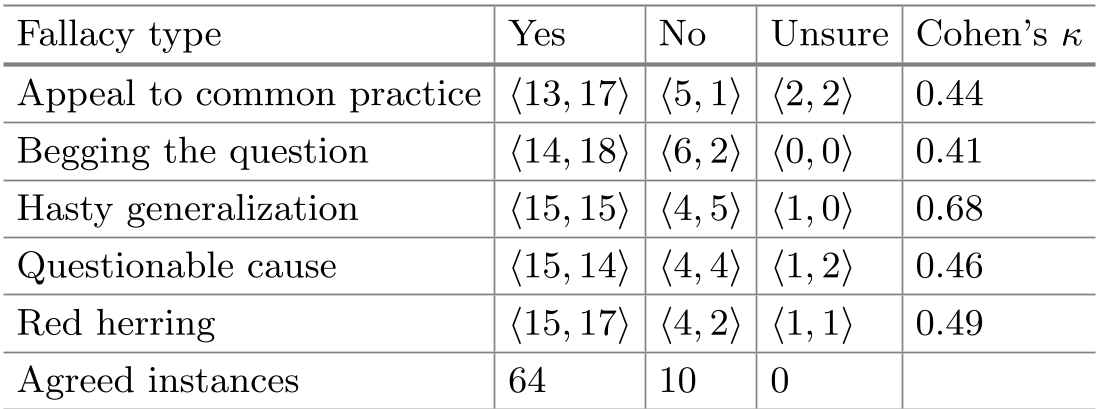
- Higher Agreement: The CAG-F protocol achieved better inter-annotator agreement (higher Cohen’s ), suggesting the outputs were more consistently "correct" in their logic.
- Success Rates: Requiring fallacy identification led to a 20% gain in instances that experts agreed were "useful" for feedback.
- Common Failures: In the simple CAG task, many workers provided "simple contradictions" (e.g., "No, internships are good") rather than nuanced reasoning. In contrast, CAG-F workers produced more sophisticated rebuttals.
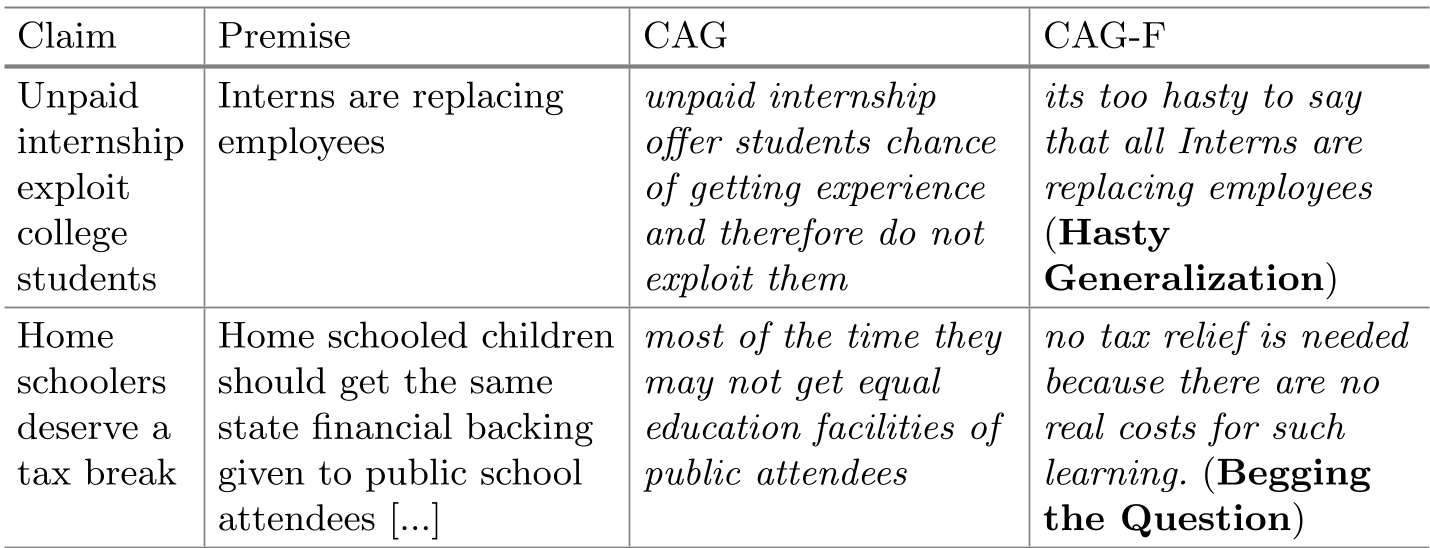 In the table above, note how the CAG-F response specifically calls out the "Hasty Generalization," providing a more precise pedagogical path for the student.
Critical Analysis & Conclusion
Deep Insights
The success of the "Fallacy-First" approach suggests that Inductive Bias doesn't just apply to machine learning models—it applies to human annotators too. By providing a "fallacy category," the protocol narrows the search space for the human mind, leading to higher-quality "data labels."
Limitations
- Scale of Fallacies: The study only used 5 fallacy types. Real-world student writing contains dozens of variations.
- Annotator Criticality: One expert was significantly more critical than the other, highlighting that "quality" in argumentation is still somewhat subjective.
Takeaway
This research provides a blueprint for building the next generation of AI writing assistants. By using fallacy-based protocols, we can collect high-quality reasoning data from non-experts, ultimately training AI that doesn't just "check" our homework, but actually debates us into becoming better thinkers.