
Resisting Label-Neighborhood Attacks: A Dynamic Approach to Social Network Anonymization
Anonymizing approach to resist label-neighborhood attacks in dynamic releases of social networks
The paper introduces a "dynamic-l-diversity" anonymization model designed to protect individual privacy in time-varying social networks against label-neighborhood attacks. It combines a structural similarity grouping algorithm (L-Grouping) with a random perturbation method to create uncertainty graphs that mask sensitive attributes across multiple releases.
TL;DR
As social networks evolve, publishing snapshots of user data for research poses a massive privacy risk. This paper presents dynamic-l-diversity, a framework that thwarts attackers who use local network structures and node labels to de-anonymize victims. By grouping nodes with high structural similarity and injecting controlled uncertainty into the edges, the authors provide a way to share dynamic data without sacrificing individual secrets.
Background: The Danger of "Neighbor Knowledge"
Imagine an attacker knows that a target person has exactly three friends: a doctor, a lawyer, and a teacher. Even if the network is "anonymized" by removing names, if only one node in the published graph has those specific labeled neighbors, the privacy is shattered. In dynamic releases (e.g., publishing data every month), this is even scarier: an attacker can watch how a node's neighborhood changes over time to confirm an identity.
Methodology: The Two-Step Defense
1. Structural Similarity Grouping (StruSim)
The first hurdle is finding which nodes should be made to "look alike." The authors introduce the StruSim metric, which calculates how similar two nodes are based on the degrees of their neighbors.
The algorithm L-Grouping ensures that every sensitive node is part of a group of at least nodes that have similar structural footprints. This creates the "crowd" in which a sensitive individual can hide.
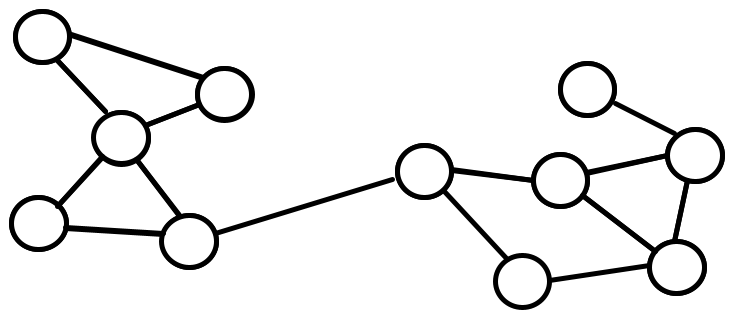
2. Creating the Uncertainty Graph
Once nodes are grouped, the network is modified via Algorithm 2 (Obfuscation). Instead of a fixed, certain edge, the method uses random perturbation:
- Edge Addition/Deletion: Edges are randomly added or removed until a target density () is reached.
- Label Matching: The neighborhood label sequences (NLS) are merged within a group to ensure that nodes and eventually appear to have the same neighbor "profile" to an outsider.
Experiments & Results
The authors tested their approach on the DBLP co-author dataset and synthetic graphs.
- Structural Information Loss: Using a metric called One-Dimensional Structural Information (ODSI), the study found that while higher privacy () naturally increases data distortion, the loss is manageable.
- Average Degree & Clustering: Remarkably, the average degree of the anonymized graphs remains very close to the original, meaning the "density" of the social network—a key metric for researchers—is preserved.
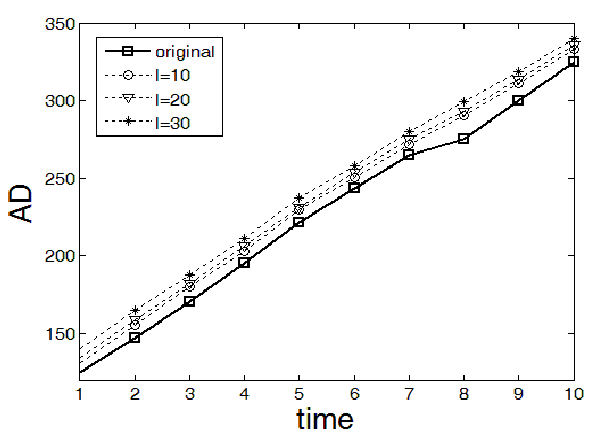 Figure: The impact of increasing on structural information across DBLP and synthetic datasets.
Deep Insight: Why This Matters
Most prior work focused on static graphs. However, the "Temporal Distance" and the appearance of new nodes (Example 1 in the paper) are the real-world vulnerabilities. By redefining the attack model for dynamic scenarios, this paper shifts the focus from "hiding in a static crowd" to "staying hidden as the crowd moves."
Conclusion
The dynamic-l-diversity approach successfully bridges the gap between data utility and privacy. While it does result in some decrease in the clustering coefficient, it maintains the fundamental characteristics of the network, making it a viable tool for organizations that need to share time-series social data responsibly.
Limitations
The current approach primarily handles node and label-neighborhood attacks. Future work might need to address Edge Attribute Disclosure (the sensitive nature of the relationship itself) and specialized attacks in extremely sparse graphs where "uncertainty" might be easier to filter out by sophisticated adversaries.