
Social Network Anonymity: The NP-Hard Sisyphus Task
On anonymizing social network graphs
This paper examines the inherent vulnerabilities of current social network anonymization techniques, specifically clustering and graph modification. It demonstrates how structural re-identification and auxiliary information attacks can bypass these defenses, achieving successful de-anonymization.
TL;DR
Social networks are treasure troves for marketers and researchers, but anonymizing this data is far more complex than scrubbing names from a database. This paper argues that because network structure itself serves as a fingerprint, anonymizing a graph to eliminate all information "channels" is an NP-Hard problem—computationally equivalent to finding a Maximum Independent Set.
Contextual Positioning
In the landscape of Privacy-Preserving Data Publishing (PPDP), this work serves as a critical theoretical checkpoint. It moves beyond simply proposing a new algorithm (like k-anonymity) and instead analyzes the fundamental impossibility of achieving perfect anonymity without completely destroying the graph's utility.
The Core Motivation: Why "Anonymized" Graphs Leak
The authors identify a fundamental insight: Relations are Information. Even if user "Alice" is renamed to "Node_742," her unique pattern of connections to "Bob" (Node_888) and "John" (Node_123) acts as a structural signature.
Previous works relied on two main pillars:
- Clustering: Merging nodes into "super-vertices" to hide individuals.
- Graph Modification: Randomly adding or deleting edges to confuse attackers.
However, the authors argue these are mere "band-aids." If an attacker has Auxiliary Information (like a second, overlapping social network where names are public), they can perform a cross-network mapping that renders these modifications useless.
Methodology: The Attack Mechanics
The paper meticulously deconstructs how anonymity is breached through three primary attack vectors:
1. Structural Fingerprinting (Embedded Subgraph)
Attackers can inject "Sybil" nodes (fake accounts) with a unique, recognizable connection pattern before the data is released. Once the "anonymized" graph is published, they simply look for that specific pattern to find their targets.
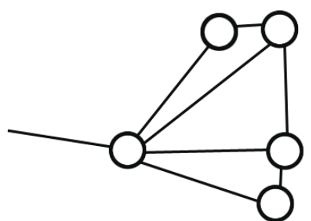 Figure: The transition from a raw social network (a) to a clustered super-vertex graph (b). Note how local structural nuances are lost, yet global connectivity may still remain exploitable.
2. The Propagation Algorithm
This is the "contagion" of de-anonymization. It starts with a few "seeds" (users the attacker definitely knows). The algorithm then looks at the neighbors of these seeds: "If I know Node A is Bob, and Node B is connected to Bob in both the public and anonymous graphs, Node B is highly likely to be Alice." This process repeats recursively across the network.
3. Group Membership Stealing
By using "browser history stealing" techniques, an attacker can discover which private groups a user belongs to. This attribute acts as a secondary key to refine the mapping in the propagation stage.
Why is this NP-Hard?
The authors' most striking contribution is the correlation to the Independent Set Problem.
- To truly anonymize a graph, one must ensure no "sensitive paths" exist between vertices.
- Achieving a state where no information can be inferred is equivalent to computing a maximal independent set where edges representing "identifiable relationships" are removed.
- Because finding an optimal solution for these graph properties is NP-Hard, we are limited to heuristics—which, by definition, can always be bypassed by a clever enough adversary.
Experimental Analysis & Critical Insights
The paper notes that measuring success purely by the number of de-anonymized nodes is misleading due to "singletons" (inactive nodes). Instead, they propose using Centrality Weights.
Key Takeaway from Results:
- Attacks are highly scalable if the attacker combines group membership data with structural mapping.
- Automated defenses by platforms like Facebook (e.g., email verification) stop large-scale Sybil attacks but do nothing against passive inference attacks using existing data.
Critical Perspective & Conclusion
The value of this paper lies in its pessimism. By proving that the "channel elimination" problem is computationally intractable, it shifts the burden of privacy from "better algorithms" to "better policy and threat modeling."
Limitations
While the theoretical grounding is strong, the paper’s discussion of "History Stealing" is somewhat dated by modern browser standards (e.g., the CSS :visited privacy patch). However, the underlying logic—that auxiliary attributes accelerate structural de-anonymization—remains entirely valid in the age of Big Data.
Future Outlook
For researchers, the next frontier isn't just adding "noise" to graphs, but perhaps moving toward Differential Privacy in Graphs, where the mathematical guarantee of privacy doesn't depend on the attacker's background knowledge.