
Ant Colony Optimization: A Swarm Intelligence Path to Hierarchical Community Discovery
18198_An ant colony optimization method to detect communities in social networks.
The paper proposes an Ant Colony Optimization (ACO) based algorithm for detecting hierarchical community structures in social networks. By integrating network modularity as a heuristic guide, the method effectively partitions complex networks into cohesive sub-groups, outperforming several state-of-the-art baselines.
Executive Summary
TL;DR: This paper introduces an innovative approach to community detection in social networks by leveraging the collective intelligence of an Ant Colony Optimization (ACO) framework. By using Network Modularity as a guiding heuristic, the algorithm "crawls" through complex topologies to identify hierarchical sub-groups with high precision.
Background: Community detection is a cornerstone of network science, essential for understanding everything from social dynamics to biological functions. While many algorithms exist, identifying high-quality hierarchical structures remains a challenge. This work positions itself as a robust meta-heuristic solution that bridges the gap between local search agents and global optimization metrics (Modularity).
The Core Motivation: Beyond Simple Partitioning
Existing methods like the Girvan-Newman (GN) algorithm rely on edge betweenness, which can be computationally expensive and may fail to reach the global optimum of clustering quality. Swarm-based methods often use local similarity, but the authors identified a critical missing link: Why not use the incremental change in Modularity () to tell the ants where to go?
The intuition is simple: if an ant moves to a neighboring node and the network's modularity improves, that path should be reinforced.
Methodology: How the Ants "Think"
The proposed algorithm operates through a signature modularity-driven transition rule.
1. The Transition Rule
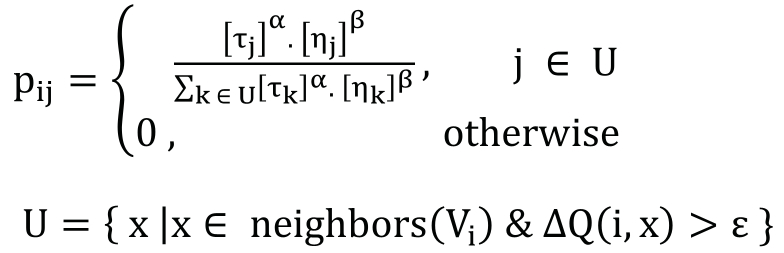
Unlike standard random walks, an ant's choice of the next node from current node is defined by: Where:
- is the pheromone level reflecting the historical "success" of node .
- is the heuristic information, which the authors uniquely define as the Modularity Gain ().
2. Hierarchical Strategy
The algorithm follows a top-down approach. It starts with the whole network and recursively applies the ACO-based split. This allows the discovery of fine-grained communities (sub-clusters) within larger ones, effectively mapping the latent hierarchy of the network.
3. Post-Processing: Label Propagation
To ensure boundary stability, the authors integrate Label Propagation (LPA). After the ants finish leur tour, nodes update their community labels based on the majority label of their neighbors, acting as a "smoothing" filter for the final clusters.
Experimental Battleground: SOTA Comparison
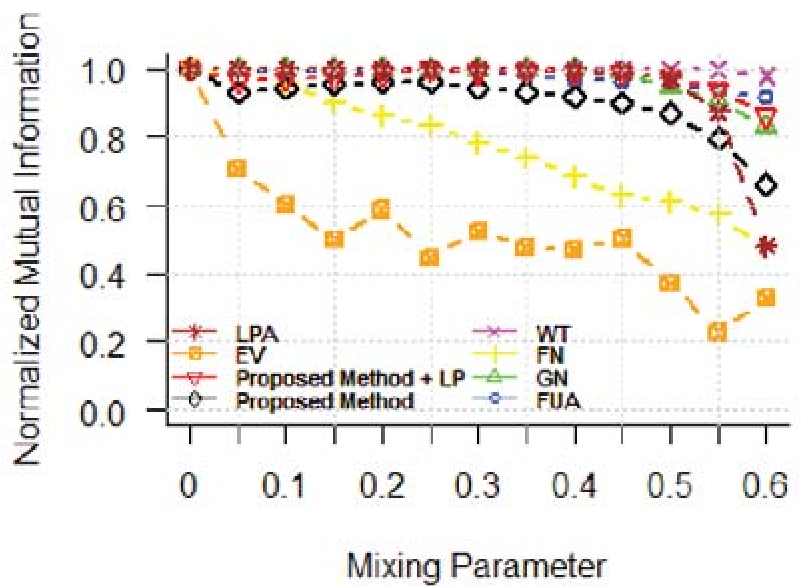
The authors tested their method against heavyweights like Louvain (FUA), Fast Newman (FN), and Walktrap (WT).
Synthetic Benchmarks
Using the LFR benchmark (which mimics real-world network properties), the proposed ACO method maintained high Normalized Mutual Information (NMI) even as the mixing parameter increased (indicating noisier communities).
Real-World Success
On classic datasets like the Zachary Karate Club, the algorithm achieved a perfect NMI of 1.0, meaning it perfectly reconstructed the ground-truth social split.
| Dataset | Best Proposed NMI | Louvain (FUA) NMI |
|---|---|---|
| Karate Club | 1.0000 | 0.5866 |
| Dolphins | 1.0000 | 0.5162 |
| Football | 0.9361 | 0.8903 |
Critical Insight & Conclusion
The true value of this work lies in the synergy between local agents and global metrics. By calculating locally during the ant's walk, the algorithm avoids the computational bottleneck of global modularity optimization while still moving toward a globally optimal partition.
Limitations: Swarm intelligence algorithms can be slower than greedy heuristics on massive networks (millions of nodes) due to the iterative nature of ant walks. Future research should focus on parallelizing the ant colony to scale with the burgeoning size of modern social graphs.
Final Takeaway: This paper proves that "thinking like an ant" can solve the "human" problem of understanding complex social structures.