
The Cat-and-Mouse Game of Audio Forensics: Masking and Detecting Spliced Speech
Anti-Forensics of Environmental-Signature-Based Audio Splicing Detection and Its Countermeasure via Rich-Features Classification
This paper investigates the vulnerability of environmental-signature-based audio splicing detection to anti-forensic attacks and proposes a robust countermeasure framework. By utilizing blind dereverberation techniques (SCIF, GSF-NMF, TSSS), the authors demonstrate how an attacker can bypass state-of-the-art forensic tools, subsequently introducing a "Rich-Feature Model" and an SVM-based classifier to detect these anti-forensic traces with up to 95% average accuracy.
TL;DR
As digital audio becomes critical evidence in legal proceedings, the ability to detect "splicing" (joining different recordings) is paramount. This paper reveals a critical vulnerability: attackers can use dereverberation to hide splicing traces. However, the authors turn the tables by proposing a Rich-Feature Model that identifies the subtle "musical noise" left behind by these anti-forensic tools, restoring detection accuracy to over 95%.
Context: When the Room Betrays the Forger
Every recording carries a "Roomprint"—a unique acoustic signature comprised of reverberation and background noise. Forensic investigators use these signatures to detect splicing; if the "Roomprint" suddenly changes mid-sentence, the audio is flagged as a forgery.
However, the authors point out a glaring blind spot: if an attacker uses a blind dereverberation algorithm to strip away the acoustic environment from all segments before splicing them, the forensic tools see a "clean" (and consistent) signal and fail to detect the manipulation.
The Attack: Bypassing SOTA Detection
The authors tested three dereverberation methods: SCIF, GSF-NMF, and TSSS. As shown in the ROC curves below, the presence of these anti-forensic attacks causes the accuracy of standard splicing detection to plummet.
 Figure: Splicing detection accuracy drops significantly (from 96% to ~58%) when SCIF or TSSS anti-forensics are applied.
The Countermeasure: Hunting for "Musical Noise"
The core insight of the paper is that dereverberation is not a "free lunch." Methods like Spectral Subtraction often result in negative values in the frequency domain. To fix this, algorithms "truncate" the signal, creating isolated artifacts known as Musical Noise.
The Rich-Feature Model (RFM)
Instead of relying on one metric, the authors propose a 1,035-dimensional feature vector:
- STFT Coefficients: Capturing multiplicative distortions in the frequency domain.
- Spectral Shape: Tracking changes in centroid, spread, and "tonalness" (crest factor).
- Modulation Spectrum: Emulating the human cochlea using Gammatone filters to find perceptual inconsistencies.
- Musical Noise Residuals: Using image denoising (BM3D) on the spectrogram to isolate "salt-and-pepper" noise artifacts.
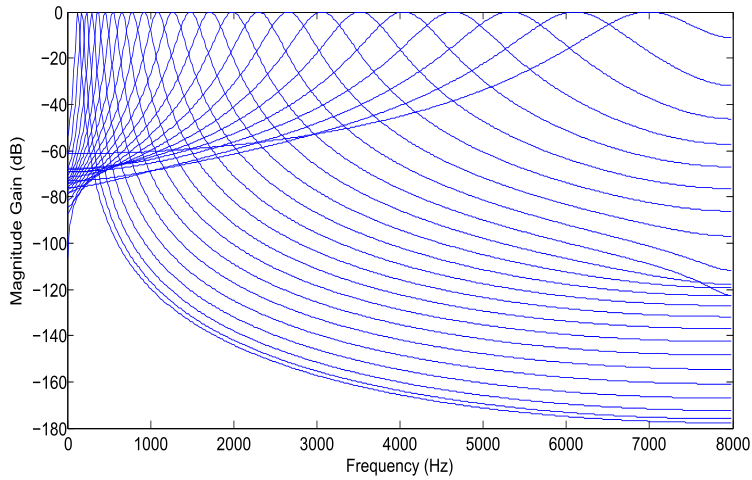 Figure: The process of emulating human hearing via Gammatone filters to catch traces of spectral manipulation.
Methodology: High Dimensions and Non-Linear Manifolds
With over 1,000 features, the risk of "overfitting" is high. Simple linear models fail because the relationship between artifacts and manipulation is complex. The authors found that Laplacian Eigenmaps (a non-linear dimensionality reduction technique) significantly outperformed linear methods (LPP). By projecting the features onto a lower-dimensional manifold that preserves local neighborhood structures, the SVM classifier could distinguish between "natural" clean audio and "anti-forensic" processed audio with near-perfect precision.
Experimental Battlefront: Real-World Performance
The system was tested against real-world recordings involving different microphones (ceramic tiles, carpeted offices, outdoors).
Key Findings:
- Source-Mismatched Excellence: Even if the investigator doesn't know which dereverberation tool the attacker used, the
fCM(Musical Noise Residual) feature remains incredibly robust, maintaining high accuracy (~99%). - Robustness: The detection survived secondary attacks like Gaussian noise addition and median filtering, which are often used by forgers to "smooth over" their tracks.
 Table: High detection accuracy (94%-100%) across different training/testing scenarios.
Critical Insight & Conclusion
The significance of this work lies in the Musical Noise Residual. By treating an audio spectrogram as a 2D image and applying computer vision denoising techniques, the authors bridged the gap between audio and image forensics.
Limitations: The paper notes that performance still degrades if the training data (synthetic) and test data (real-world) are highly mismatched.
Future Outlook: As we move into the era of AI-generated audio (Deepfakes), the "environmental signature" remains one of the few physical-world constraints that neural networks still struggle to simulate perfectly. This research provides a foundational framework for using those physical inconsistencies to protect the truth.