
AntiPhiMBS-Auth: Eliminating Mobile Phishing via Formal Mutual Verification
AntiPhiMBS-Auth: A New Anti-phishing Model to Mitigate Phishing Attacks in Mobile Banking System at Authentication Level
AntiPhiMBS-Auth is a novel anti-phishing model designed specifically for mobile banking authentication. It introduces a two-tier verification mechanism using a "Unique ID for Authentication" (unqIdAuth) and an "Application ID" (appId) to ensure that only legitimate banking apps can verify a user's identity before the user provides sensitive login credentials.
TL;DR
Phishing remains a multi-billion dollar plague for the banking industry. AntiPhiMBS-Auth is a new authentication framework that prevents credential theft by requiring the banking application to "prove itself" to the user before the user ever enters a password. By utilizing a Unique ID (unqIdAuth) and a hidden Application ID (appId), the model eliminates the possibility of a phishing app successfully masquerading as a legitimate one.
The Problem: The "Look-Alike" Trap
Most phishing attacks succeed because the burden of verification lies entirely on the user. When a user opens an app that looks like their bank, they instinctively enter their User ID and Password.
Existing solutions fail in specific ways:
- Machine Learning (ML): Good at catching known patterns but struggles with brand-new "zero-day" phishing apps.
- Email Filtering: Only works if the attack arrives via email, ignoring SMS (Smishing) or social media links.
- Bio-metrics: While secure, they often only trigger after the initial app has gained control of the local authentication session.
The core motivation for this research is to create a protocol where a phishing app cannot technically trigger the password prompt because it lacks the "secret handshake" with the bank's backend.
Methodology: The Secret Handshake
The brilliance of AntiPhiMBS-Auth lies in its three-way knowledge distribution.
- The User knows: UserID, Password, and a secret "Unique ID" (e.g., a specific string or token).
- The Bank/Server knows: All the above + the "Application ID".
- The Real Bank App knows: Only the "Application ID".
The Authentication Flow
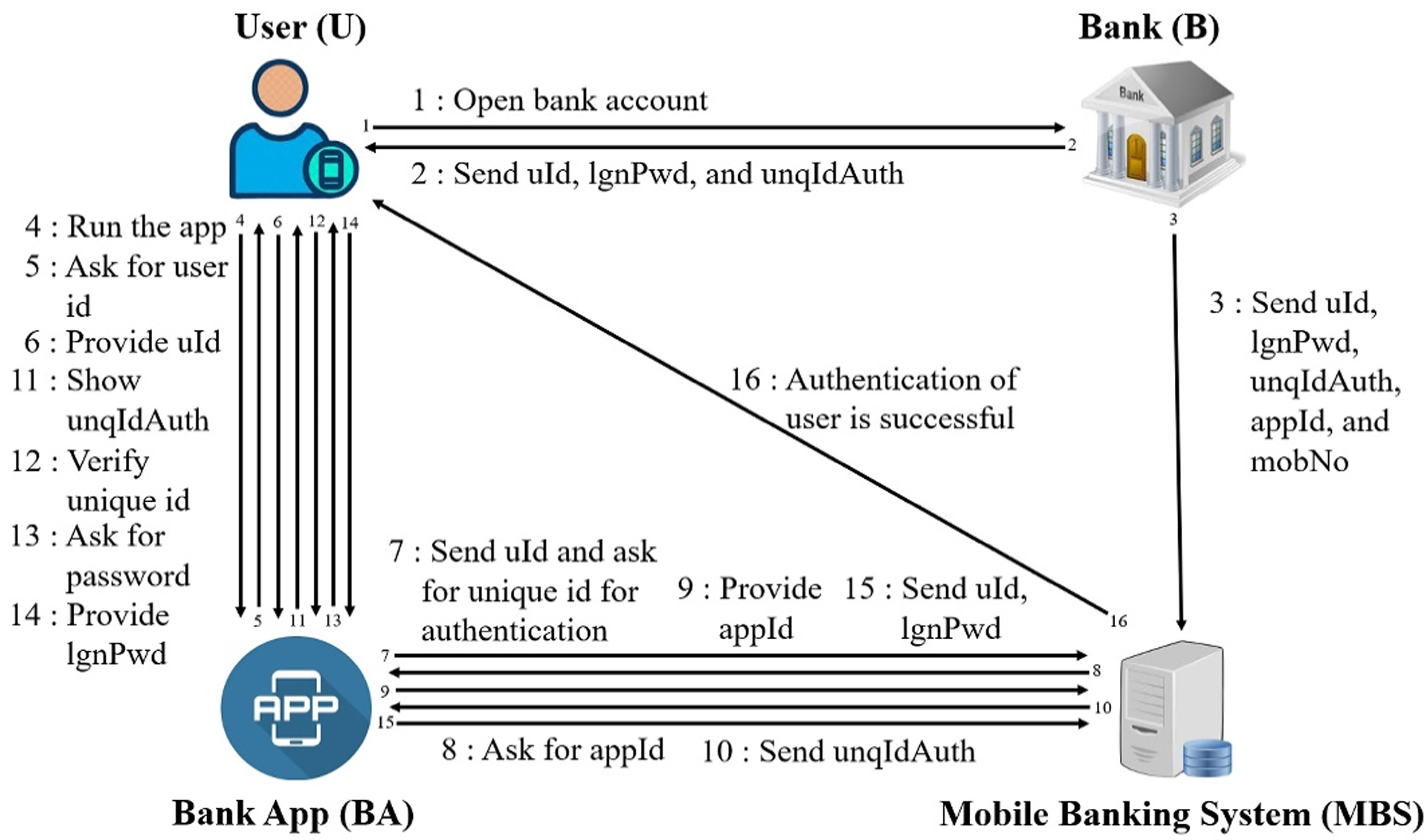
Instead of the traditional "User -> App -> Server" credential push, the paper proposes a pull-based verification:
- App Identification: The user enters their User ID. The Bank App then sends its
appIdto the server. - Server Challenge: If the
appIdis valid, the server sends the user’s specificunqIdAuthback to the app. - Visual Proof: The app displays this secret ID.
- User Consent: The user sees their secret ID (which a phishing app wouldn't have) and then chooses to enter their password.
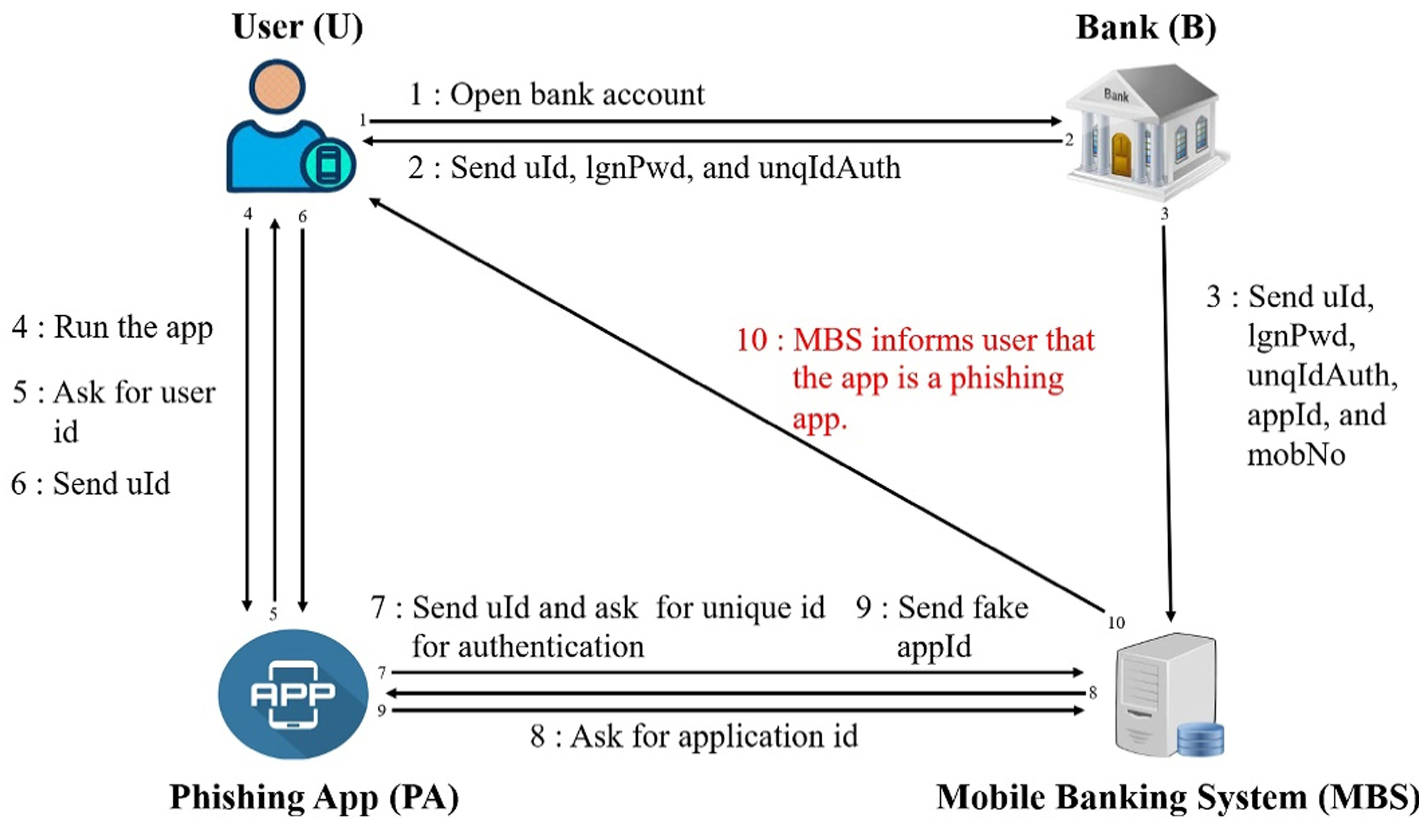
In the event of a Phishing App (which does not have a valid appId), the server detects the fraud at Step 2. The phishing app is never sent the unqIdAuth, and the user, seeing a blank or incorrect ID, realizes the app is fake and refuses to enter their password.
Verification: Proof via SPIN
To ensure the protocol doesn't have hidden deadlocks or logic flaws, the authors used PROMELA (Process Meta Language) to build a mathematical model of the system.
They tested the model against Safety Properties (ensuring the system never enters an "illegal" state) and LTL (Linear Temporal Logic) properties (ensuring that authentication only happens if all three IDs match).
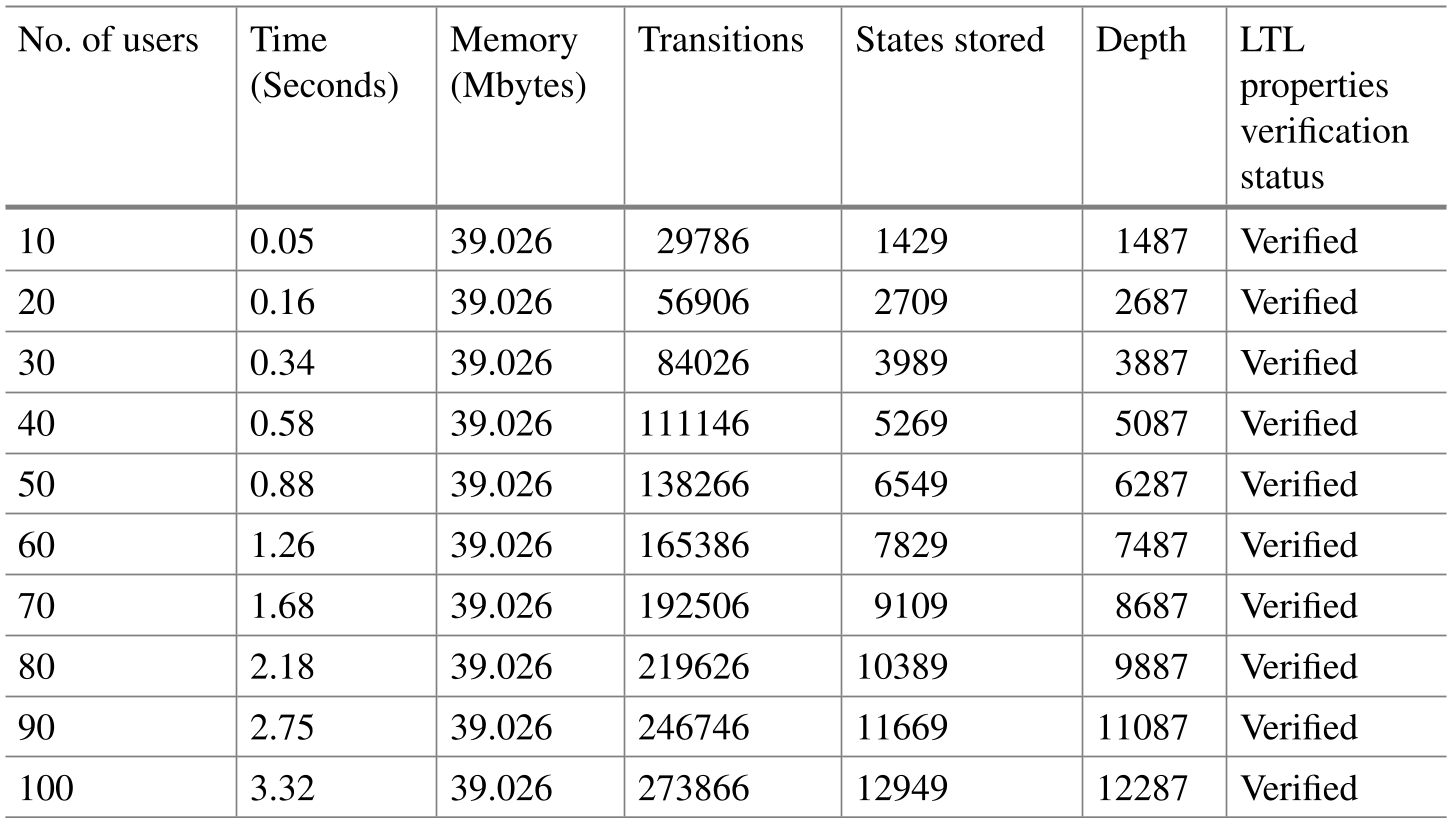
| Metrics | Performance at 100 Users |
|---|---|
| Verification Time | ~3.32 Seconds |
| States Stored | 12,949 |
| Transitions | 273,866 |
| Errors Found | 0 |
The results (detailed in the tables below) show that the computational cost of this protocol is negligible, making it highly scalable for global financial institutions.
Critical Insight & Conclusion
The industry has spent years trying to make users "smarter" (e.g., teaching them to check URLs). This paper argues that security should be an architectural constant, not a user variable.
Takeaways:
- Infrastructure over Education: By forcing the app to prove its identity to the user via a visual secret, we remove the "human error" factor.
- Formal Security: The use of SPIN/PROMELA provides a level of mathematical certainty that empirical testing (like black-box testing) cannot match.
Limitations:
While the model protects the authentication phase, the authors acknowledge that it doesn't solve "Transaction Level" phishing (e.g., Man-in-the-Middle attacks during a transfer). This remains an open area for their future research.
AntiPhiMBS-Auth represents a significant step toward a "Zero-Trust" mobile banking environment where the app itself is treated as untrusted until it proves its lineage through a verified appId.