
AOPUT: Deciphering the Dual Logic of Content and Social Sharing in SNS
AOPUT: A recommendation framework based on social activities and content interests
AOPUT is a dual-task recommendation framework designed for Social Networking Sites (SNSs) that provides both content recommendations (Recder) and friend-sharing lists (ShareAider). It introduces an "Extended Jaccard" similarity measure to weigh active social interactions like commenting more heavily than passive views in a Collaborative Filtering (CF) context.
TL;DR
AOPUT (Social Activities and Content Interests) is a recommendation framework that solves two critical social networking problems: what content to consume and who to share it with. By introducing a weighted "Extended Jaccard" similarity and a hybrid social-decay model, it significantly outperforms traditional Collaborative Filtering (CF).
Academic Positioning: This work moves beyond simple "User-Item" matrices by treating social interactions (sharing, commenting) as high-signal indicators of user preference, bridging the gap between social graph analysis and recommendation systems.
Problem & Motivation: The "Blind Spot" of Traditional RS
Most Recommender Systems (RS) treat users as isolated entities or rely on explicit ratings (e.g., 1-5 stars) which are rare in Social Networking Sites (SNS). Two major issues arise:
- Visibility Gap: Users miss interesting topics from friends if they aren't online constantly.
- Selection Fatigue: When sharing a topic, users struggle to find the right subset of friends among hundreds of connections.
Existing solutions often use "trust" metrics, but the authors argue that trust is often a one-way street, whereas social friendship is mutual and dynamic.
Methodology: The AOPUT Framework
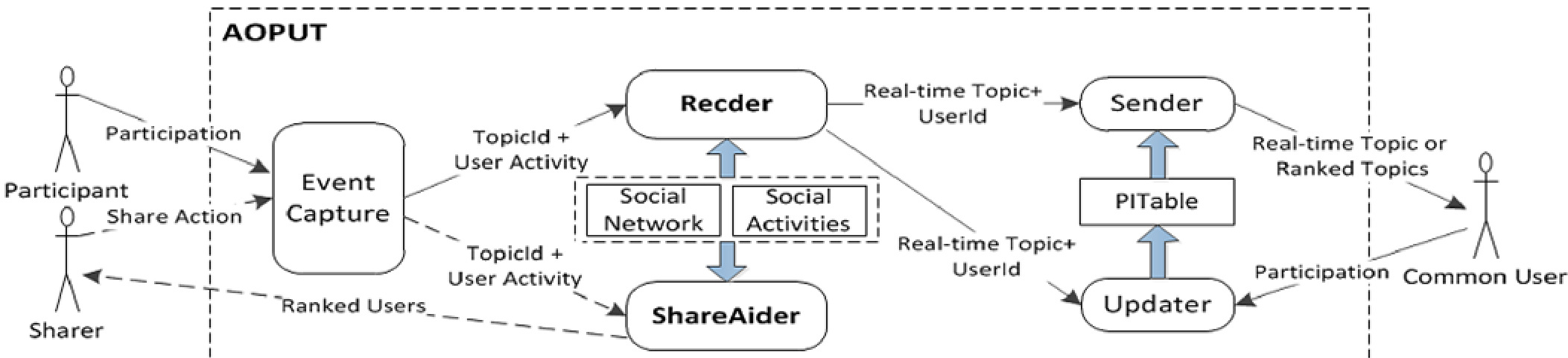
The framework consists of two engines: Recder (Content) and ShareAider (Friends).
1. Recder & The Extended Jaccard Similarity
Traditional Jaccard similarity treats all interactions as equal ( for participated, for not). AOPUT introduces the Extended Jaccard formula:
- (Weighting): Assigns 4x more importance to "Commenting" vs "Viewing."
- (Penalty): Penalizes user pairs with very few interactions to reduce statistical noise.
2. ShareAider: Beyond Content Similarity
ShareAider recognizes that you might share a "Tech" article with a "Close Friend" even if they don't usually read tech. It uses a Social-Based Approach measuring the probability of selection ():
Where is the frequency of past shares and is the time decay (recency).
Experiments & Results
The framework was tested on the AceBridge community dataset (6,400+ users).
Content Recommendation Performace
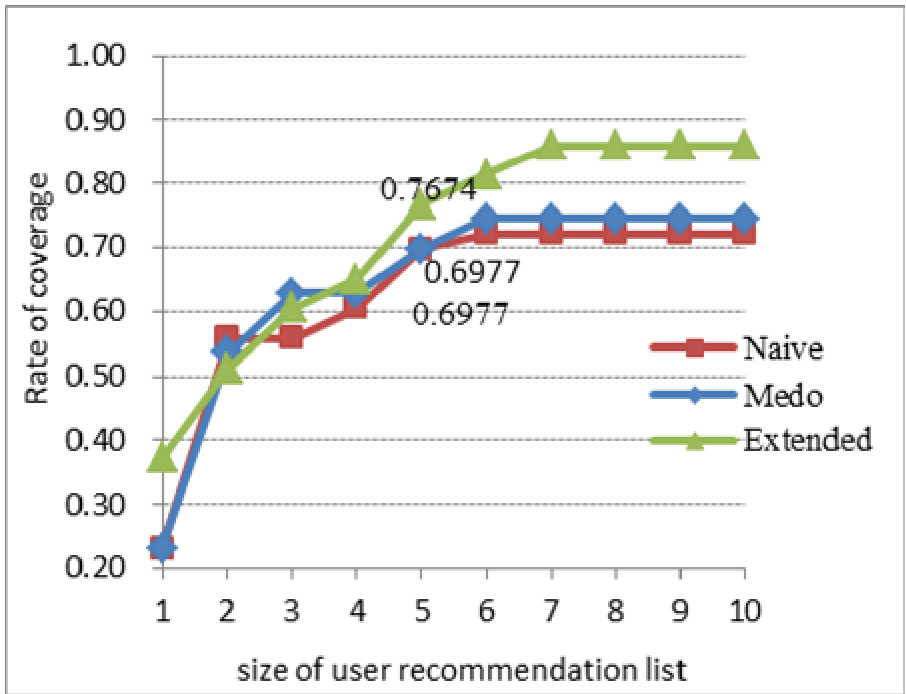
The "Extended" approach achieves a higher coverage rate than "Naive" Jaccard or "Medo" (which only uses the penalty). As shown below, CF methods vastly outperform simple "Popularity" benchmarks.
The Social Supremacy in Sharing
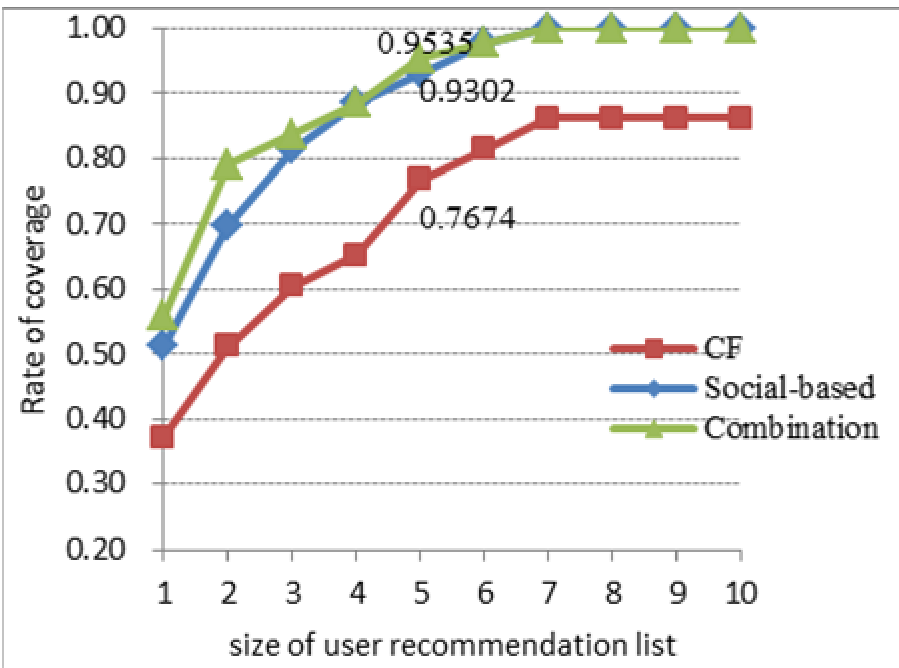
One of the paper's most striking findings is that for friend list recommendation, the social-based approach (frequency + recency) is significantly more accurate than content-based CF ( improvement at N=1). The best results come from a linear combination of both.
Critical Insight & Conclusion
The "Social Dominance" Takeaway: The authors demonstrate that sharing is a social ritual. Our choice of who to "tag" or "share with" is governed more by our relationship strength with the recipient than by the recipient's inherent interest in the topic.
Limitations: The weight and penalty are heuristics found via testing. In much larger, sparser networks, these parameters might require automated tuning (e.g., via reinforcement learning).
Future Outlook: This work paves the way for "Activity-Aware" recommenders that can distinguish between a passive scroll and an active engagement, an essential distinction for modern algorithmic feeds.