
Deciphering the App Lifecycle: Momentum, Sociality, and the Path to Longevity
The Lifecycles of Apps in a Social Ecosystem
This paper presents a comprehensive study of the app ecosystem on Facebook Login, introducing a novel framework to analyze user retention and social adoption. By leveraging high-dimensional temporal, demographic, and structural data, the authors developed a time-dependent retention model and a 2D "popularity-sociality" mapping to predict long-term app success with over 70% accuracy.
TL;DR
What makes an app survive the "valley of death" while others vanish? By analyzing billions of data points within the Facebook ecosystem, this research reveals that app success is not just about going viral. It is a complex interplay of temporal momentum (users get stickier the longer they stay) and social neighborhood structure. The authors demonstrate that with just a few temporal and social markers, we can predict an app’s survival a year in advance with surprising precision.
The Popularity-Sociality Wedge
Every app exists in a two-dimensional trade-off: Popularity (what fraction of the total population uses it) and Sociality (the likelihood of adoption if a friend already uses it).
When these are plotted, a striking "wedge" emerges. The research identifies two frontiers:
- The Asocial Frontier: Apps that spread almost independently of the social network.
- The Social Frontier: Niche apps with high clustering but limited broad appeal.
The most successful apps eventually navigate toward the right side of this wedge, where sheer popularity makes social clustering inevitable.
Beyond Exponential Decay: The Physics of Retention
The standard industry metric for churn often assumes a constant probability of leaving—essentially Exponential Decay. However, this paper proves that model wrong.
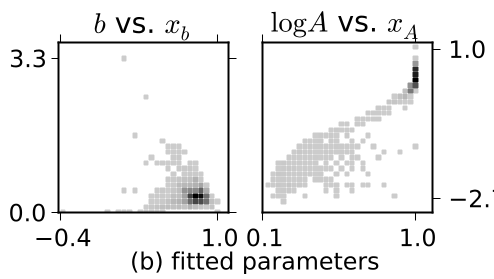
The authors propose a Time-Dependent Retention Model. The intuition is powerful: Momentum.
- In a standard model, a user is as likely to quit on day 100 as on day 2.
- In the author's model, the probability of departure is proportional to .
- Insight: The longer a user is retained, the lower their probability of leaving becomes. This "momentum" parameter () serves as a unique DNA for an app's stickiness.
Social Neighborhoods: Who Influences You?
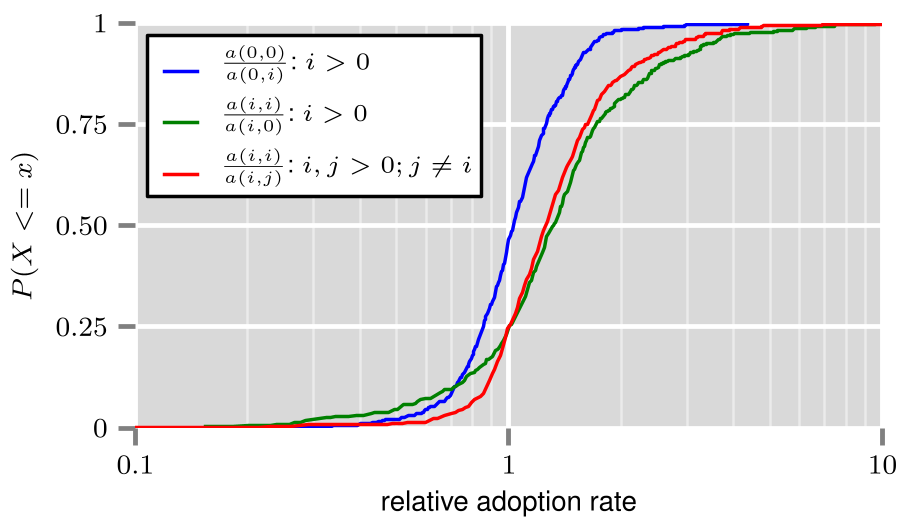
The study dives into the "periphery" of an app—people who don't use it yet but have friends who do. Two major findings reshape our understanding of social contagion:
- Homophily vs. Demographics: If you are an outlier (e.g., a different nationality than the "typical" app user), you are more likely to join if your friend is like you, rather than if your friend is like the typical user. Personal similarity trumps the "app's brand" demographic.
- Structural Diversity: Does having a tight-knit "clique" of friends using an app make you more likely to join than having two unconnected friends using it? The answer is "it depends on the app." This confirms that social diffusion isn't a one-size-fits-all phenomenon but varies across the ecosystem.
Predicting the Future: What Actually Matters?
Using a Random Forest classifier, the authors attempted to predict which apps would lose 50% of their users within a year.
| Feature Set | Accuracy | Key Insight |
|---|---|---|
| All Features | 73% | Combined signals are strongest |
| Temporal | 71% | Stability (weekly minimums) is the best predictor |
| Demographic | 66% | Active Facebook users make for loyal app users |
| Social | 60% | Surprisingly, sociality alone is a weak predictor of longevity |
Interestingly, High Sociality (being very "niche") was often a negative indicator of survival. Niche apps are highly clustered but fragile; if the tight circle moves on, the app collapses.
Critical Analysis & Future Outlook
The "appification of the Web" has turned attention into a zero-sum game. This paper provides the mathematical tools to move beyond "vanity metrics" like peak DAU.
Limitations: The study doesn't differentiate between organic growth and paid user acquisition (ads). In the modern era, marketing spend heavily skews the "natural" lifecycles described here.
Takeaway: For developers and investors, the "Stability Signal"—median usage in the later months of an observation window and the retention momentum parameter—provides a much clearer crystal ball than a viral spike in adoption.