
The Interplay of Attitude and Action: How Social Attention Rescues the Environment
Applied Mathematics and Computation
This paper introduces a Public Goods Game (PGG) model that explores the co-evolution of individual behaviors and social attitudes towards environmental investment. By integrating an SI-like epidemic model with evolutionary game theory, the authors demonstrate how social attention, driven by Internet-era response mechanisms, acts as a dynamic feedback loop that can significantly promote or inhibit large-scale cooperation.
TL;DR
In the battle against ecological decay, individual behavior (cooperation) and public sentiment (social attention) are two sides of the same coin. This paper proposes a mathematical framework where environmental investment efficiency is tied to how "enthusiastic" a society is. The verdict? Precautionary social responses—where the public reacts strongly even to slight environmental issues—are the ultimate catalyst for long-term cooperation.
Motivation: More Than Just Game Theory
Most environmental models treat cooperation as a simple "pay-to-save" transaction. However, the authors argue that we live in a "social attention economy." Thanks to the Internet, our attitudes spread like viruses (using an SI model logic). When people stop caring (the "forgetfulness" factor), the budget for environmental protection becomes less effective. The real challenge is understanding the feedback loop: Does ecological degradation spark enough social attention to fund the rewards that make cooperation worth the cost?
Methodology: The Four-Quadrant Society
The researchers split the population into four types based on Behavior (Cooperate/Defect) and Attitude (Enthusiastic/Unenthusiastic):
- Enthusiastic Cooperator (CI): The ideal citizen.
- Unenthusiastic Cooperator (CS): Cooperates but is losing interest.
- Enthusiastic Defector (DI): Cares about the environment but remains selfish.
- Unenthusiastic Defector (DS): Neither cares nor acts.
The core of the model is the Response Mechanism, defined by the index :
- Precautionary (): High social alarm even when degradation is low.
- Linear (): Attention grows proportionally to degradation.
- Lagging (): Society only starts caring when things are already a disaster.
 Fig 1: The transition pathways between different individual states based on social contact and payoff comparisons.
Key Insights from the Data
1. The Power of "Early Alarms"
The simulations show a clear winner: the precautionary mechanism. When the public is sensitive to early signs of environmental decay, it creates a "social pressure" and a "funding pool" early enough to prevent the "Tragedy of the Commons."
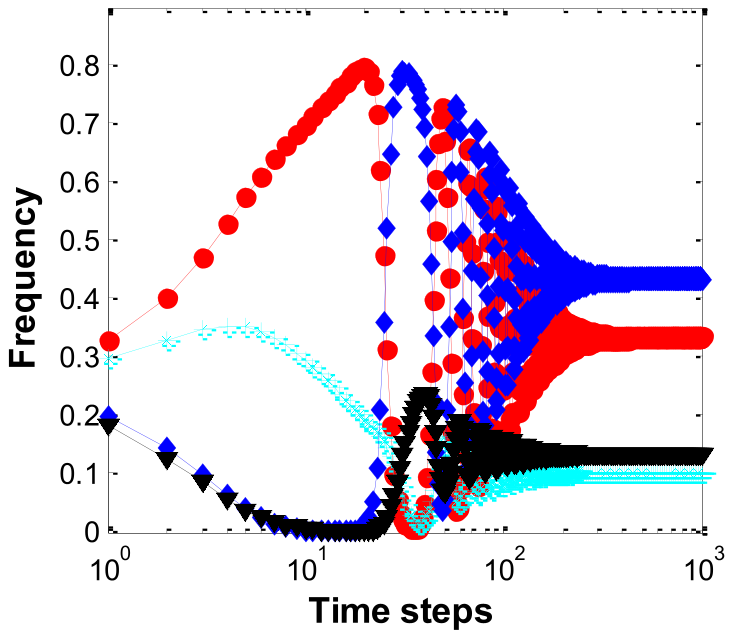 Fig 2: Evolution of groups under varying sensitivity and forgetfulness. Notice how shifting (sensitivity) can revive a dying population of cooperators.
2. The Budget Threshold ()
Throwing money at the problem only works if you throw enough. The researchers found a critical threshold for environmental investment. Below this value (), defectors dominate regardless of social attention. Once the budget passes the threshold, cooperation explodes, but interestingly, the rate of promotion slows down as the budget gets even larger—suggesting diminishing returns on pure financial incentive.
3. Forgetfulness vs. Sensitivity
The survival of the environment depends on a delicate balance. If the "forgetfulness rate" () of social media and public interest is too high, the entire cooperative structure collapses into a state of "unenthusiastic defection."
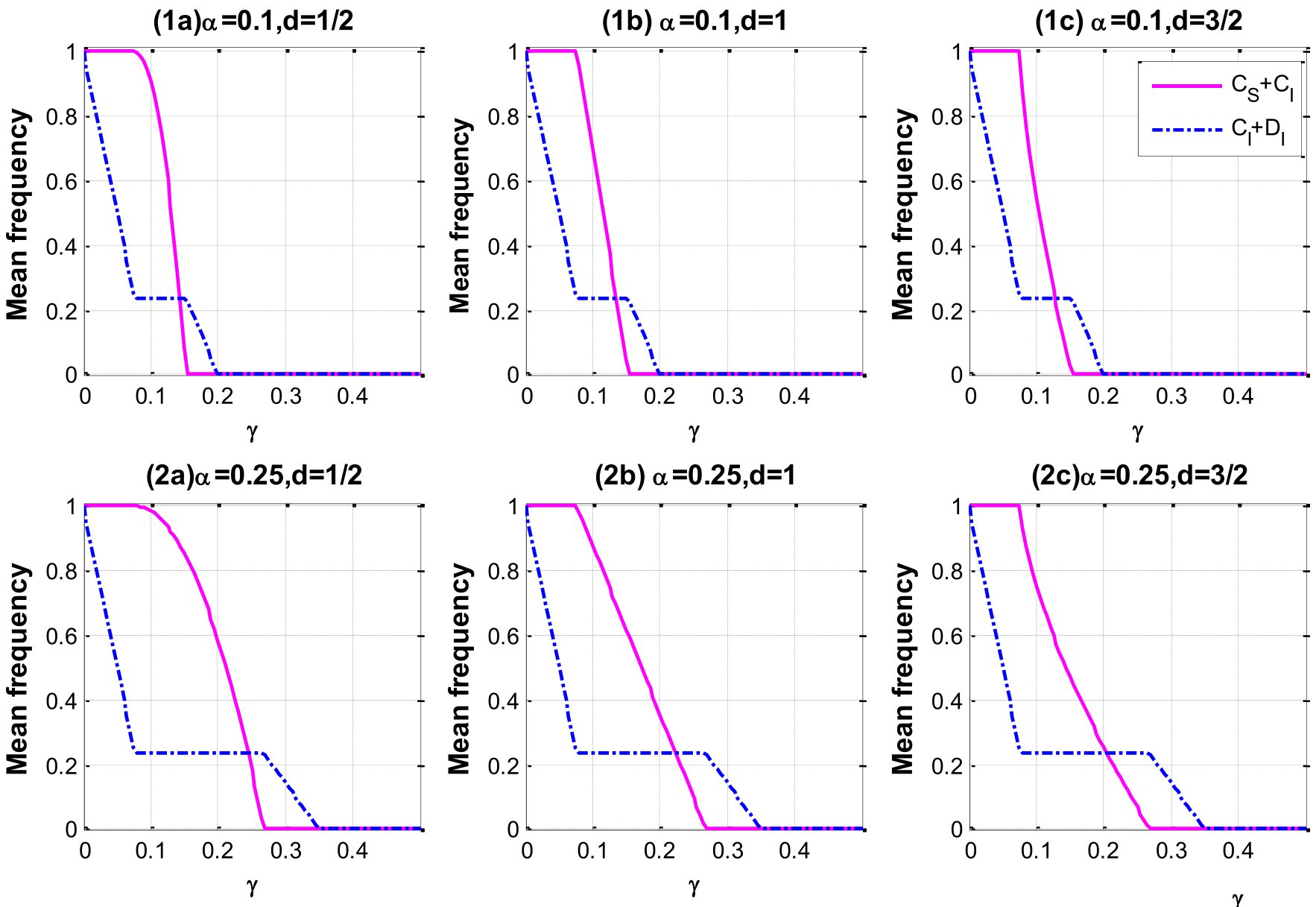 Fig 3: The phase diagram showing the "Stable Interval" of attention. It highlights that sensitivity must significantly outweigh forgetfulness to maintain a cooperative equilibrium.
Critical Analysis & Conclusion
The paper successfully bridges the gap between epidemiology (how attitudes spread) and economics (how payoffs drive behavior).
Takeaway for Policy Makers:
- Don't wait for a crisis: Foster "precautionary" social attitudes.
- Manage the 'Internet Forgetfulness': Continuous engagement is required to prevent the "unenthusiastic" state from becoming a dominant strategy.
- Budgeting: Ensure environmental rewards are above the critical threshold to ensure they aren't wasted on a defect-heavy population.
Limitations: The model assumes an infinitely mixed population (Mean Field Approximation), which might not capture the "filter bubble" effects of modern social networks where attitudes cluster geographically or ideologically. Future work should test these dynamics on structured networks.
Main Contribution: This work proves that social attention is not just a byproduct of environmental status, but the primary engine that determines whether cooperation is economically viable.