
Modeling the "Viral" Customer: A Compartmental Approach to Marketing Policy
Applied Mathematics and Computation
The paper introduces a four-compartment mathematical model based on ordinary differential equations (ODEs) to track the dynamics of regular and referral customers. By incorporating social network structure and marketing policy parameters, the authors establish the conditions for long-term customer base stability and growth.
TL;DR
This research bridges the gap between epidemiology and economics by treating customer acquisition like a viral spread. Using a four-compartment ODE system (Regular vs. Referral customers), the authors demonstrate how companies can mathematically determine whether their marketing spend will lead to an "epidemic" of growth or an inevitable collapse of the customer base.
Context & Motivation: Why ODEs for Marketing?
In modern CRM, we talk a lot about "going viral," yet the mathematical tools used by marketing departments are often surprisingly static. The authors argue that a firm's survival depends on two distinct groups:
- Regular Customers (C): Those who buy but don't necessarily advocate.
- Referral Customers (R): The "influencers" who actively pull potential customers into the brand's ecosystem.
The core problem is that Customer Referral Value (CRV) is dynamic. It depends on the underlying social network and the incentives (marketing policy) provided by the firm. The authors propose that we can model these interactions using compartmental systems—the same math used to track the spread of diseases like COVID-19 or the flu.
Methodology: The Four-Compartment Architecture
The model splits the universe into four distinct pools. The movement between these pools is governed by a system of four autonomous differential equations:
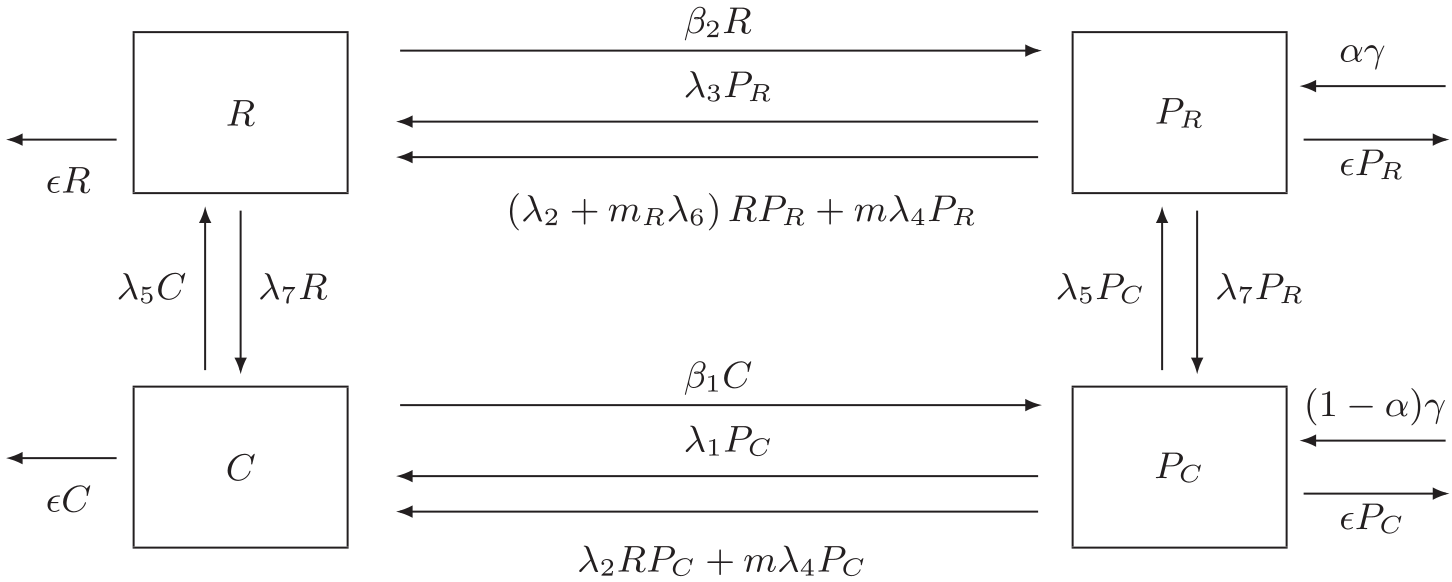
The Governing Equations
The dynamics are defined by the transition rates between Potential Regular () and Potential Referral () states. A key innovation here is the inclusion of (Natural Referral Pull) and (Directed Marketing Pull).
The system equations effectively capture:
- Natural Transition: Potential customers becoming customers via standard interest.
- The Pull Effect: Existing referrals () "infecting" potential customers ( and ).
- Marketing Policy: The impact of undifferentiated costs () vs. referral rewards ().
Experiments: When Marketing Fails (and When it Scales)
The researchers identified a critical threshold, , which acts similarly to the (Basic Reproduction Number) in epidemiology.
1. The "Word of Mouth" Case
In ecosystems where all acquisition relies on referrals ():
- If : The brand is doomed. Even with a large initial customer base, the population decays to zero.
- If : The brand reaches a stable non-zero equilibrium.
 Above: Left (Decay when ), Right (Stability when )
2. Strategy Shift: vs
The most actionable part of the study compares Undifferentiated Marketing (spray and pray) with Referral-Targeted Marketing.
- When the budget was spent entirely on undifferentiated marketing (), customer counts slowly bled out.
- By simply reallocating 25% of the budget to referral incentives (), the model showed a sharp reversal: the customer base asymptotically doubled.
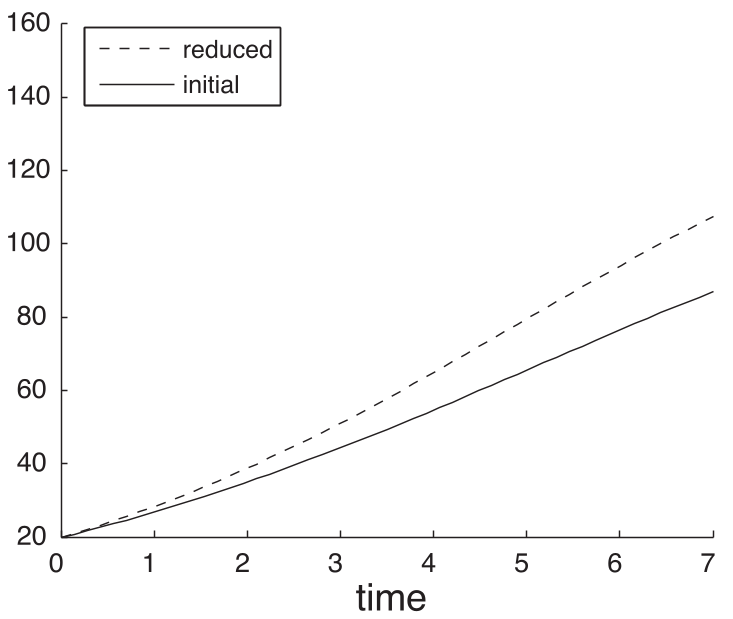 Figure: The "hockey stick" recovery after introducing incentives.
Critical Insight: The "Stability" Takeaway
The paper proves that for a referral network to be self-sustaining, the rate of acquisition driven by a single referral customer must exceed the rate of defection () and "exit" from the market ().
Limitations: The model assumes a constant recruitment rate (), which might not hold in highly volatile or seasonal markets. Furthermore, the "Network Structure" parameters () are treated as static, whereas in reality, customer centrality changes over time.
Conclusion
This work provides a rigorous mathematical justification for the "Growth Hacking" movement. It suggests that marketing is not just about the volume of noise made, but about fine-tuning the transition parameters of the customer journey. For practitioners, the message is clear: if your is below 1, no amount of traditional ad spend will save your brand in the long run.