
Dialogue Games: Turning Social Network Recommendations into a Rational Debate
Applying Dialogue Games to Manage Recommendation in Social Networks
This paper introduces a decentralized recommendation framework for social networks based on Dialogue Games and the Argument from Expert Opinion scheme. By modeling the interaction as an argumentation-based dialogue, personal agents can justify their suggestions, challenge others' credibility, and propagate requests through multi-level neighbors to achieve more precise results.
TL;DR
In the era of information overload, getting a reliable recommendation from a friend is better than a cold algorithm. This paper formalizes that intuition by treating social network recommendations as a Dialogue Game. By moving beyond simple "ratings" and into the realm of Argumentation Theory, agents can now justify why a restaurant is good, challenge the expertise of others, and navigate dynamic social ties to find the best possible match for a user’s preferences.
The Motivation: Why Your "Friends" Aren't Enough
Most decentralized recommendation systems treat social links as static pipes for data. However, true social interaction is argumentative. Prior works often struggled because:
- Dynamic Preferences: Users don't always know what they want until they see options.
- Partial Knowledge: No single agent knows every restaurant in the city.
- Implicit Trust: How do you know if a "friend of a friend" is actually an expert in Mediterranean cuisine?
The authors argue that recommendation shouldn't be a one-way broadcast; it should be a collaborative discovery process governed by the rules of logic and debate.
Methodology: The Rules of the Game
The core of this research is the instantiation of the Argument from Expert Opinion scheme within a Multi-Agent System (MAS).
1. The Interaction Protocol
The dialogue is structured as a series of moves (locutions) between an Initiator and Proponents.
- The Experts: Agents evaluate one another using two metrics: Local Confidence (personal history) and Expertise Degree (the network's collective view).
- Critical Attacks: The initiator doesn't just accept a suggestion. They can pose "Critical Questions" (CAs) such as:
- Is the proponent truly an expert in this specific field?
- Is this suggestion consistent with what other experts say?
- Is the source personally reliable?
2. Architecture & Decision Policy
The system leverages a sophisticated decision policy where agents use "level-k" resonance. If your neighbor doesn't know a good restaurant, they don't just say "no"; they ask their neighbors, acting as a proxy in the dialogue.
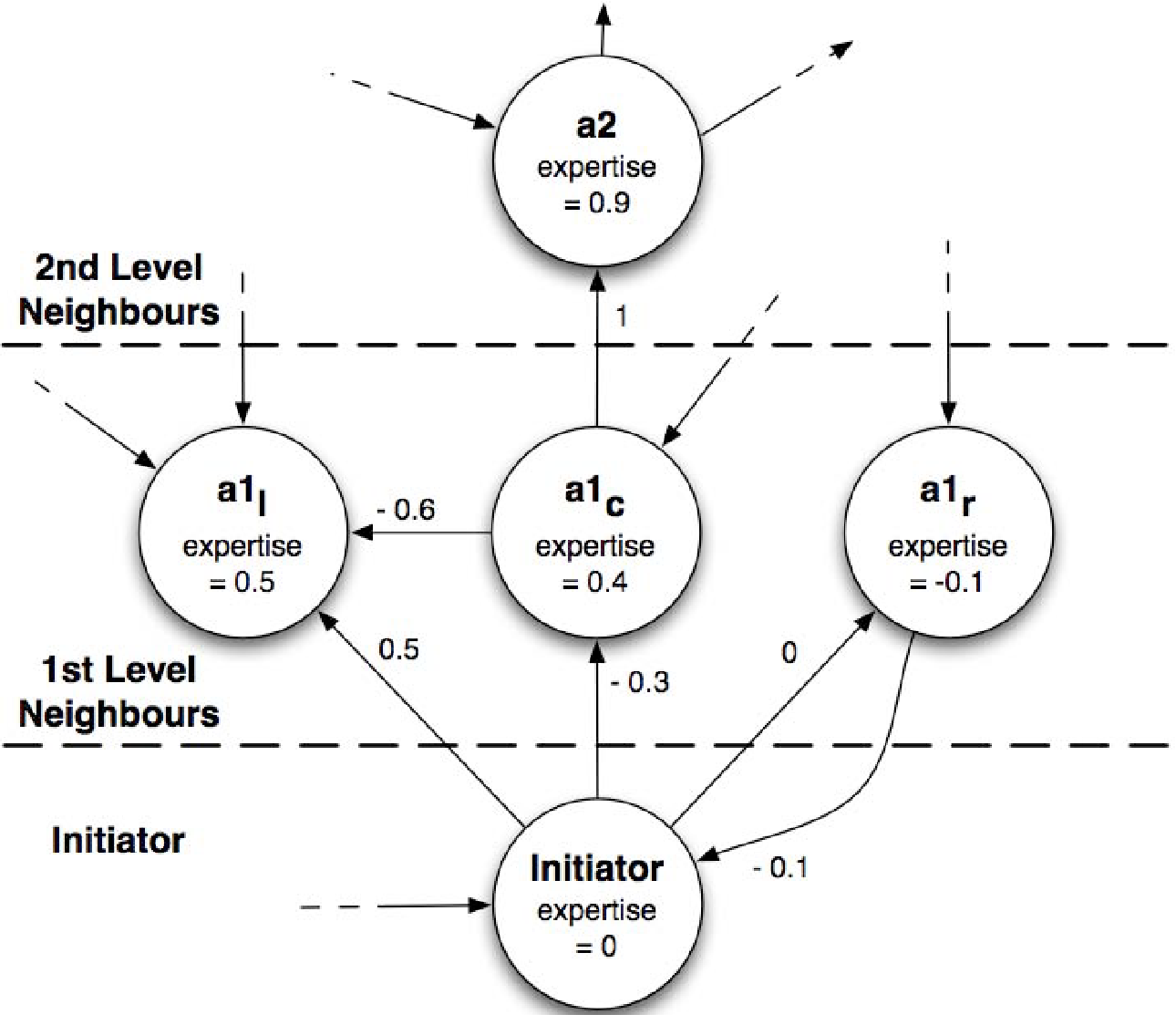 Above: A partial view of the social network where nodes represent agents with various expertise degrees and weighted confidence edges.
Evidence: Outperforming Simple Metrics
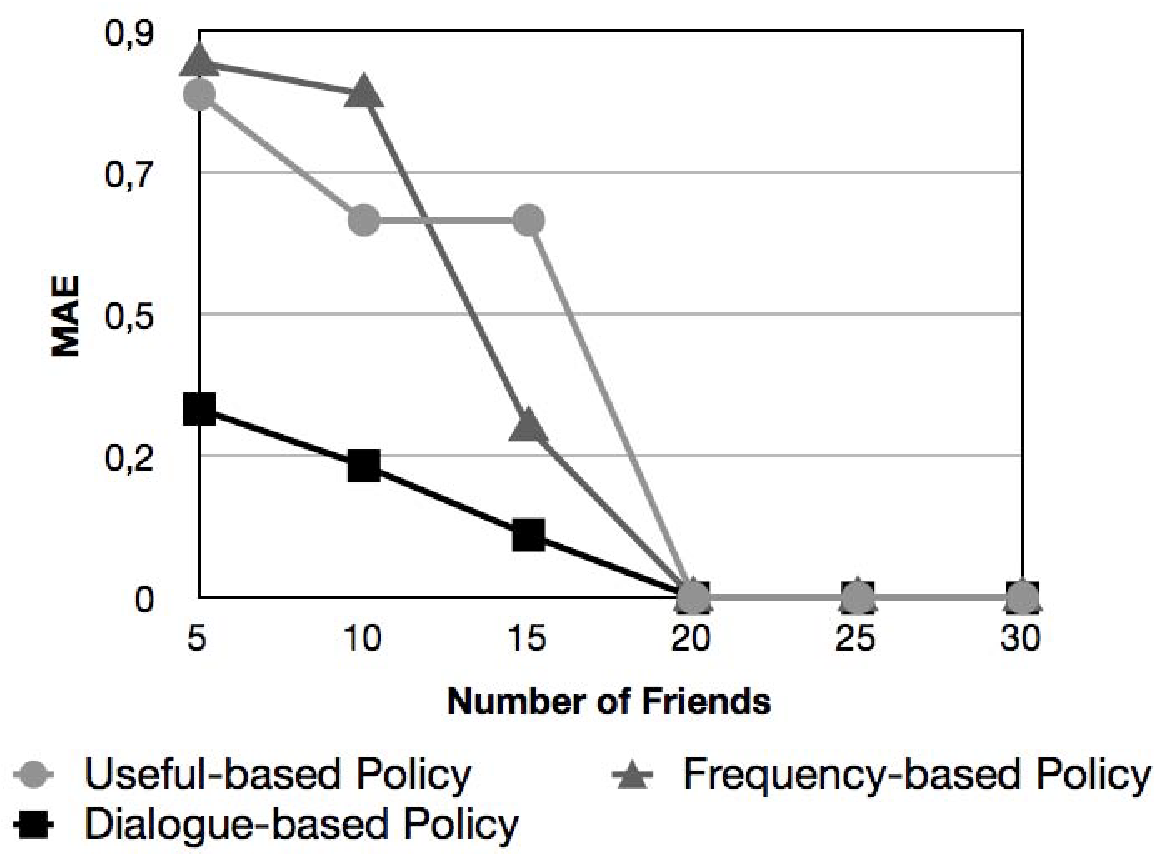
The authors tested their "Dialogue-based Policy" against standard "Confidence-based" and "Frequency-based" (most popular) methods.
Key Finding 1: Scalability
As the number of agents grows (and information becomes more dispersed), the Dialogue-based policy maintains a much lower Mean Absolute Error (MAE).
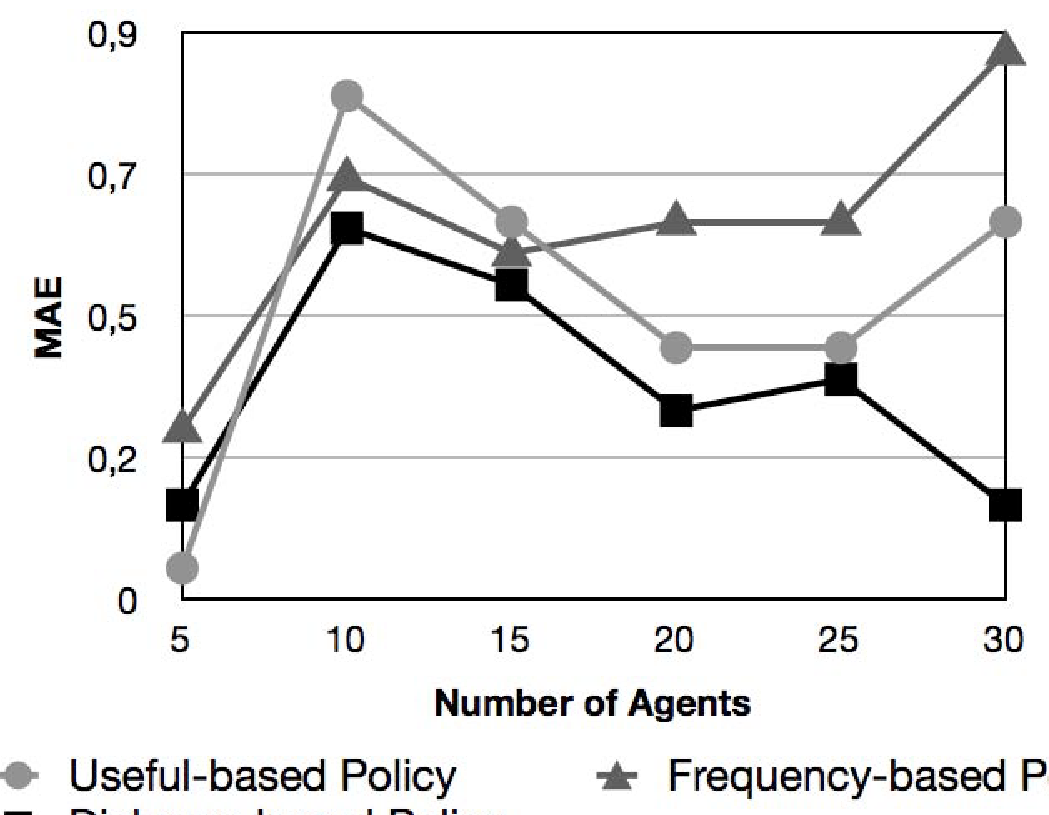 The MAE for the dialogue policy stays lower and more stable compared to the erratic spikes of simpler policies.
Key Finding 2: The Power of Propagation
Even when agents have few friends, the ability to "argue" and propagate requests allows them to find high-quality information that is deep in the network—information that local-only algorithms would miss entirely.
Critical Analysis & Conclusion
The "Why" behind the "How"
Why does this work better? Because the dialogue game forces clarification. In the experiment, agents could ask the initiator for more details (e.g., "What kind of cuisine?") before making a proposal. This reduces the search space and increases the relevance of the "arguments" (recommendations) presented.
Limitations & Future Work
- Honesty Assumption: Currently, the model assumes agents are honest. In a real-world social network, "malicious" agents might use argumentation to spread spam or biased ads.
- Propagation Limits: The study limited propagation to "level-2" to save compute. Future work could explore how a "budgeted depth-first search" using argumentation might work in massive-scale networks like X (Twitter) or LinkedIn.
Final Takeaway: By treating AI interactions as a game of logic rather than just a flow of numbers, we can create recommendation systems that are not only more accurate but also more transparent and justifiable.