
Bridging the Gap: How Energy Sharing Among Strategic Prosumers Approaches Social Optimum
13409_Approaching Prosumer Social Optimum via Energy Sharing With Proof of Convergence.
This paper proposes a distributed energy sharing mechanism for prosumers using a Generalized Nash Game framework. It introduces a bidding process that enables prosumers to maintain privacy while approaching the social optimum, achieving a Price of Anarchy (PoA) of .
TL;DR
The rise of the "prosumer"—households that both produce (via solar/wind) and consume energy—threatens the efficiency of traditional centralized power grids. This paper introduces a Generalized Nash Game mechanism for energy sharing. It proves that a decentralized bidding process not only protects user privacy but also reaches a result nearly identical to a "perfect" centralized operator as the market scales.
The Prosumer Dilemma: Privacy vs. Efficiency
In the traditional grid, an operator tells everyone what to do. But modern prosumers have their own interests and private data (like their unique cost and utility functions).
- Centralized systems are too slow and invasive.
- Price-taker markets ignore that prosumers can be strategic, potentially "gaming" the system.
The fundamental question this paper answers is: Can we design a market where strategic, self-interested prosumers naturally move toward the best outcome for everyone?
The Core Mechanism: Prosumers as "Price-Makers"
Unlike models where users just accept a price, this paper treats prosumers as strategic bidders. Each prosumer submits a bid , and the market clearing price is determined by the average of these bids.
Crucially, when a prosumer decides how much to produce () or consume (), they calculate the Price Impact. They don't just look at the current price; they estimate how much the price will change if they buy or sell more energy.
The Model Architecture
The sharing framework relies on a platform that coordinates bids without ever seeing a prosumer's internal costs.
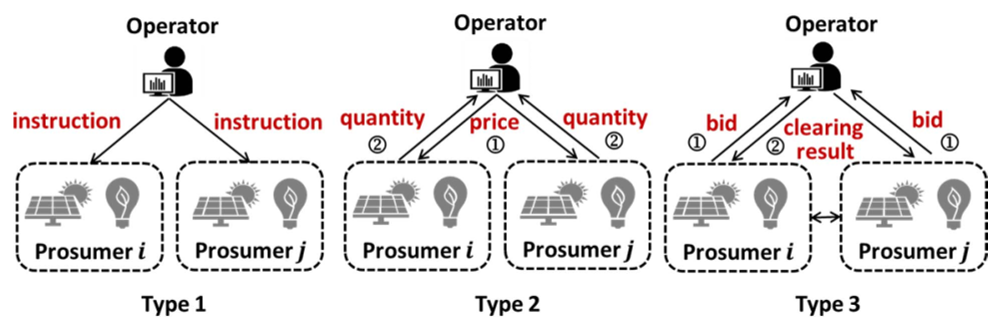 Figure 1: Comparison between Centralized, Retail, and the proposed Sharing Market structures.
Mathematical Intuition: Why It Converges
The authors prove that the game reaches a Generalized Nash Equilibrium (GNE). They show that as the number of participants () grows, the influence of any single person on the price drops to nearly zero.
The Price of Anarchy (PoA)—the ratio between the social cost at equilibrium and the absolute minimum cost—is proven to be: This is a massive result. It means that as , the PoA becomes 1, implying the decentralized market becomes 100% efficient.
Experimental Validation
The paper validates this through a bidding algorithm where smart meters iteratively update bids.
Key Findings:
- Incentive Alignment: In a 3-prosumer test, the researchers found that under the centralized model, some participants actually ended up worse off than if they had stayed isolated. In their Energy Sharing model, everyone's utility improved (Pareto Improvement).
- Scalability: In tests with 50 prosumers, the price converged in just about 8 iterations.
- Stability: The system remained stable even when prosumers were "lazy" and missed updates (asynchronous bidding).
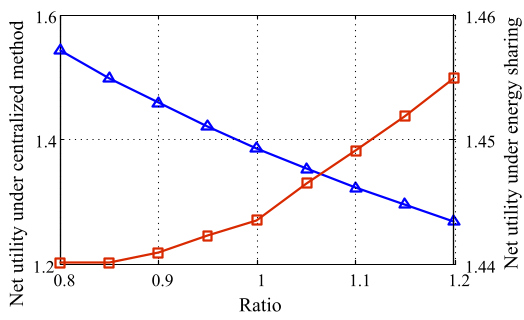 Figure 2: Convergence of the sharing price across different market sensitivity settings (a).
Critical Insight & Conclusion
The beauty of this research lies in its bridge between Game Theory and Power Systems. It proves that "selfish" behavior in an energy market isn't a bug—it's a feature. If the market is designed correctly (using the bidding rules proposed here), the collective behavior of thousands of strategic households perfectly replicates the wisdom of a centralized super-computer, all while keeping individual data private.
Limitations
- Network Constraints: The current model assumes a small microgrid where line limits aren't an issue.
- Single Time-Step: It doesn't yet account for batteries that might shift energy from 10 AM to 6 PM.
Future Outlook: By proving that decentralized energy sharing can reach social optimum, this work paves the way for "Uber-like" energy platforms where neighborhoods generate and trade their own green power without needing a massive utility middleman.