
Engineering Affection: How Uber and Lyft Manipulate the "Driver Experience" Through Language
Appropriated or Inauthentic Care in Gig-Economy Platforms: A Psycho-linguistic Analysis of Uber and Ly
This paper presents a psycholinguistic analysis of communications from Uber and Lyft, utilizing a 4-month auto-ethnographic study by an HCI researcher. By applying the LIWC tool to 324 emails and field notes, the study explores how platform-specific messaging strategies shape the felt experience of "care" and emotional labor in the gig economy.
TL;DR
Why do drivers often feel better about driving for Lyft even when they might earn more with Uber? This study reveals that it isn't just about the money or the app's UI—it's about the psycholinguistic engineering of "care." By analyzing months of emails and field notes, researchers found that Lyft uses a consistently positive tone to simulate a community bond, while Uber oscillates between clinical facts and urgent "community" demands to drive behavior.
Background: The Illusion of Choice in the Gig Economy
Uber and Lyft are functionally twins. They solve the same problem using the same pool of human resources. Yet, one is often seen as the "evil giant" while the other is the "friendly underdog." Researchers in this paper wanted to move beyond the app functionality and dive into the sociotechnical systems that dictate how these platforms are felt.
The core of this investigation is Auto-ethnography: an HCI scholar actually spent four months behind the wheel, tracking not just the dollars earned, but the emotional response to every notification and email.
Methodology: Coding the Corporate Voice
The researchers categorized 324 interactions (emails and field notes) into eight primary categories, ranging from "Onboarding" to "Hourly Guarantees." They then processed this text through LIWC (Linguistic Inquiry and Word Count), a tool designed to extract psychological states from word usage.
They measured four key dimensions:
- Analytic: Logical and hierarchical thinking.
- Clout: Confidence and expertise.
- Authenticity: Honest and disclosing vs. guarded.
- Tone: Upbeat and positive vs. anxious or hostile.
The Core Conflict: Facts vs. Feeling
The most striking finding was the stability of "Clout" and "Analytic" scores across both platforms—both want to appear professional and expert. However, the Tone and Authenticity dimensions revealed a deep divergence in strategy.
The "Win-Win" vs. The Fact Sheet
When offering "Hourly Guarantees," Lyft framed the interaction as an emotional victory: "Lucky you!" and "It’s a win-win." Uber, conversely, presented a strict list of requirements: "Meet the minimum requirements... are you ready to go?"
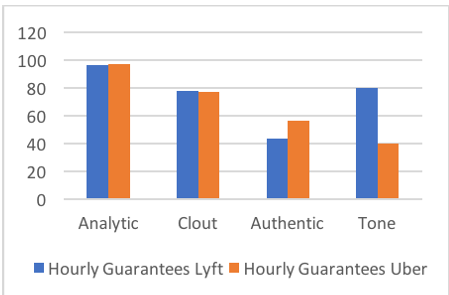
As shown in the charts, Lyft (blue) often spikes higher in Tone during these crucial incentive periods compared to Uber (orange).
Onboarding: The Honeymoon Phase
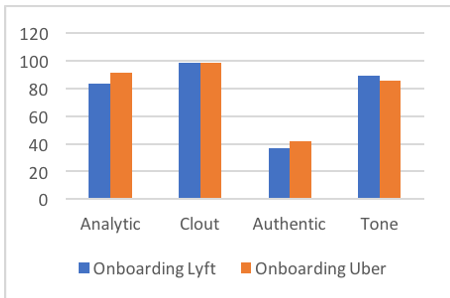
Both platforms start strong. During onboarding, Tone is high for both companies as they seek to build a relationship and "lure" the driver into the system.
Deep Insight: Appropriated Care
The study highlights a phenomenon the authors call "Appropriated or Inauthentic Care." Lyft capitalizes on personable language to make their promises feel better, even when the underlying contract is identical to Uber’s.
Uber, on the other hand, uses "community" language selectively—usually when they need something. When the researcher stopped driving, Uber sent an email claiming, "Your city needs you!" This isn't actual care; it's a "psychological trick" (as noted in prior work by Scheiber) to guilt-trip drivers back onto the road.
Critical Analysis & Future Outlook
Takeaway: The study proves that in the gig economy, the "product" isn't just the ride—it's the driver's psychological state. Lyft’s "comfortable" emails serve as a buffer against the harsh reality of contractor labor.
Limitations:
- The sample is based on a single driver’s experience (N=1), which is a characteristic of auto-ethnography but limits generalizability.
- It does not account for the impact of actual app UI/UX, which also mediates the driving experience.
Future Outlook: The next step for this research is to cross-reference these psycholinguistic scores with public sentiment during the same period. How does a corporate scandal (like #DeleteUber) change the way a driver reads a "warm" email from the company? As gig work expands, understanding this "manipulative care" will be essential for designing more ethical, transparent labor platforms.
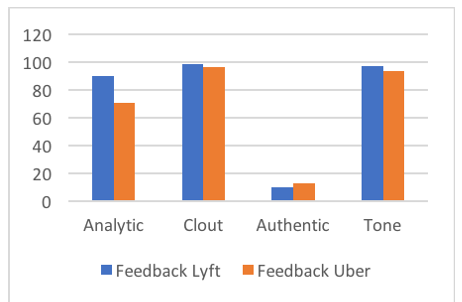 Figure: Variations in "Tone" across different email categories illustrate the divergent communication strategies.