
Beyond the Broadcast: Why Direct Peer-Querying Trumps Social Media Posts for Information Needs
Appropriateness of Search Engines, Social Networks, and Directly Approaching Friends to Satisfy Information Needs
This study investigates human information-seeking behavior by comparing Search Engines, Status Message Question Asking (SMQA), and direct peer-to-peer querying. Using a survey of 112 participants, it identifies that while search engines remain dominant, users significantly prefer direct messaging to specific friends over broadcasting queries on social networks.
TL;DR
Is "social search" dead, or are we just doing it wrong? While broadcasting questions on Facebook (SMQA) has historically shown low engagement, a study from the Technical University of Munich reveals that users are actually very willing to use their social networks—provided they can ask friends directly. By shifting from broadcasting to targeted communication, the preference for social search doubles, and expectations for answer quality skyrocket.
The "Loudspeaker" Problem in Social Search
Most early research into "social search" focused on Status Message Question Asking (SMQA)—the act of posting "Does anyone know a good mechanic?" to your entire feed. Previous studies by Oeldorf-Hirsch et al. found that people were reluctant to do this. Why?
- Social Noise: Fear of annoying your entire contact list with niche questions.
- Lack of Specificity: Broadcasting is a "shotgun" approach; it doesn't target the one person who actually knows the answer.
- Privacy/Ego: Not everyone wants their information gaps made public.
Methodology: Testing Preference and Quality
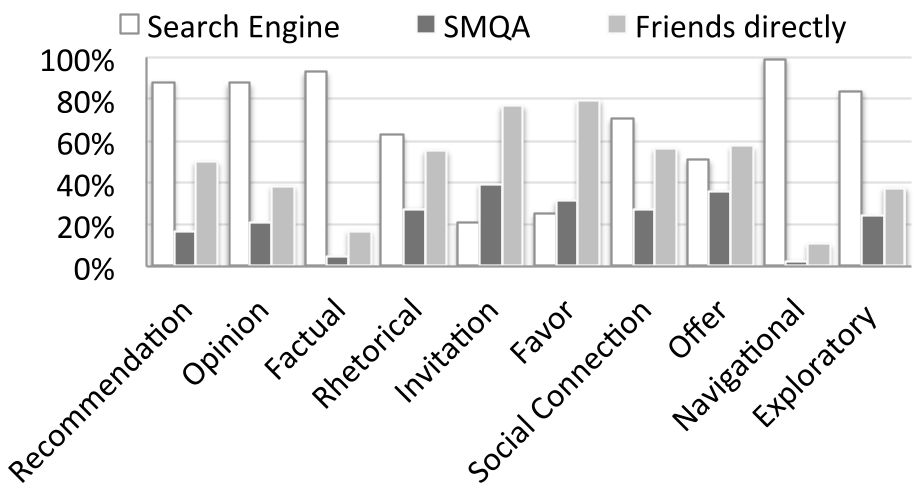
The researchers surveyed 112 participants, presenting them with 30 diverse information needs ranging from "factual knowledge" (weather) to "favors" (borrowing a tool).
The core of the study involved comparing three distinct routing paths for these needs:
- Search Engines: The traditional Google/Bing route.
- SMQA: Posting a broadcast message on a Social Network.
- Direct Approach: Messaging specific, well-chosen friends via IM, email, or phone.
Key Insights: The Power of Directness
1. Preference Shift
The study found a massive disparity between how people view broadcasting vs. direct messaging.
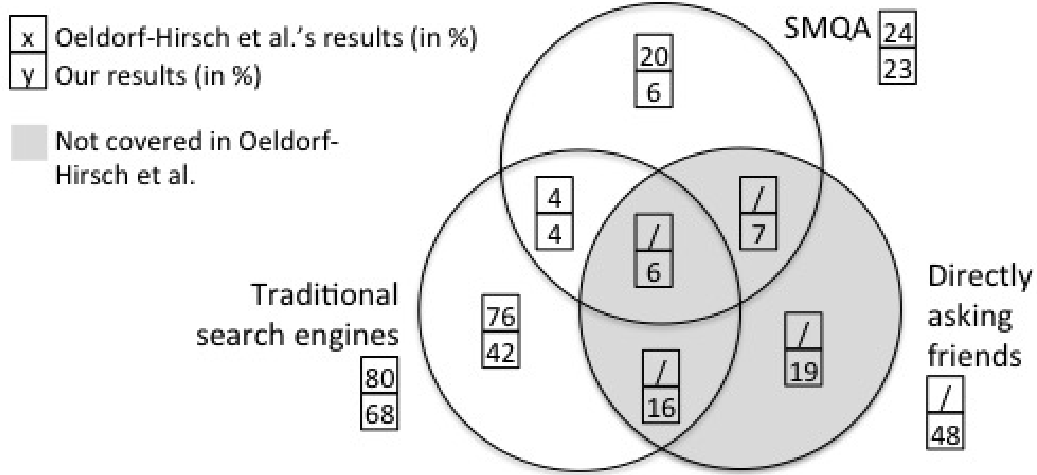
- Search Engine dominance dropped: In previous studies where only SMQA was an option, 76% of queries went to search engines. When "Direct Approach" was added as an option, only 42% of queries remained exclusive to search engines.
- Broadcast vs. Direct: Only 23% of routing decisions involved SMQA, while 48% involved asking a friend directly.
2. Quality and Trust
Users expressed significantly higher expectations for responses from direct queries () compared to broadcast queries (). This suggests that target selection is a cognitive part of the search process—we don't just want an answer; we want an answer from someone we trust to be an expert.
3. The Need for Speed
Time is the biggest barrier to social search. The study found that 58% of users needed an answer within 5 hours. For factual knowledge or favors, the deadline was often under 1 hour. This explains why search engines still win: they are instantaneous, even if their answers are less "personalized."
Critical Analysis: Is Forwarding the Secret Sauce?
The study also explored "Friends of Friends" (forwarding). Interestingly, users didn't think forwarding would help for factual questions (which anyone can Google) or favors (you don't ask strangers for favors), but they saw high potential for recommendations and opinions. This suggests that social search systems should prioritize "extended networks" specifically for subjective or exploratory tasks.
Conclusion
This paper provides a vital correction to the "SMQA-is-ineffective" narrative. The issue isn't that we don't want to ask our friends; it's that we don't want to shout at them.
Future Outlook: The study suggests that the ultimate social search engine would be a hybrid system where automated agents can index the "restricted information spaces" of our friends and provide immediate, direct answers that mimic the quality of a personal message with the speed of a search engine.
Takeaways for Tech Leaders:
- UX Design: If you are building search into a social platform, prioritize "direct send" features over "post to wall."
- Context is King: The high value placed on direct queries stems from the "mutual context" shared between close ties.
- Automation Opportunity: There is a massive market gap for "social agents" that can answer personal queries by proxy to bridge the 5-hour lag time inherent in human social search.