
It’s Always April Fools’ Day: Why Structural Propagation Can't Catch Fake News
It's always April fools' day!: On the difficulty of social network misinformation classification via propagation features
The paper investigates the feasibility of classifying misinformation on Facebook by using exclusively structural features of content propagation cascades. Evaluated on a dataset of Italian Facebook posts, the study compares conspiracy theories against scientific news to determine if topological dynamics alone can differentiate fake from real content.
TL;DR
Can we detect misinformation without even reading the post? This paper proves it's much harder than we thought. By analyzing the "skeleton" of how news spreads on Facebook—ignoring the words and looking only at the network shape—researchers found that conspiracy theories and scientific news propagate almost identically. Even with advanced machine learning, the classification F1-score struggled to cross 0.7, suggesting that social media echo chambers make all news look "viral" in the same way.
The "Adversarial" Motivation
We are currently in an arms race. Most fake news detectors look at keywords or the reputation of the website. However, misinformation creators are clever: they can change their vocabulary or buy new domains to bypass filters.
The authors of this study had a brilliant intuition: Structural properties are resilient. An attacker can change their text, but they can't easily change how thousands of people interact with that text over a friendship graph. If misinformation spreads differently—perhaps more "explosively" or through more "knotted" clusters—we could catch it using math alone, creating a manipulation-proof filter.
Methodology: Mapping the Invisible Cascade
The researchers analyzed a unique dataset of Italian Facebook pages divided into two camps: Science (fact-checked, peer-reviewed) and Conspiracy (unsubstantiated claims).
To model the spread, they used Potential Propagation Graphs. Since Facebook doesn't always show exactly who reshared from whom, the authors used friendship data to infer potential paths.
Key Feature Sets
- High-Level Properties: Size of the cascade, lifetime, and the "time to reach 90% interactions."
- Topological Properties: The "shape" of the network. This includes Assortativity (do similar people link together?) and Clustering Coefficients (how densely packed are the interaction groups?).
- Evolution Properties: How the "Friendship Ratio" (the proportion of shares coming from friends vs. the original page) changes over the first 48 hours.
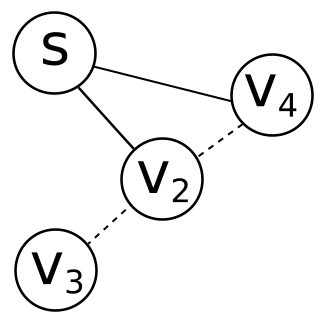 Figure 1: Distinguishing the static friendship network from the dynamic potential propagation path.
The Harsh Reality of the Results
The experiment was a cold shower for those hoping for an "automatic structural filter." Whether using Random Forests or SVMs, the performance was mediocre.
- The Problem of Imbalance: Most cascades are small and look alike, regardless of content truth.
- The ROC Dilemma: As shown in the ROC curves, trying to catch more conspiracy theories (True Positive Rate) inevitably led to a massive spike in falsely flagging scientific news (False Positive Rate).
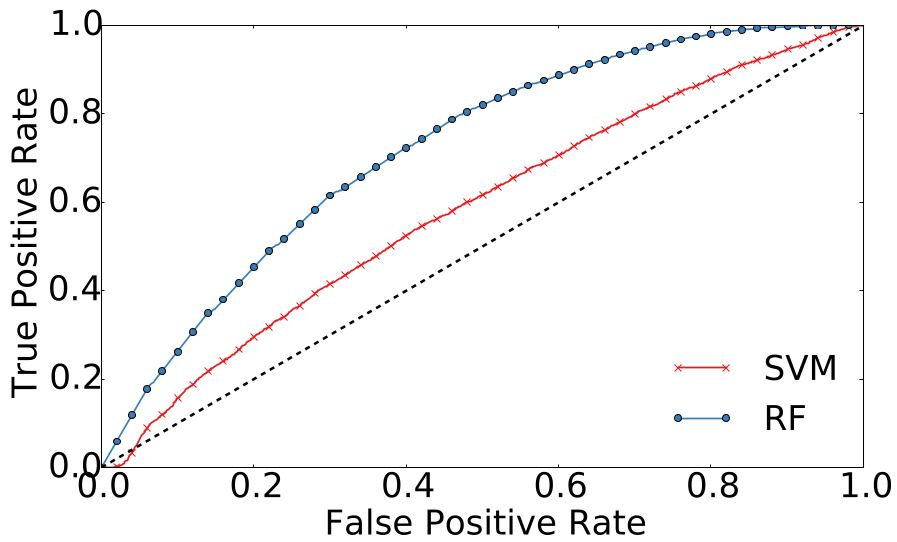 Figure 2: The ROC curves sit uncomfortably close to the diagonal baseline, indicating poor discriminative power.
| Classifier | Precision | Recall | Accuracy | F1 score |
|---|---|---|---|---|
| Random Forest | 0.669 | 0.734 | 0.685 | 0.700 |
| SVM | 0.583 | 0.549 | 0.578 | 0.565 |
Deep Insight: The Echo Chamber Effect
Why did it fail? The authors point to the Echo Chamber hypothesis. On Facebook, users are highly polarized. People who follow science pages and people who follow conspiracy pages actually behave in very similar ways within their respective tribes.
If both groups "like," "share," and "comment" on content they agree with at the same rate and through the same social structures, the "shape" of the cascade becomes a reflection of human psychology and platform algorithms rather than the veracity of the information.
Conclusion & Future Outlook
This work serves as a vital warning: we cannot treat misinformation as a "topological anomaly." It doesn't spread like a virus in a healthy population; it spreads like a fire in a dry forest—and on social media, both science and conspiracy are burning in their own separate, dry forests.
To move forward, the industry must look at Polarization Metrics. Instead of asking "How is this spreading?", we should ask "To whom is this spreading?" and "Are those users known for objective cross-referencing or isolated confirmation bias?" Until then, automatic detection remains one of the greatest open challenges of the digital age.