
Deciphering the Drivers: Effector Detection in Social Networks via Influence Distance and MLE
This article has been accepted for inclusion in a future issue of this journal. Content is final as presented, with the exception of pagination.
This paper addresses the "Effector Detection" task in social networks under the Independent Cascade (IC) model, aiming to identify a subset of active users that best explains a given activation state. The authors propose two main frameworks: MBED/FBED based on influence distance with a 3-approximation guarantee, and MLBED based on Maximum Likelihood Estimation (MLE), achieving state-of-the-art performance on real-world networks like Facebook.
TL;DR
In the complex web of social media, how do we identify the specific users responsible for a certain pattern of information spread? This paper moves beyond simple "influence maximization" to Effector Detection. It introduces two robust frameworks—one based on a novel Influence Distance metric (with a 3-approximation guarantee) and another using Maximum Likelihood Estimation (MLE)—to pinpoint the nodes that best explain observed network activations.
Background: Why Effector Detection Matters
Most research in social networks focuses on Influence Maximization: "If I pick 10 people, how can I reach the most users?" Effector detection asks the inverse but more difficult question: "Given that these 100 people are active, which set of 'effectors' most likely caused this specific pattern?"
This is crucial for:
- Rumor Tracing: Identifying the culprits behind misinformation.
- Marketing Attribution: Understanding which early adopters actually triggered a specific viral trend.
- Epidemiology: Finding the source of a virus based on the current list of infected patients.
The problem is notoriously hard (NP-hard) because it requires balancing two opposing forces: the effectors must have high probability to activate the "Active" set and a low probability to activate the "Inactive" set.
Framework 1: The Intuition of Influence Distance
The authors define an Influence Distance derived from the propagation probabilities of the Independent Cascade (IC) model. The shorter the distance, the higher the chance of activation.
The Optimization Goal
The goal is to find a set that minimizes a weighted cost function:
- Proximal to Active Nodes: Short distance to nodes that actually turned on.
- Distal to Inactive Nodes: Long distance to nodes that remained off.
MBED: Bipartite Matching to the Rescue
For the case of (considering the single most probable path), the authors prove that this problem satisfies the Triangle Inequality. This allows them to transform the problem into a Bipartite Minimum Perfect Matching problem, yielding a 3-approximation algorithm (MBED) that runs in polynomial time.
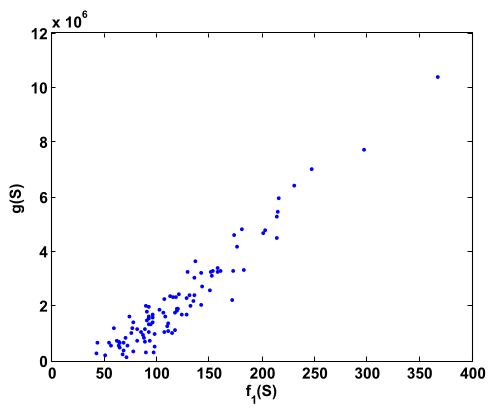 Figure: The strong correlation between the proposed Influence-Distance objective and actual effector quality confirms the physical intuition.
Framework 2: Maximum Likelihood Estimation (MLE)
If we assume the world is probabilistic, the best effectors are those that maximize .
The DAG Shortcut
Generally, calculating this probability is #P-hard (extremely difficult). However, the authors discover a "sweet spot": Directed Acyclic Graphs (DAGs). On a DAG, the influence of parents on a child node is independent, allowing the likelihood to be decomposed into a simple product of probabilities.
General Graphs & Entropy
To handle real-world social networks (which have cycles), the authors propose MLBED:
- Extract a DAG: Use the "Maximum Entropy Principle" to prune edges while keeping as much "information volume" as possible.
- Solve the DAG: Apply the polynomial-time MLE solution to the pruned graph.
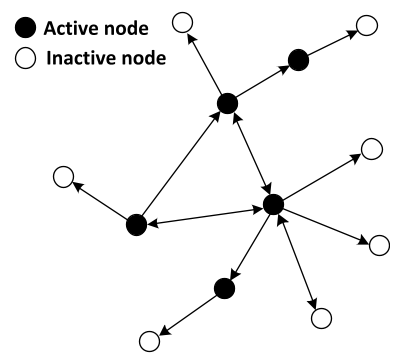 Figure: The conceptual difference between identifying sources vs. effectors (a) and (b).
Experimental Battleground: Facebook Network
The authors tested their algorithms on a Facebook dataset (4,039 nodes, 88,234 edges) against two primary settings: Uniform (fixed activation probability) and Weighted Cascade (probability inversely proportional to degree).
Key Findings:
- Superiority: MBED and FBED (the distance-based methods) consistently provide the lowest error rates.
- Failure of Heuristics: Top-degree nodes (OutDegree) are often poor effectors because they are too influential—they tend to activate inactive nodes that shouldn't be active in the target state.
- Robustness: Even when activation states are generated randomly (not through a structured diffusion), the distance-based methods remain effective.
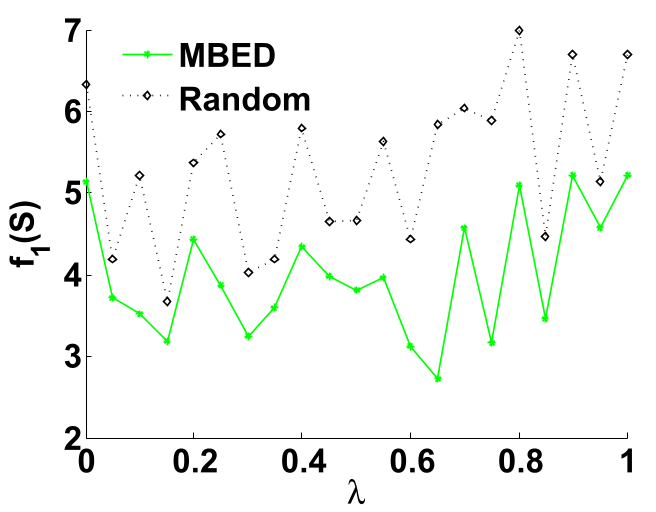 Figure: Comparison of MBED, FBED, and MLBED against the OutDegree baseline under the Uniform setting.
Critical Insight & Conclusion
A fascinating takeaway is the concept of the "Elusive Activation State." The authors acknowledge that some patterns are simply impossible to explain via network topology alone—for example, when every active node is surrounded by inactive ones. In these cases, no algorithm can find a "good" effector.
This paper provides a rigorous mathematical foundation for "retrospective analysis" in social networks. By successfully combining approximation algorithms with MLE, it provides a toolkit for anyone needing to solve the "Who started this?" mystery in a digital world.
Future Directions
The authors suggest extending this to the Linear Threshold (LT) model, where node activation depends on a cumulative threshold of neighbors rather than individual "tosses of a coin."