
WMAIS: Leveraging Evolutionary Computing to Navigate the Political Blogosphere
An Artificial Immune System for recommending relevant information through political weblog
The paper introduces WMAIS (Web Mining using Artificial Immune System), a recommendation system specifically designed to extract relevant political information from Malaysian weblogs. By utilizing a Clonal Selection Algorithm, the system outperforms traditional semantic-based methods in the specific context of multi-lingual and slang-heavy blog content.
TL;DR
Researchers from Universiti Teknologi Malaysia have developed WMAIS, a web mining system that treats information retrieval like a biological defense mechanism. By using an Artificial Immune System (AIS), the tool effectively filters and recommends highly relevant Malaysian political blog content, significantly outperforming systems that rely on standard semantic dictionaries.
The Problem: The Chaos of Web 2.0 Politics
In the late 2000s, political blogs became a primary alternative media source in Malaysia. However, mining these blogs is a technical nightmare. Unlike formal documents, blog posts are:
- Dynamically Changing: New content and links appear constantly.
- Noisy: Full of advertisements, sidebars, and irrelevant metadata.
- Linguistically Unique: Authors frequently mix Malay and English, using localized shorthand (e.g., "PR" for Pakatan Rakyat) that standard tools like WordNet cannot decipher.
Existing SOTA methods like AISIID tried to use semantic expansion, but in the localized context of Malaysian politics, these expansions often led to "Concept Drift," where the system recommended semantically related but contextually irrelevant information.
Methodology: The Biological Blueprint
WMAIS mimics the Adaptive Immune System. In this analogy, "Antigens" are the web pages, and "Antibody/Immune Cells" are the search agents.
The Clonal Selection Process
- Initial Population: The user provides a Seed URL and Keywords. WMAIS creates a population of immune cells programmed with these keywords.
- Affinity Calculation: The system calculates the "Affinity" (relevancy) of a new page using a Term Frequency scheme.
- Cloning & Mutation:
- If a cell finds a high-affinity page (very relevant), it Clones itself rapidly to explore nearby links.
- If the affinity is low, the cell undergoes Mutation to "search" for better matches or is eventually deleted.
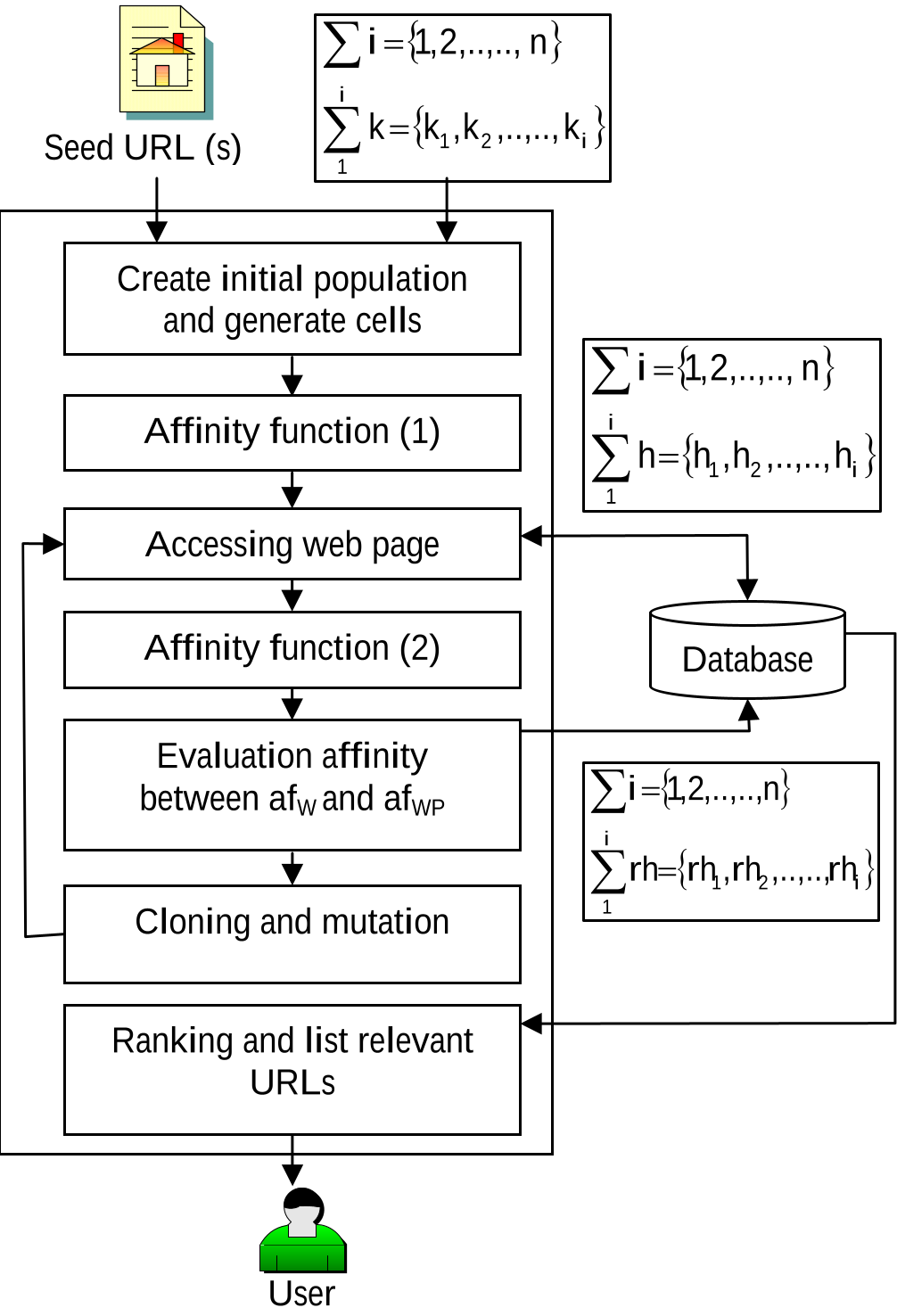
The beauty of this approach lies in the Affinity Function. By using the simple presence of keywords (Term Frequency) rather than complex semantic mapping, the system remains robust against the linguistic "noise" of political slang.
Experimental Results: Heuristics vs. Semantics
The authors conducted a head-to-head battle between WMAIS (Keyword Frequency) and AISIID (Semantic Transformation).
Key Performance Indicators (KPIs):
- User Satisfaction: 10 expert bloggers ranked results on a 1-5 scale.
- Mean Score: WMAIS scored 3.51, while AISIID trailed at 1.99.
- Consistency: WMAIS showed a lower Standard Deviation (0.27 vs 0.48), meaning it provided consistently relevant results across different users.

Critical Insight: Why Simplicity Won
The failure of AISIID in this study highlights a critical lesson in NLP: Context is King. While semantic engines like WordNet are powerful for standard English, they act as "noise generators" in niche domains like regional politics. WMAIS's success proves that in highly specialized or slang-heavy environments, evolutionary algorithms powered by rigid frequency counts can adapt more effectively to the "local language" of the data source.
Conclusion & Future Horizons
WMAIS demonstrates that the Artificial Immune System is more than just a biological curiosity; it is a viable framework for adaptive web mining.
Limitations: The system relies heavily on the quality of the initial seed URL provided by the user. If the seed is biased or poor, the "evolution" of the search cells may lead into an echo chamber.
Future Work: Integrating modern LLM-based embeddings (like BERT or GPT) into the AIS affinity function could combine the "evolutionary" efficiency of WMAIS with the deep understanding of modern AI, potentially creating the ultimate "Information Filter" for the misinformation age.
Paper: An Artificial Immune System for recommending relevant information through political weblog (iiWAS 2009)