
SET: Solving the Security-Lifetime Paradox in Mobile Edge Computing Traceback
Artificial intelligence aware and security-enhanced traceback technique in mobile edge computing
The paper proposes the Security-Enhanced Traceback (SET) scheme for Mobile Edge Computing (MEC) sensor networks. It combines unequal probability packet marking with a novel data migration strategy to improve network security (traceback speed) and longevity simultaneously, achieving SOTA performance in balancing resource constraints.
TL;DR
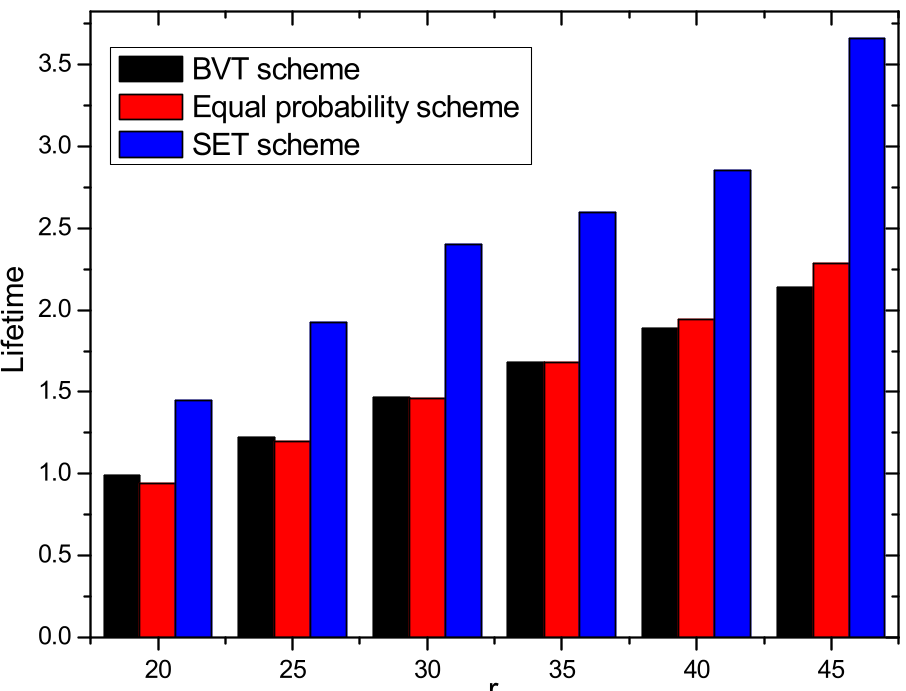
Researchers have developed the Security-Enhanced Traceback (SET) scheme, a novel framework for MEC sensor networks that breaks the trade-off between security and network life. By intelligently migrating security logs to energy-rich peripheral nodes and using unequal marking probabilities, SET achieves faster malicious node detection while extending network life by up to 20%.
Context: Why Traceback is Hard in MEC
Mobile Edge Computing (MEC) and AI integration have revolutionized smart cities and industrial IoT. However, the decentralized nature of these networks makes them vulnerable to spoofing and adversarial attacks. Traceback—the process of identifying the source of malicious packets—is a critical defense.
The technical bottleneck is the "Hotspot Effect." Nodes near the central "Sink" are burdened with forwarding all network traffic. Traditional traceback adds "marks" to packets or "logs" them locally. This creates a lethal cycle:
- Packet Marking: Increasing packet size, which kills the battery of hotspot nodes.
- Logging: Filling up the limited storage of hotspot nodes, causing data loss or node failure.
The Insight: Leveraging Network "Richness"
The authors observe a physical intuition: while nodes near the sink are "resource-poor" (overworked), nodes at the network edge are "resource-rich" (high residual energy and idle storage). The SET scheme exploits this spatial imbalance through three distinct zones:
- Rich Area (Remote): High marking probability () to catch attack details early.
- Buffer Area (Transition): Moderate marking; acts as a "pressure release" valve.
- Hotspot Area (Near Sink): Lowest marking probability to save energy for vital transmission.
Architecture: Marking and Migration
The core of SET is its Logging and Migrating logic. When a node's storage reaches a threshold, it doesn't just stop logging; it migrates the marking tuples back to the "Rich Area."
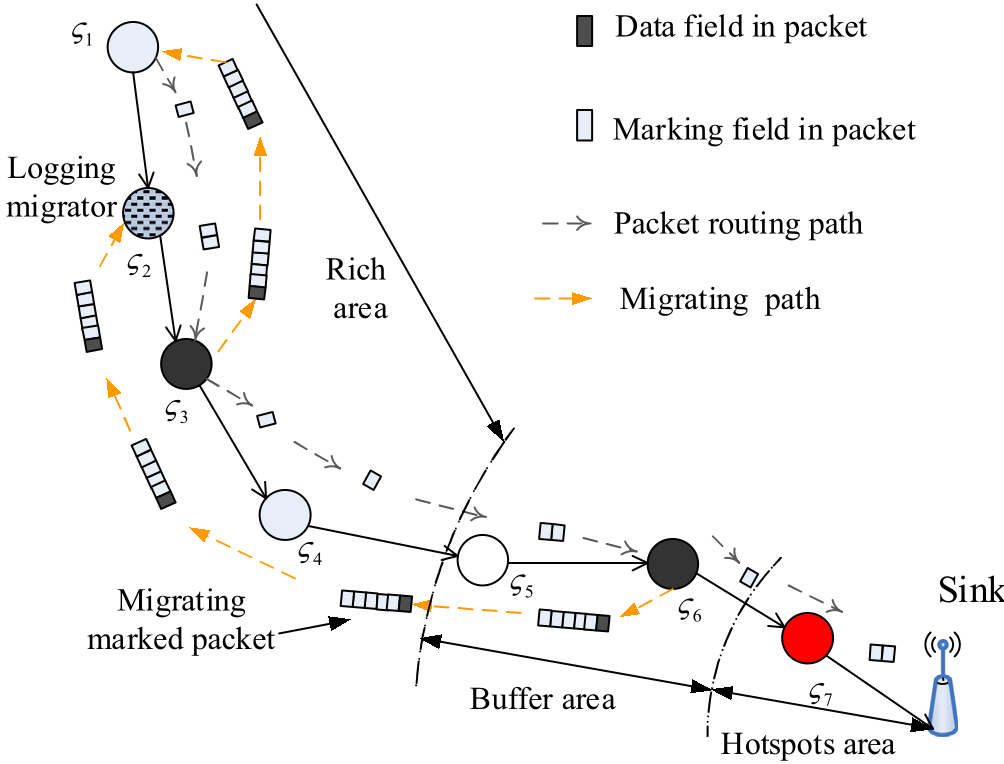 In the figure above, note how the marking tuple is migrated from the buffer zone back to in the rich zone.
Methodology: The Math of Unequal Probability
The marking probability is not a static constant. It follows a piecewise linear function based on the node's distance from the sink:
This ensures that the "Rich Area" nodes do the heavy lifting of security, while the "Hotspot Area" nodes (where is small) are protected.
Experimental Performance
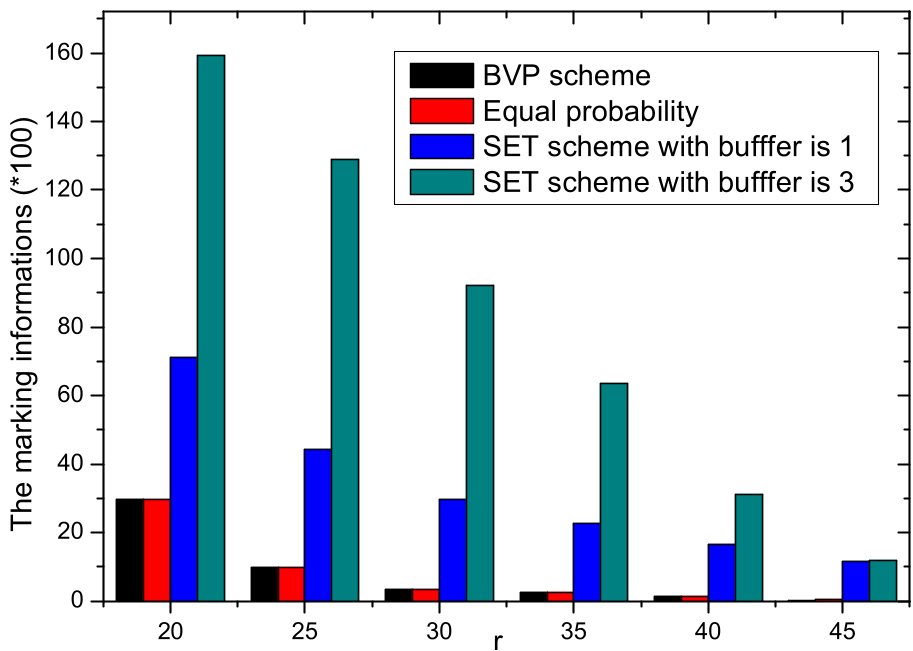
The SET scheme was tested using Omnet++ against the Baseline Version Traceback (BVT) and Equal Probability schemes.
1. Security (Traceback Speed)
SET increased the total amount of available marking information by 210% to 520%. More marks mean the Sink can reconstruct an attack path much faster.
2. Storage Utilization
The storage space utilization in the SET scheme is 2.3 times greater than traditional methods because it effectively moves data from congested centers to empty peripheries.
Critical Analysis: A Step Toward AI-Aware Security
The SET scheme is a masterclass in Load Balancing. It treats security not as a fixed cost, but as a dynamic variable that can be distributed across the manifold of the network's energy state.
Limitations:
- Traffic Sensitivity: The current model assumes relatively static traffic; bursty AI workloads might require even more dynamic probability adjustments.
- Migration Overhead: While migrating logs back to remote nodes saves storage, the act of migration itself consumes energy. The paper claims this is offset by using "surplus" energy, but the threshold for "surplus" must be carefully tuned.
Conclusion
The SET scheme demonstrates that we can achieve high-fidelity security in energy-constrained MEC environments. By moving security data "upstream" away from the sink, SET ensures that the network stays alive longer while being harder to attack—a vital advancement for industrial IoT and smart city ecosystems.