
AI in Healthcare: From Big Data to Precision Medicine
The Application of Artificial Intelligence Technology in Healthcare: A Systematic Review
This paper presents a systematic review of Artificial Intelligence (AI) applications in healthcare, focusing on how machine learning (ML) and natural language processing (NLP) handle big health data. It highlights the transformation of diagnosis and treatment across cardiology, oncology, and neurology, specifically identifying Support Vector Machines (SVM) as a cornerstone algorithm for medical imaging and stroke management.
TL;DR
Artificial Intelligence is no longer just a buzzword in medical labs; it is becoming the backbone of clinical decision support. This systematic review explores how AI—powered by Machine Learning (ML) and Natural Language Processing (NLP)—is tackling the "Big Data" explosion in healthcare. By leveraging algorithms like SVM and Deep Learning, AI is achieving diagnostic accuracies (up to 95%) that often exceed human experts, particularly in oncology and stroke management.
Background Positioning
In the coordinate system of medical evolution, this work acts as a comprehensive mapping of the transition from human-centric to AI-augmented medicine. It positions AI not as a replacement for physicians but as a "high-performance lens" capable of seeing patterns in unstructured data that the human eye might miss.
Problem & Motivation: The Data Deluge
The healthcare industry is drowning in data. Electronic Health Records (EHRs), high-resolution MRI scans, and genomic sequences generate a volume of information that makes manual interpretation prone to error. The motivation for AI implementation is two-fold:
- To Err is Human: Reducing therapeutic and diagnostic mistakes.
- Unlocking Hidden Patterns: Identifying correlations across global datasets (e.g., using treatment outcomes from one country to save a patient in another) via cloud platforms.
Methodology: The Analytical Twin Towers
The paper divides AI's technical architecture into two core pillars:
1. Structured Data Analysis (Machine Learning)
Classic ML algorithms, specifically Support Vector Machines (SVM), are the workhorses of medical AI. They classify patient traits into risk categories by defining an optimal hyperplane.
- Equation Insight: The decision criterion allows the system to weight specific patient attributes (age, ethnicity, prior history) to predict outcomes with mathematical precision.
2. Unstructured Data Analysis (NLP)
Since a massive portion of medical data exists as physician notes, NLP serves as the bridge, converting human narrative into machine-readable "corpora" for sentiment and risk analysis.
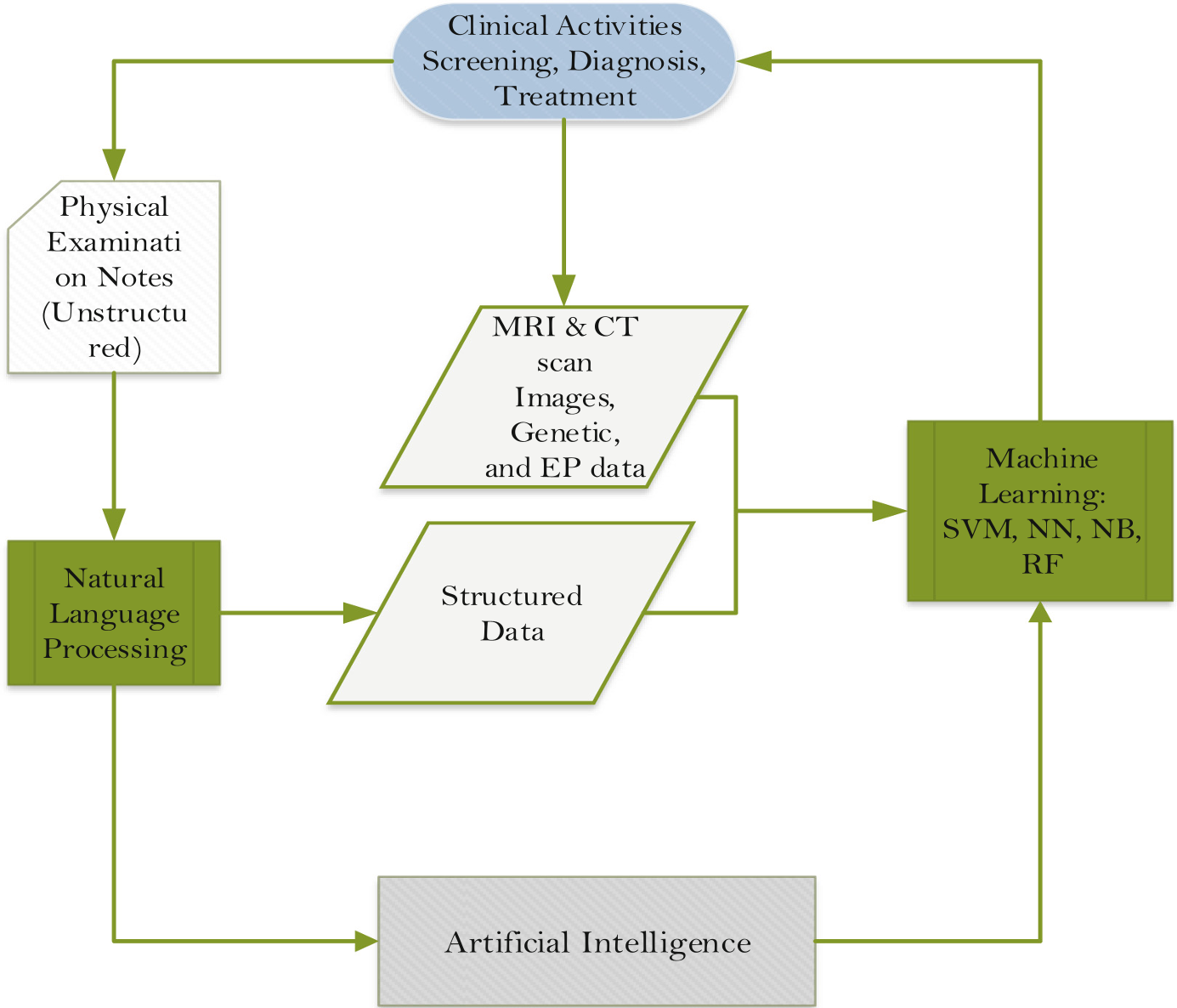 The flow from clinical activity to data enrichment (NLP) and finally to model-based decision making.
Clinical Focus: Stroke and Cancer
The effectiveness of these methods is best seen in Stroke Management:
- Early Detection: Using CNNs on CT and MRI scans to find thrombi that are indistinguishable to the human eye.
- Outcome Prediction: AI identifies "endophenotype responses," achieving a 90.5% classification accuracy for pathological gaits using wearable sensor data.
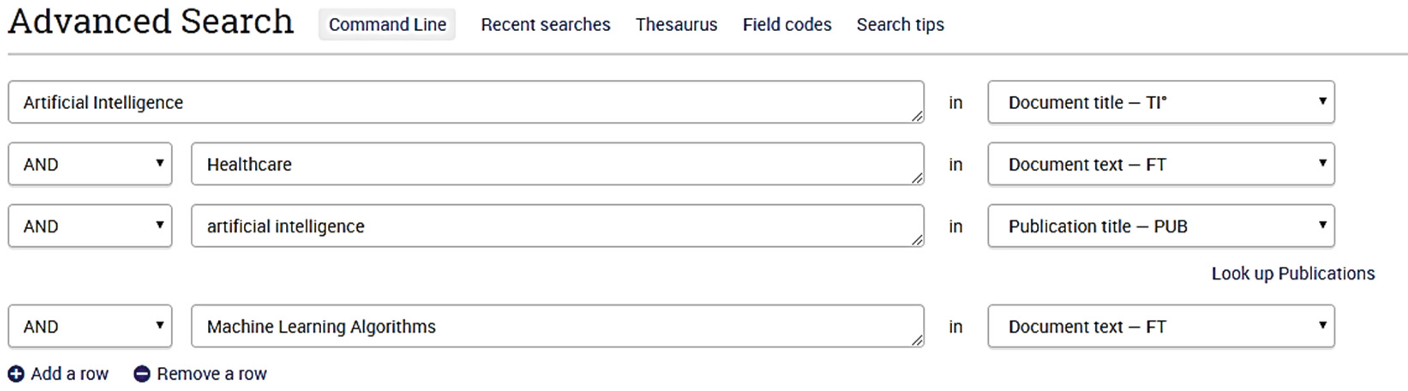 Distribution of AI research across specific medical domains, highlighting the dominance of imaging-heavy fields.
Deep Insight & Conclusion
Takeaway
The integration of AI into healthcare is an inevitable consequence of Industry 4.0. By shifting the doctor's role from data processor to decision-maker, AI optimizes hospital resources and saves lives through early intervention.
Limitations & Future Work
Despite the SOTA (State Of The Art) results, the authors identify critical bottlenecks:
- Regulatory Vacuums: The lack of global standards for AI medical devices.
- Data Silos: The tension between patient privacy (CIA triad) and the need for pooled data to train more robust models.
- Trust Gap: The necessity for operators to fully understand the "Black Box" of AI before full-scale automation.
The path forward lies in Federated Learning and Interpretable AI, ensuring that while the machine finds the patterns, the human remains the final arbiter of care.