
AI as a Gear: Preserving Educational Effectiveness in the Age of Pandemics
Artificial Intelligence as a Gear to Preserve Effectiveness of Learning and Educational Systems in Pandemic Time
This paper explores the pivotal role of Artificial Intelligence (AI) in maintaining educational continuity during the COVID-19 pandemic. It categorizes AI's contributions into descriptive, predictive, and perspective analytics, showcasing how machine learning and deep learning models (e.g., ANN, LSTM, CNN) were used to diagnose system status, predict student outcomes, and prescribe future adaptive learning strategies.
TL;DR
The COVID-19 pandemic triggered the largest "digital experiment" in educational history. This paper argues that Artificial Intelligence (AI) served as the essential gear that kept the mission of learning operational. By categorizing AI’s role into Descriptive, Predictive, and Perspective analytics, researchers demonstrate how technologies like Neural Networks and NLP helped schools move from panic-induced shutdowns to data-driven resilience.
Problem & Motivation: The Digital Shock
When schools closed for 1.8 billion learners, "distance learning" was less of a choice and more of a survival tactic. However, the transition was far from smooth. The authors identify three primary "frictions":
- The Information Gap: Teachers struggled to assess affective behaviors through a screen.
- Resource Inequality: Low-budget institutions and disadvantaged students faced a "digital divide," leading to significant learning losses.
- Mental and Technical Stress: Unstable networks and quarantine-related stress hindered student focus and self-discipline.
The motivation behind this study is to move beyond "emergency remote teaching" and understand how AI can proactively diagnose system health and predict future risks.
Methodology: The Three Pillars of Educational AI
The paper structures the integration of AI into a systematic three-pillar framework:
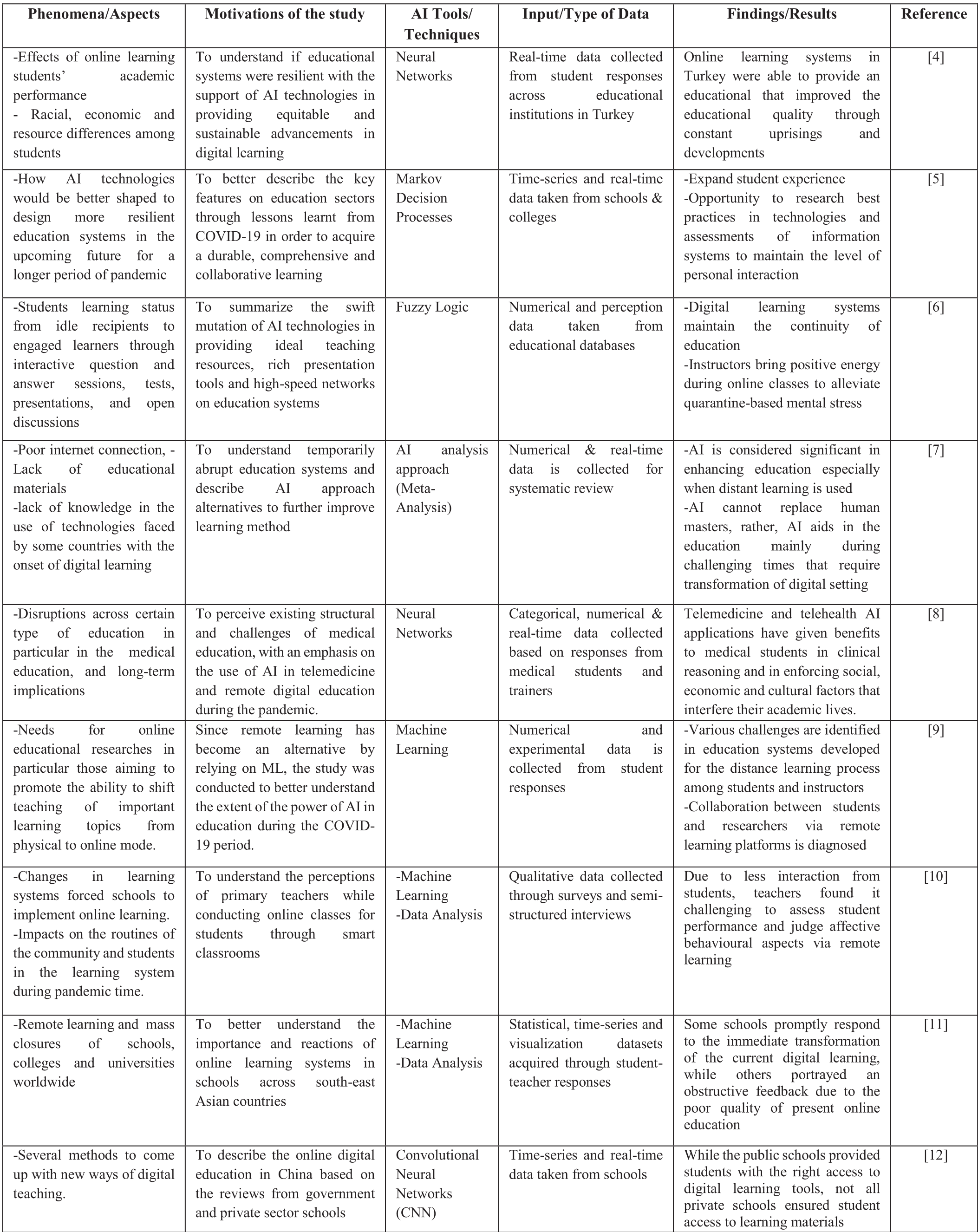
1. Descriptive & Diagnostic Analytics
This stage focuses on "What is happening?" Researchers used Fuzzy Logic and Neural Networks to analyze the success of platform transitions.
- Insight: AI tools confirmed that while digital platforms maintained continuity, students struggled with "self-control."
- Architecture: Models focused on processing real-time student response data and perception surveys.
2. Predictive Analytics
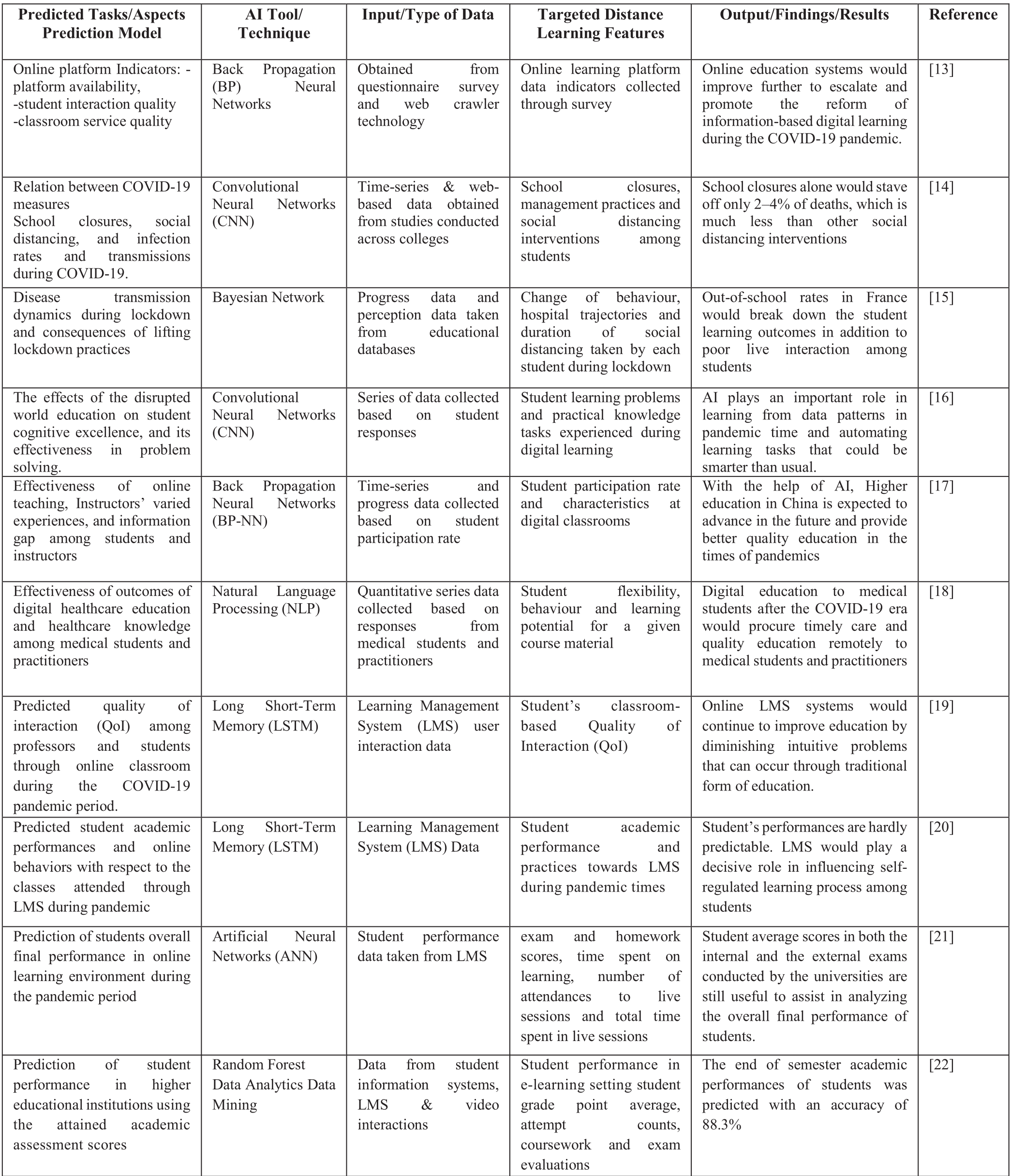
This stage answers "What will happen?" using time-series data.
- Performance Forecasting: Using LSTM and ANN, researchers predicted student final grades and "at-risk" status based on their interaction with Learning Management Systems (LMS).
- Epidemiological Modeling: CNNs were used to simulate the impact of school closures on viral transmission, providing decision-makers with data on whether to keep schools open.
3. Perspective (Prescriptive) Analysis
The most forward-looking pillar asks "How can we make it better?"
- Adaptive Learning: Implementing NLP-based Chatbots to act as virtual assistants.
- Hybrid Models: The "pre-class-in-class-after-class" cycle was promoted to ensure that online resources augment rather than just replace traditional classrooms.
Experiments & Results: Quantifying the Impact
The paper synthesizes various studies to show that AI isn't just a theoretical concept—it delivered measurable results:
- Accuracy: Random Forest classifiers predicted student performance with an 88.3% accuracy rate.
- Simulation: Data showed that school closures alone were less effective (preventing only 2-4% of deaths) than AI-optimized social distancing protocols.
- Engagement: Longitudinal studies indicated that AI-assisted medical education (Telemedicine) significantly reduced mental health risks for students by maintaining clinical reasoning practice.
Deep Insight: Beyond the Pandemic
The core takeaway is that the "Pandemic Era" was a catalyst for a Digital Transformation that was already overdue.
Critical Analysis
- The Resilience Paradox: While AI provides the tools for resilience, it can also exacerbate the gap for those without hardware access. The paper correctly notes that ML models predict the "disadvantaged" will pay the highest price.
- The Human-AI Balance: A recurring theme is that AI cannot replace the "human master." Instead, it acts as a competitor/assistant to traditional pedagogy.
Conclusion
This paper serves as a roadmap for the future of EdTech. We are moving toward a world where the LMS (Learning Management System) is no longer just a file repository, but an active, intelligent environment that monitors student sentiment, predicts failures, and adapts content in real-time.
Future Outlook: The next step in this research involves "Bibliometric studies" to track the convergence of AI with other sectors (like health and economy) to create a holistic response system for future global crises.