
Mapping the Intellectual Silk Road: ASEAN's Economic Research and the Power of International Ties
International research collaborations of ASEAN Nations in economics, 1979–2010
This study provides a comprehensive bibliometric and social network analysis (SNA) of Economics research in ASEAN nations from 1979 to 2010. It identifies Singapore as the regional leader in research efficiency and reveals a significant shift from local to international collaboration, which correlates strongly with higher citation impact.
TL;DR
A 31-year dive into ASEAN’s Economics research reveals a region in transition. While Singapore dominates the efficiency landscape, the real story lies in the "International Collaboration Bonus": papers co-authored with global partners receive double the citations. However, despite political rhetoric, ASEAN nations rarely research with each other, preferring Western partners like the USA.
The "Soft Science" Gap: Why Economics Matters
Most bibliometric analyses of the ASEAN region focus on high-spend Science and Technology (S&T) sectors. Yet, as a geo-political bloc defined by "Economic Cooperation," analyzing how ASEAN thinks about Economics is a vital proxy for regional integration. This study uncovers a paradox: as ASEAN grows more economically integrated, its research community remains fragmented, looking outward rather than inward.
Research Efficiency: Beyond Raw Paper Counts
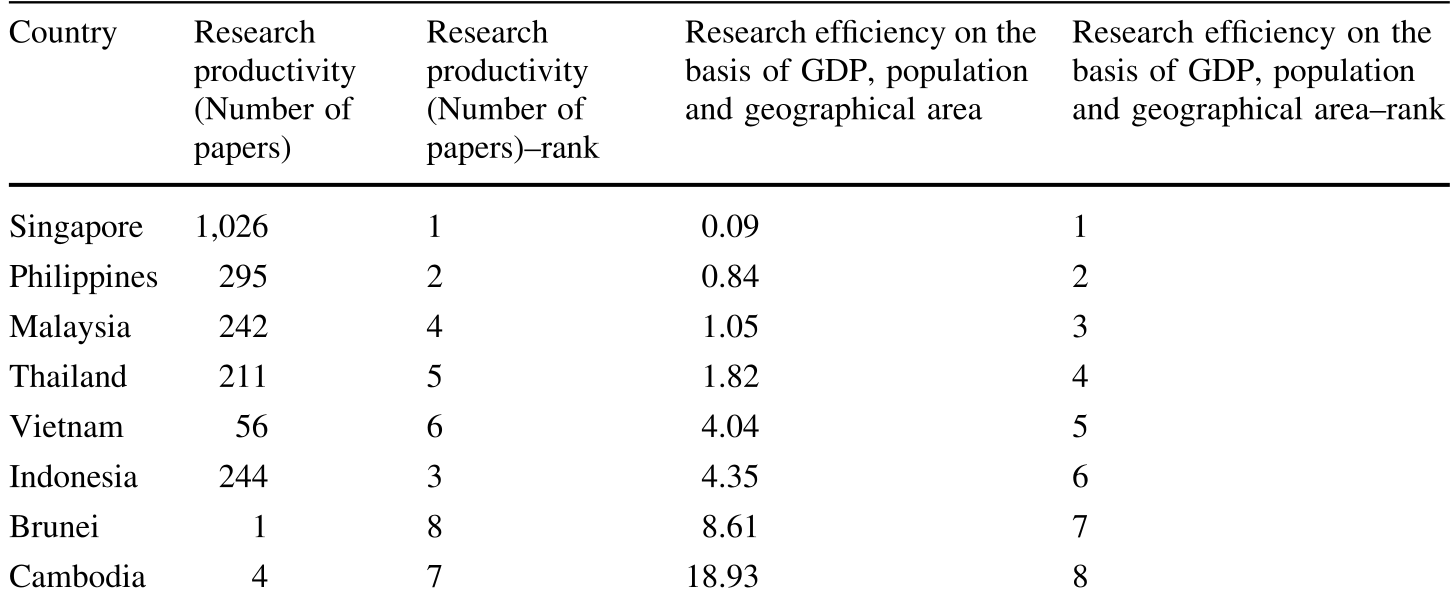
Traditional rankings often favor large nations. By introducing Research Efficiency—calculating papers relative to GDP, population, and geographical area—the authors level the playing field.
- Singapore is the undisputed "Tower" of the region, producing one paper for every 0.7 sq. km and every 5,000 people.
- Vietnam shows a fascinating trend where it performs better in efficiency than in raw productivity, suggesting a high-impact use of limited resources.
- Indonesia, conversely, struggles with efficiency despite a high total volume of papers, due to its massive population and land area.
The Collaboration Paradigm Shift
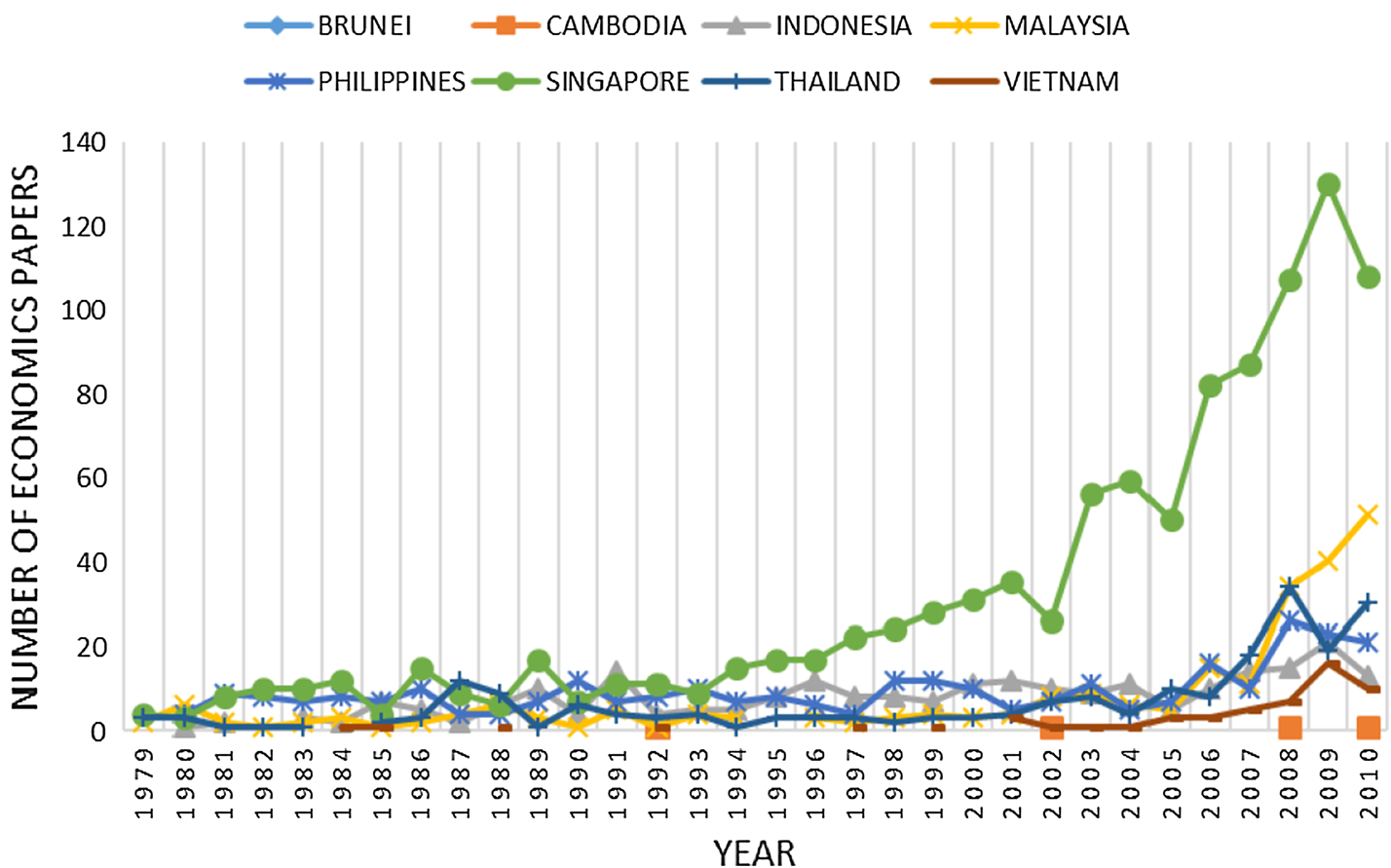
The data shows a clear evolution: Locally co-authored papers are declining while International Research Collaborations (IRC) are skyrocketing.
Why the shift? The "Bonus Effect." The study finds that internationally collaborated papers are cited twice as often as local ones. This serves as a powerful incentive for researchers to seek partners abroad. However, this doesn't apply equally across the board—The Philippines and Indonesia showed little difference in citation rates between local and international work, suggesting strong domestic research quality in specific niches.
Network Topology: Strength Over Connections
Using Social Network Analysis (SNA), the authors analyzed the "Small World" of economic research.
Key findings from the network analysis include:
- The Hub: The USA is the most favored partner for almost all ASEAN nations.
- Bridging Power: Interestingly, Malaysia emerged with the highest betweenness centrality, acting as a crucial bridge in the regional knowledge network.
- The Tie-Strength Insight: The study proves that Vertex Tie-Strength (repeat collaborations) correlates more strongly with research performance than simply having a high number of different partners. Deep, long-term institutional relationships matter more than "one-off" co-authorships.
Conclusion: The Intra-ASEAN Disconnect
The most striking takeaway is the 4% statistic: only 4% of ASEAN’s international collaborations happen within the ASEAN family. This "Core-Periphery" structure shows ASEAN nations at the periphery of a network centered around the US, Australia, and the UK.
For policymakers, the message is clear: To build a true "ASEAN Community," the region must move beyond economic treaties and foster academic mobility. Joint scientific funds and regional university networks (like AUN) are not just "nice-to-haves"—they are essential to building a self-sustaining regional knowledge economy.
Limitations & Future Work
The study relies on SSCI data, which primarily indexes English-language journals. This may under-represent the research output of nations like Vietnam or Indonesia where local-language publishing is prevalent. Future research should explore the "Micro" level—examining individual researcher motivations for choosing international partners over regional ones.