
Ambient Suite: Capturing the Invisible Pulse of Human Interaction in Real-Time
asi-realtime social network construction with heterogeneous sensors in ambient environment
The paper presents a prototype system for quasi-realtime social network construction using heterogeneous sensors (infrared cameras, accelerometers, and microphones) in an "Ambient Suite." By tracking head positions, directions, and utterance volumes, it successfully maps physical human interactions into dynamic social graphs.
TL;DR
Researchers from Osaka University have developed a system capable of mapping physical social interactions into dynamic graphs in near real-time. By combining infrared tracking with sensor-equipped cups (microphones and accelerometers), the "Ambient Suite" detects who is talking to whom, allowing for the immediate calculation of social network metrics that correlate strongly with how participants actually perceive their social engagement.
The Gap: From Static Snapshots to Living Networks
Historically, social network analysis (SNA) has been a "post-mortem" science. Sociologists used questionnaires to build static snapshots of small groups, or more recently, mined email logs to see how networks evolve over months. But what about the now?
The nuance of physical interaction—the way we turn our heads toward a speaker or the intensity of a group discussion—is lost in digital logs. The "Ambient Suite" attempts to solve this by turning a physical room into a social sensor, capturing the "quasi-realtime" dynamics of face-to-face communication.
Methodology: Fusing Heterogeneous Sensors
The system doesn't rely on a single data source. Instead, it uses a multi-modal approach to define a "social tie":
- Spatial Relation: Multiple infra-red cameras (OptiTrack) track head-mounted markers to determine position and orientation.
- Acoustic Evidence: Sensor-equipped cups (iPod Touches) record utterance volume.
- The Logic: A directed link is formed only when:
- Distance between and is meters.
- The relative head angle is (face-to-face).
- The volume of 's voice exceeds a specific decibel threshold.

Experiments and SOTA Comparison
The team conducted 17 separate 12-minute experiments with groups of six strangers. Unlike traditional methods that only provide a final graph, this system generated snapshots every few seconds.
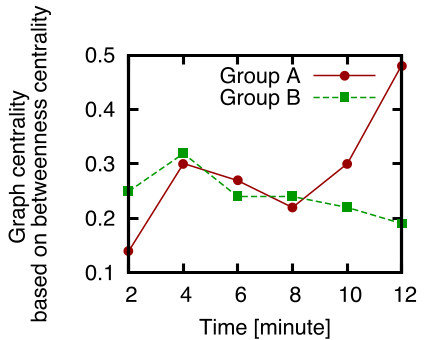
The most striking finding was the correlation between Betweenness Centrality and Subjective Activity. When the system's graph showed high centrality (indicating a few people were "bridging" or dominating conversations), the participants' self-reported "activity scores" reflected similar shifts.
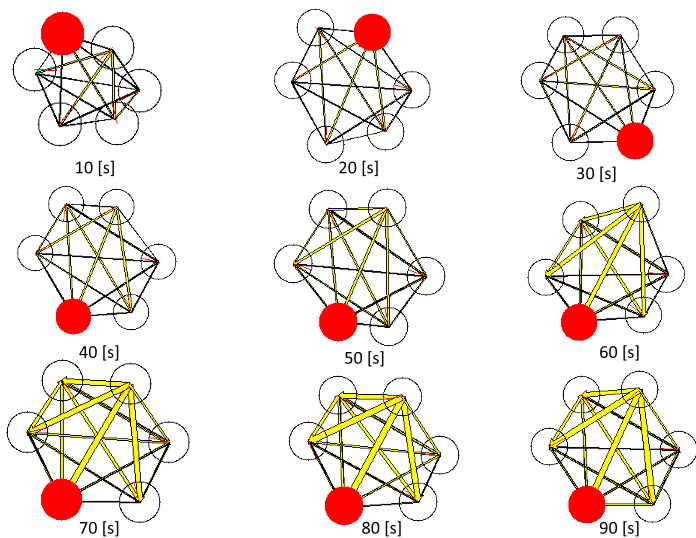
 Above: Snapshots showing the evolution of social ties. Edge thickness represents the accumulated duration of communication.
 (a) Evolution of graph centrality based on betweenness centrality, showing how communication balance shifts over time.
Critical Analysis & Future Outlook
Why it works: The "Ambient Suite" avoids the intrusive nature of heavy wearable gear by embedding sensors into objects like cups and using ceiling-mounted cameras. The 100ms sensing interval is fast enough to capture the "rhythm" of a conversation, which most Llama-based or LLM-driven social analysis tools currently lack.
Limitations: The current model uses a simple threshold-based trigger. It doesn't account for background noise or the content of the speech (NLP). Furthermore, head markers are still required, which limits "natural" behavior.
Conclusion: This research moves us toward "Responsive Environments." Imagine a meeting room that detects a lack of engagement (via low clustering coefficients) and automatically adjusts lighting or suggests a break to revitalize interaction. The Ambient Suite proves that the "invisible" social tie can be measured accurately and immediately through environmental sensing.