
Beyond Popularity: Assessing Node Credibility via Trust-Similarity Reinforcement
Assessing the Credibility of Nodes on Multiple-Relational Social Networks
The paper introduces a novel framework for assessing node credibility in multiple-relational social networks by integrating trust and similarity measures. It proposes an iterative reinforcement algorithm that decouples complex networks into Trust and Similarity layers to evaluate the expected reliability of node behaviors, achieving superior node ranking compared to traditional PageRank and HITS.
TL;DR
In an era of conflicting online reviews and "fake news," popularity metrics like PageRank are no longer sufficient to determine who to trust. This paper presents a framework that redefined Credibility as the expected value of interactions based on Behavioral Similarity. By allowing trust and similarity to reinforce each other in a multiple-relational network, the authors provide a more robust way to rank reliable nodes in platforms like Epinions and DBLP.
The Popularity Paradox: Why PageRank Fails at Truth
The fundamental flaw in many modern ranking systems is the assumption that Authority = Connectivity. In a hyperlinked environment, a spammer or a malicious actor can artificially inflate their "popularity" through aggressive link-building. However, Credibility is intrinsic; it depends not on how many people point to you, but on whether your behavior aligns with other trustworthy actors.
The authors argue that previous works, such as TrustRank, are too dependent on human-selected "seed sets" of good nodes, which is impractical for massive, dynamic networks.
Methodology: The Trust-Similarity (TS) Framework
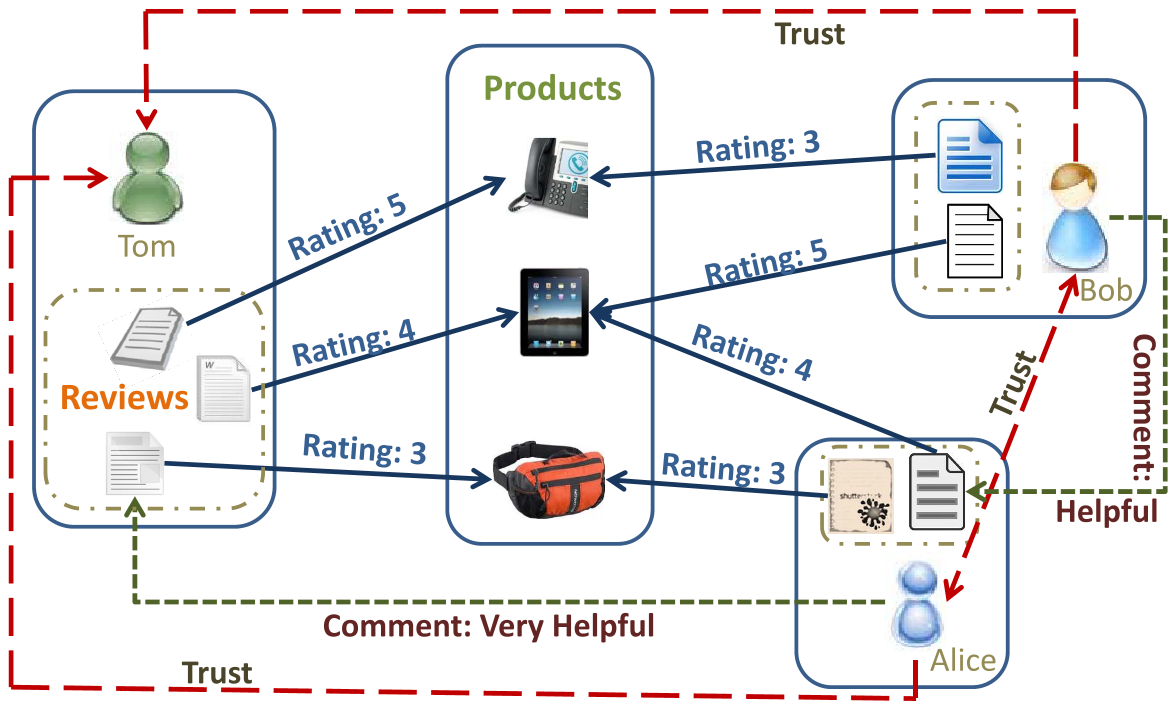
The core innovation lies in the reinforcement scheme. Instead of treating a social network as a simple graph, the authors view it as a Multiple-Relational Network.
1. Network Decomposition
The framework decouples the complex network into two layers:
- The Trust Network: Capturing explicit "trust/distrust" links.
- The Similarity Network: Assessing how similarly nodes behave (e.g., giving similar ratings to the same products).
2. Mutual Reinforcement
The credibility of a node is not just a sum of its neighbors' scores. It is calculated as: This formula ensures that an opinion from a "truthful" user (whose behaviors are consistent/similar to others) carries significantly more weight than a "random" or "unfair" user.
Experimental Validation: Epinions and DBLP
The authors tested their model on the Epinions (consumer reviews) and DBLP (scientific citations) datasets.
Key Finding 1: Higher Precision in Node Ranking
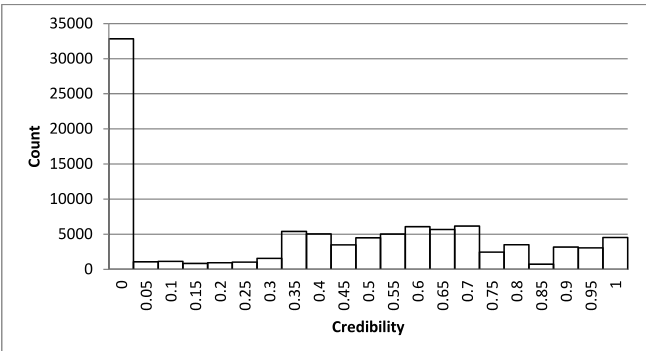
When identifying the top-10 most reliable users, the Credibility score aligned much more closely with real-world prestige (like the H-index for researchers) than PageRank or HITS did. PageRank tends to over-reward nodes in small, highly-connected clusters, whereas this framework identifies quality over quantity.
Key Finding 2: Alignment with Balance Theory
Social psychology suggests that "an enemy of my enemy is my friend." The research proved that by removing "unreliability" via similarity weighting, the network's structure converged more closely toward Balance Theory. The error rates in predicting social relationships dropped significantly.
Critical Insight & Conclusion
This paper shifts the paradigm from Structural Trust (where you are in the graph) to Behavioral Trust (how you act compared to others).
Takeaway: If you want to find the most credible source in a sea of conflicting information, don't look for the loudest voice (the most links); look for the voice that consistently agrees with other proven reliable sources across multiple types of interactions.
Note: While powerful, the authors acknowledge that highly sophisticated "plotting groups" (sybil attacks) that mimic similarity could still pose a threat—a key area for future research in decentralized systems.