
Beyond the Friend Request: Quantifying Trust via Information Disclosure
Assessing Trust by Disclosure in Online Social Networks
This paper introduces a computational model to assess trust in Online Social Networks (OSNs) by analyzing the disclosure of personal information items. The author proposes the "Trust Function" (), which weights trust based on the privacy value of shared profile items, moving beyond simple friendship counts to a more nuanced interpersonal metric.
TL;DR
Is a "friend" on Facebook truly a trusted confidant? Likely not. This paper argues that disclosure behavior—what we share and with whom—is a far more accurate and computational metric for trust than binary friendship links. By assigning "Privacy Values" to profile items (like your phone number vs. your favorite music), the author builds a mathematical framework to calculate trust scores without requiring user surveys or manual ratings.
Background: The Faded Meaning of "Friendship"
In modern Online Social Networks (OSNs), the term "friend" has become diluted. A user's friend list might include family members, professional colleagues, and accidental acquaintances never met in real life. These links fail to indicate relationship intensity. The author suggests that the true indicator of trust is vulnerability through disclosure. Trusting someone means being willing to share information that carries a high privacy cost.
Methodology: The Trust Function and Privacy Values
The paper shifts from qualitative analysis to a structural model. It defines trust as a function of a Disclosure Hypergraph, where edges represent the release of specific profile items to specific sets of nodes.
1. Privacy Value (PV)
Not all data is equal. The model calculates the Network Privacy Value (NetPV) of an item based on its scarcity:
- If everyone shares their "Hobbies" (), it shows little trust.
- If only a few share "Sexual Preferences" or "Legal Offenses" (), disclosing this item to a specific person signals high trust.
2. The Trust Function
The proposed trust score is the sum of the privacy values of all items a user has disclosed to a peer. If User A discloses their entire profile to User B, (complete trust).
 Figure 1: A weighted friendship graph where edge thickness represents the trust value derived from disclosure levels.
Ring Disclosure: Hierarchies of Secrecy
The author introduces "Rings" to categorize disclosure levels:
- R1 (Friends)
- R2 (Friends-of-Friends)
- R3 (OSN Members)
- R4 (Everyone)
This hierarchy provides structural information. Sharing to an outer ring automatically implies disclosure to all inner rings. By analyzing which ring an item "stops" at, the system can autonomously rank the sensitivity of data.
Case Study Results
In a study at Leuphana University, the author mapped disclosure for 13 different Profile Items (PIs).
| Item Type | Sensitivity (NetPV) | Disclosure Distribution |
|---|---|---|
| Legal Offenses (PI13) | High (0.126) | Mostly "Nobody" |
| Sexual Preferences (PI12) | High (0.107) | Mostly "Nobody" |
| Hobbies (PI08) | Low (0.047) | Mostly "Everyone" |
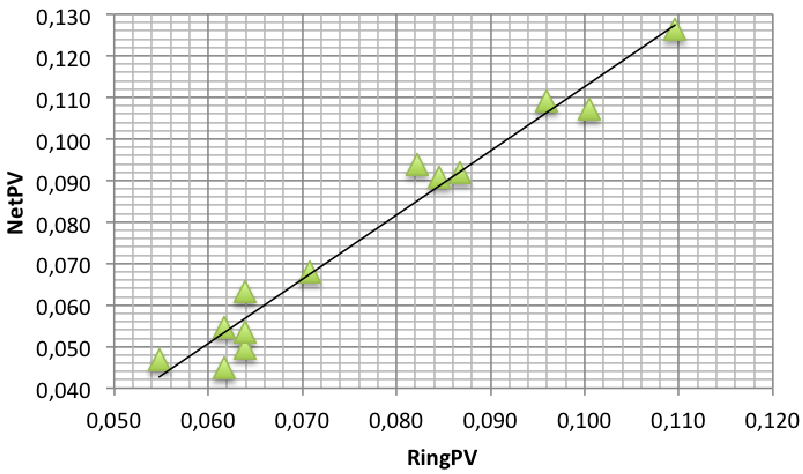 Figure 2: The strong correlation between calculated Network Privacy Values and the manual Ring-based assignments, validating the computational model.
Critical Insight: Why This Matters
The brilliance of this approach lies in its passivity. Traditional trust models require users to "rate" each other (like Uber or eBay). This model extracts trust from the actions users already take when they adjust their privacy settings.
However, there are limitations. The model assumes users are "rational" and "aware." If a user leaves their profile on "Public" by mistake (default settings), the model might incorrectly assume they trust the entire world. Future iterations would need to account for "Privacy Fatigue" or default-setting bias.
Conclusion
By treating privacy as a currency of trust, this work provides a scalable blueprint for social platforms to understand the true "social capital" existing between their users. It transforms the social graph from a flat map of "who knows whom" into a deep topography of intimacy and confidence.