
Crowdsourcing vs. Gamification: Quantifying the Human Cost of Object Segmentation
Assessment of crowdsourcing and gamification loss in user-assisted object segmentation
This paper investigates the performance of human computation in object segmentation by introducing "Click’n’Cut" (interactive tool) and "Ask’nSeek" (Game With A Purpose). It quantifies the performance gap between experts, paid crowd-workers, and casual gamers, establishing benchmarks for "crowdsourcing loss" and "gamification loss."
TL;DR
Is making work "fun" always better for data quality? This paper dives into the trade-offs of human-in-the-loop object segmentation. By comparing experts, paid micro-workers, and gamers, the authors identify two critical metrics: Crowdsourcing Loss (manageable through filtering) and Gamification Loss (significant due to shifted user incentives). While paid workers can rival experts (0.82 vs 0.89 Jaccard Index), gamers often miss the mark by focusing only on salient parts.
The Semantic Gap and the Human Solution
Despite the rise of automated vision, the "Semantic Gap"—the distance between raw pixels and high-level concepts—persists. Object segmentation is easy for humans but tedious. To scale this, researchers often look to the "crowd." But the crowd is a double-edged sword: they are either bored (leading to low quality) or distracted by the game mechanics of "serious games" (GWAPs).
Methodology: Two Tools, Three Profiles
The researchers deployed two distinct web-based platforms:
- Click’n’Cut: A professional-grade interactive tool where users provide foreground (green) and background (red) clicks. It uses pre-computed "object candidates" to suggest masks in real-time.
- Ask’nSeek: A cooperative game where a "Master" hides a region and a "Seeker" finds it using spatial clues (e.g., "on the left of the car").
The User Profiles
- Experts: CV researchers who understand boundary precision.
- Workers: Paid individuals from Microworkers.com (financial incentive).
- Players: Casual gamers (hedonic incentive).
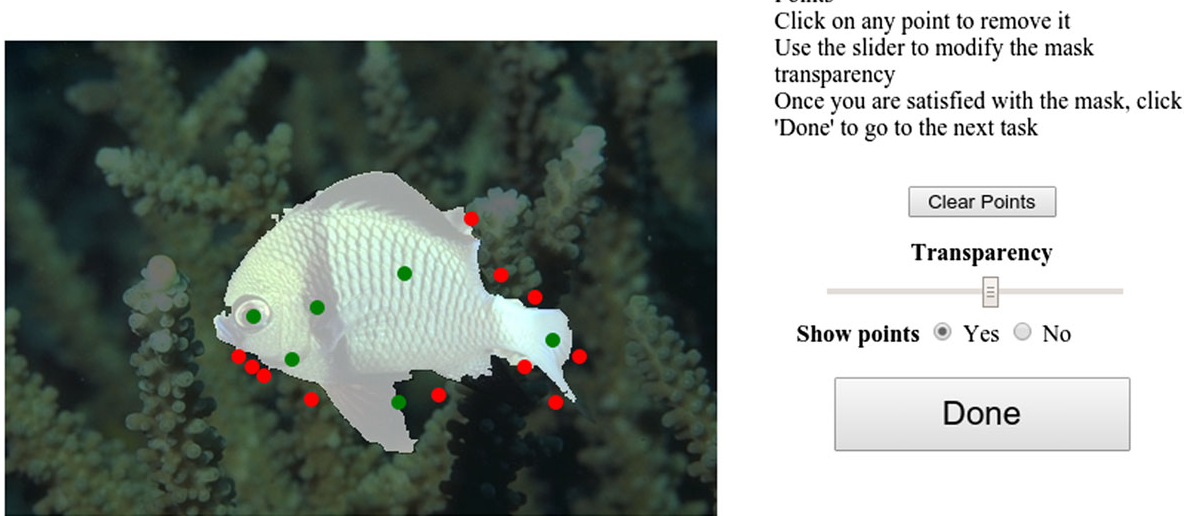 Figure: The Click’n’Cut interface showing real-time mask updates based on user clicks.
The "Crowdsourcing Loss": Bad Workers or Bad Instructions?
Initial results for paid workers were disastrous (Jaccard Index of 0.14). However, the authors discovered the issue wasn't a lack of skill, but a diversity of "misunderstandings." They categorized workers into archetypes:
- The Painter: Tries to color the whole object with clicks.
- The Mirror: Confused foreground with background.
- The Surrounder: Draws a polygon of clicks (like LabelMe) instead of pinpointing seeds.
- The Spammer: Clicks randomly to finish in seconds.
The Fix: By using a Gold Standard (5 images with known answers) and filtering out users with >20% error rates, the performance jumped to 0.82, nearly matching the researchers' 0.89.
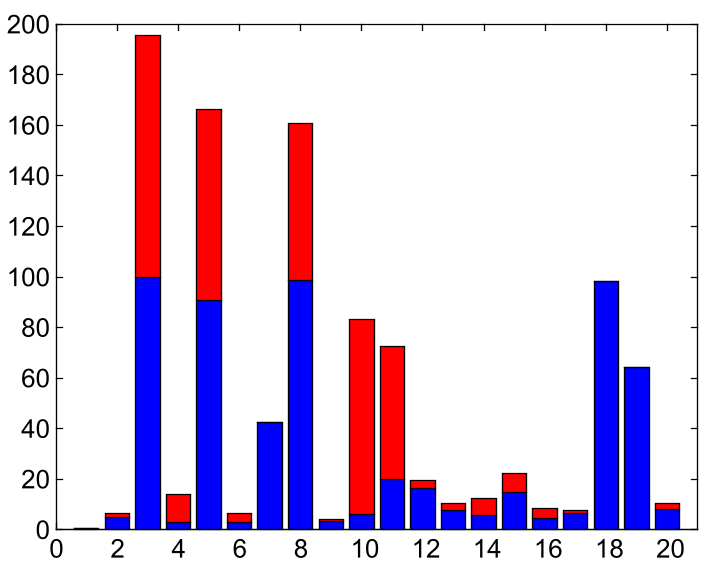 Figure: Comparison of interaction patterns: expert workers vs. spammers and "painters".
The "Gamification Loss": Why Fun Isn't Always Accurate
The most striking finding was that gamification halved the quality. Players achieved only a 0.44 Jaccard Index. Why? In a game, the incentive is to win quickly. Seekers click on the "most salient" parts (e.g., a duck's head) to find the hidden region. They have no incentive to click near the tricky boundaries where the segmentation algorithm actually needs help. This bias makes game-generated traces spatially redundant and boundary-poor.
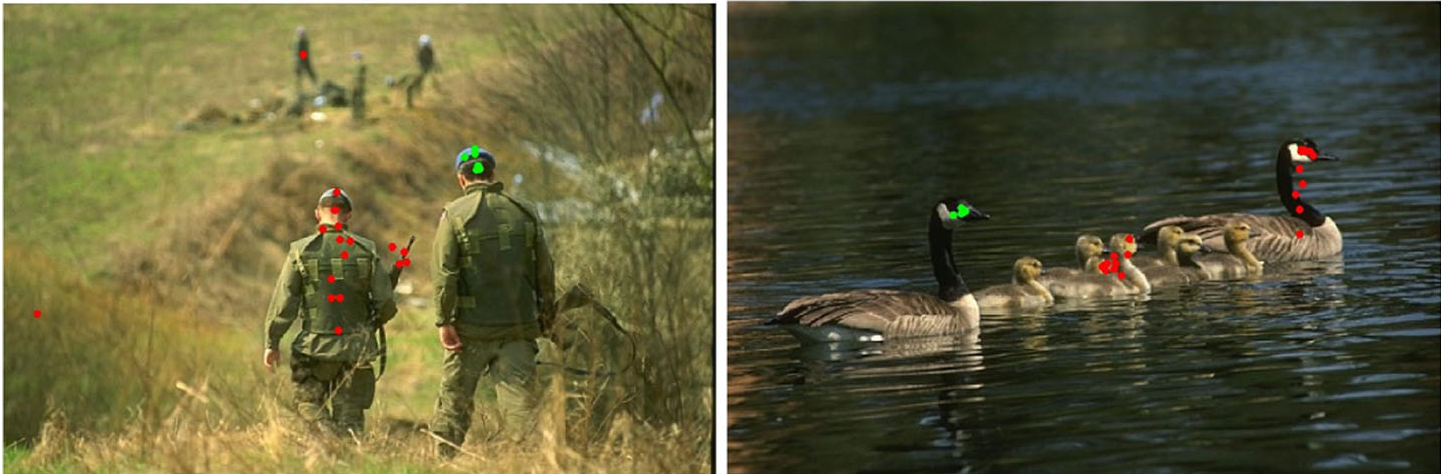 Figure: Ask’nSeek clicks (bottom) cluster on salient centers, while Click’n’Cut clicks (top) target the boundaries.
Critical Insight & Conclusion
This paper serves as a cautionary tale for "Human-in-the-loop" practitioners.
- Instruction over Incentive: Most "bad" crowd data comes from misunderstood tasks, not lack of effort. Better tutorials could outperform higher pay.
- The Gamification Trap: Unless the game mechanics require boundary precision to win, gamers will always optimize for "center-of-object" clicks, providing diminishing returns for segmentation.
Future Outlook: The authors suggest that instead of discarding "Painters" or "Surrounders," we should develop algorithms that adapt to their specific interaction styles, potentially extracting even more value from the diverse ways humans perceive visual tasks.