
Decoding the Gender Divide: Why Scientific Success is a Network Effect
Assessment of gender divide in scientific communities
This paper proposes a multi-dimensional methodological framework to assess the "gender divide" in scientific communities by modeling them as Semantic Social Networks (SSN). It utilizes complex network analysis and semantic analytics across four Computer Science (CS) and Information Systems (IS) communities (ITAIS, SEBD, ICIS, VLDB) to evaluate differences in context, attitude, and success.
TL;DR
Is the under-representation of women in STEM due to a talent gap or a structural one? By analyzing over 30 years of conference data through Semantic Social Networks (SSN), this paper proves that women are often more creative and treat more central topics than their male counterparts. However, they are consistently sidelined in social topology—possessing fewer "Keyness" connections and less influence over their peers' research directions.
Contextualizing the Problem: Beyond Gender Ratios
Most diversity reports stop at the surface, counting heads in classrooms or names on papers. These "Gender Ratios" ignore the mechanics of influence. The authors argue that science is a complex system where success is determined by three dimensions:
- Context: The discipline's semantic landscape (who owns which topics?).
- Attitude: Individual psychological tendencies like creativity and susceptibility to trends.
- Success: Empowerment (authority) and self-realization (citations/h-index).
The core motivation is to move past the "intrinsic talent" myth and use Complexity Science to identify exactly where the socio-cultural friction occurs.
Methodology: The Semantic Social Network (SSN)
The authors treat scientific communities as a hybrid of an Ontology (a map of research topics) and a Social Network (the co-authorship graph).
Architecture of the Tools
The workflow involves extracting a domain ontology from paper titles using NLP and then mapping "Interests" to individual authors.
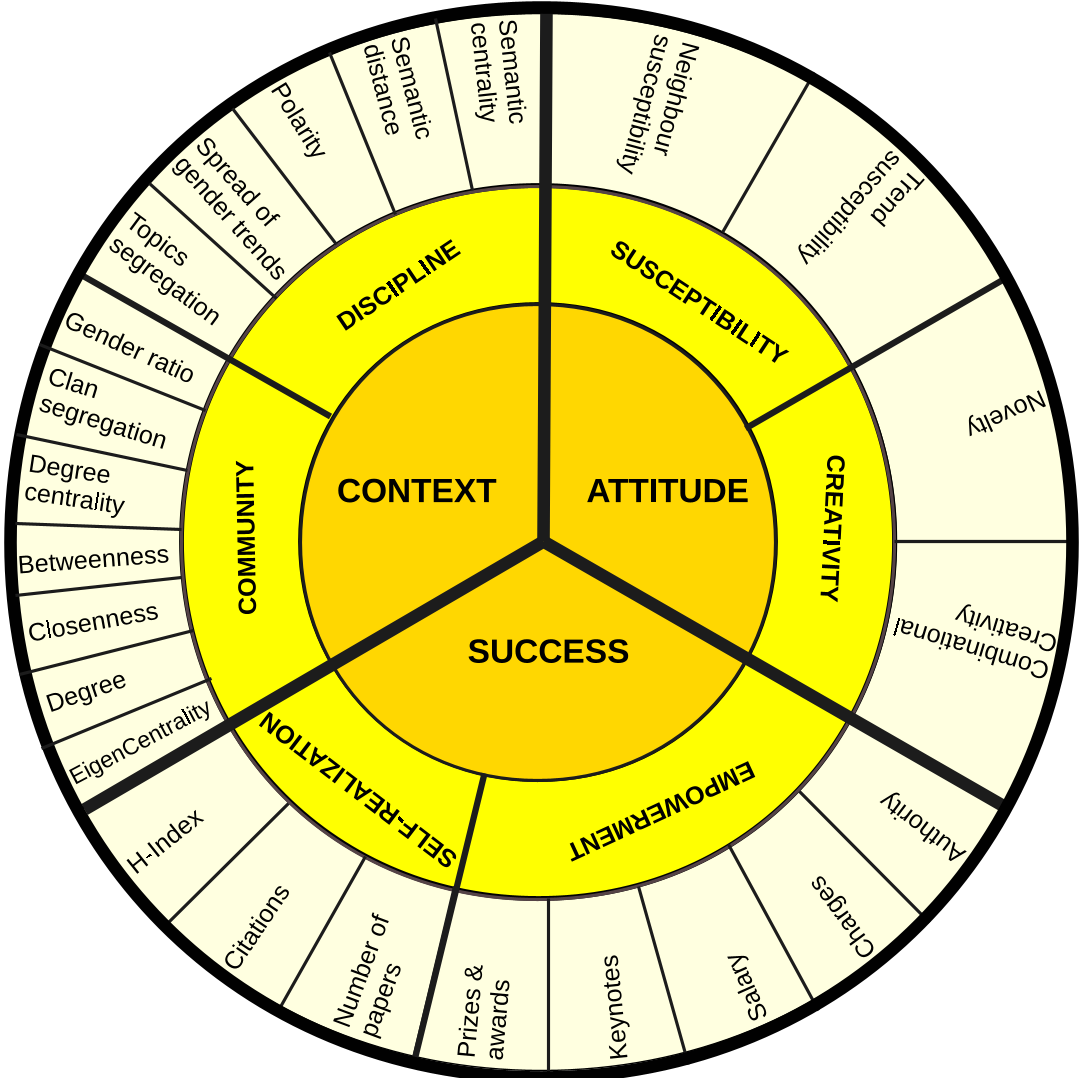
Two standout metrics introduced here are:
- Combinational Creativity: Measuring an author's ability to bridge disparate research silos by being the first to combine two specific topics.
- Authority: Not just a citation count, but a measure of how much an author’s current research influences the future topics chosen by their collaborators.
Hard Evidence: Creativity vs. Centrality
The results from four major conferences—ITAIS (Italy, IS), SEBD (Italy, CS), ICIS (International, IS), and VLDB (International, CS)—reveal a paradoxical landscape.
1. The Creativity Paradox
In the Italian Information Systems community (ITAIS), women actually outperformed men in Novelty and Combinational Creativity.
 The scatter plot shows many female authors (purple) occupying the high-novelty, high-creativity sectors, particularly in the IS discipline.
2. The Topological Trap
While women generate high-value ideas, they are often located in "peripheral" clusters of the social graph. In the international VLDB (Computer Science) community, men dominated every topological centrality metric (Betweenness, Degree, EigenCentrality).
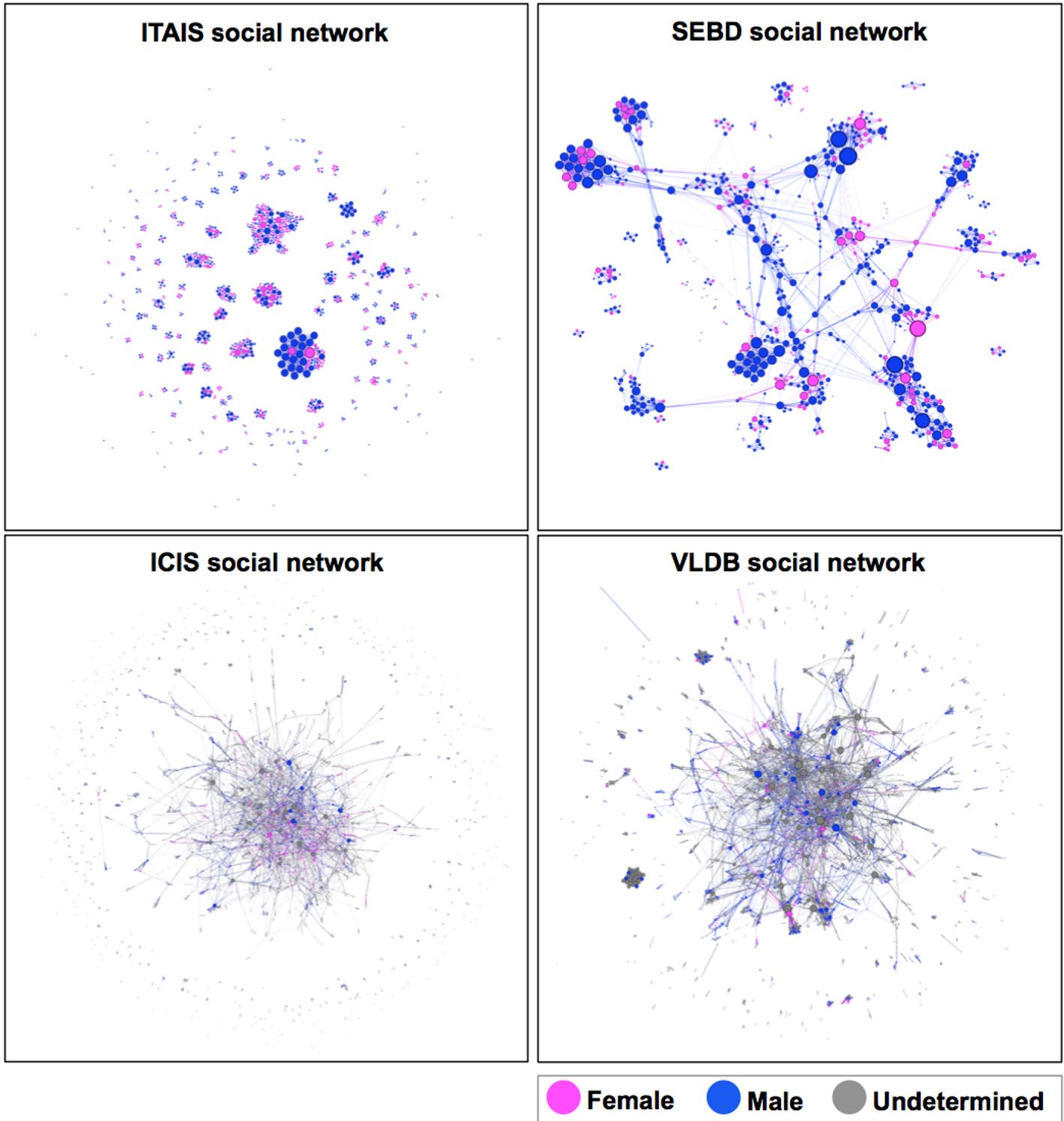 Visualization of social networks: Note the "Clans" where gender segregation becomes statistically significant.
Critical Insights: Why it Matters
- Italian vs. International: The "Gender Divide" is significantly lower in Italy compared to international conferences. This suggests that national-level policies or cultural norms play a massive role in network inclusion.
- The "Keyness" Gap: Men are more "Key" to the community. They address more "mainstream" (semantically central) topics and are more influenced by trends. Women, while more creative, often work on the "frontier," which may lead to slower adoption of their ideas by the broader community.
- Authority is a Peer Effect: The study found that authority is driven more by the number of peers (Degree) than the volume of papers. To gain authority, women don't need to publish more; they need to be more "socially central."
Conclusion: A Call for Network-Based Policy
The research concludes that the "talent" narrative is a fallacy. Women in these communities are equally if not more capable of disrupting the field with novel topic combinations. The real "divide" is a structural exclusion from the social core.
Takeaway for Research Leaders: To fix the gender gap, stop focusing solely on recruitment (Gender Ratios). Instead, focus on Network Integration. Mentorship programs should prioritize moving women into the "High-Centrality" nodes of the co-authorship graph to ensure their high-novelty work translates into community-wide influence.