
Beyond the Glass Box: Engineering Social Transparency in Modern Enterprises
Towards an Assessment Method for Social Transparency in Enterprise Information Systems
This paper introduces a Goal-Oriented Requirement Engineering (GORE) based framework to assess social transparency within Enterprise Information Systems (EIS). The authors conceptualize a reference model to evaluate the quality of voluntary information sharing among employees and identify associated risks like information overload and stressful competition.
TL;DR
Transparency is often hailed as the ultimate workplace virtue, but in the digital age of "Activity Streams" and "Progress Bars," more visibility doesn't always mean more productivity. A new research paper from Bournemouth University proposes a systematic framework to assess Social Transparency—the voluntary sharing of work info—using Requirement Engineering to balance collaboration benefits against risks like "Performance Pressure" and "Information Overload."
The "Transparency Paradox"
In modern Enterprise Information Systems (EIS), we are constantly encouraged to share our task priorities, skills, and progress status. While the goal is to foster trust and coordination, the reality is often more sinister. When transparency is unmanaged, it shifts from a "collaboration aid" to a "surveillance mechanism." Employees feel a constant pressure to perform "for the gallery," leading to stressful competition and a perception of exploitation.
The authors argue that the industry lacks a systematic way to measure whether transparency is actually helping or hurting. Their insight? Transparency is not a static feature; it is a dynamic social requirement that must be engineered with the same precision as security or privacy.
Methodology: The GORE Mindset
The researchers utilized Goal-Oriented Requirement Engineering (GORE). Why? Because transparency is inherently about the "Why" and "Who"—intentions, tasks, and the social dependencies between actors.
Through focus groups and interviews with managers and staff, they identified a four-dimensional assessment matrix:
- Recipients: Who sees the info? (Customized based on dependency).
- Content: What is shared? (Goals, tasks, skills, or resources).
- Presentation: Is it readable? (Quantitative vs. Qualitative formats).
- Timeliness: Is it up-to-date? (Avoiding "noise" from inactive tasks).
The Reference Model
The core of the paper is a reference model designed to identify risk factors before they manifest as organizational dysfunction.
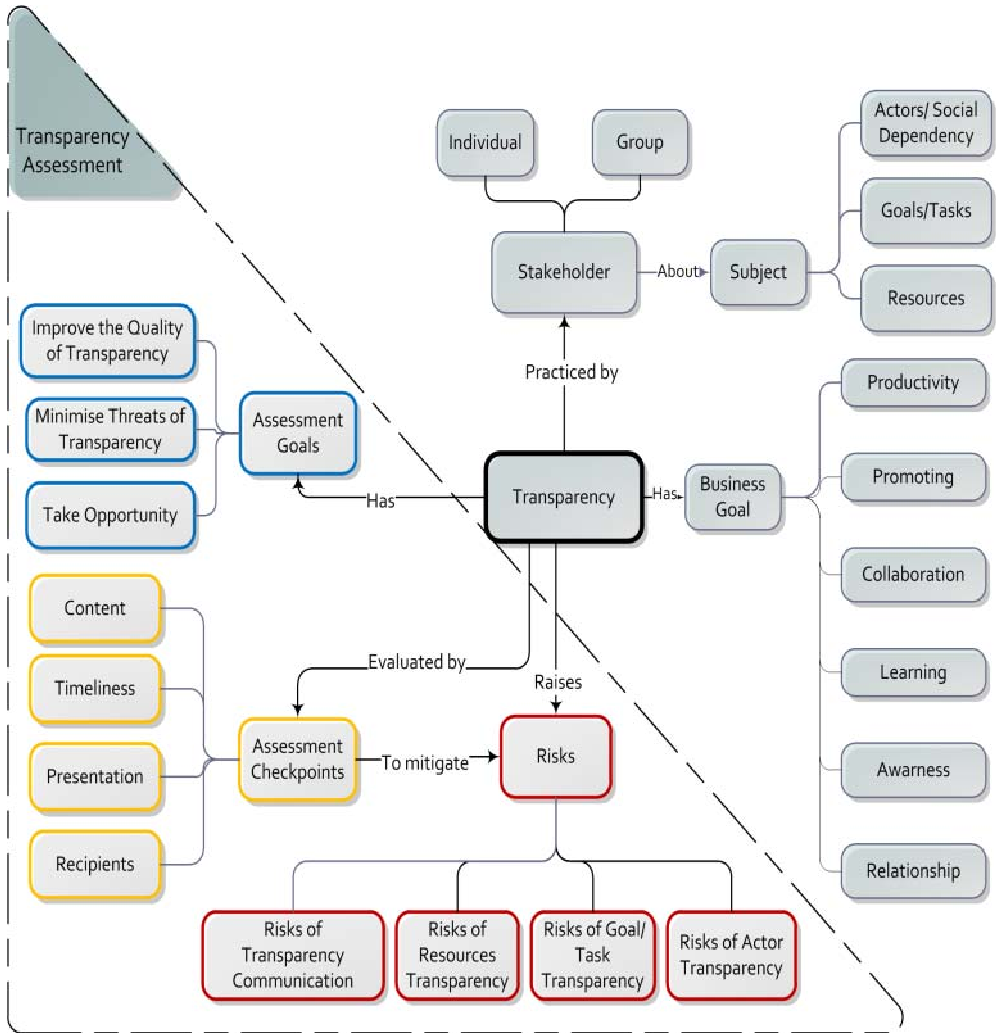 Figure 1: The proposed reference model mapping actors, goals, tasks, and resources to transparency risks.
Deep Dive: Risk Factors and Side Effects
The paper provides a fascinating taxonomy of how transparency goes wrong:
- Actor Performance Risks: Real-time progress bars can create "counterproductive competition" between senior and junior staff.
- Social Loafing: Sharing high task interest can backfire if teammates "loaf," relying on the interested individual to do all the work.
- The Domino Effect: Solving a "lack of transparency" (e.g., showing task status) might immediately trigger "information overload" or "distraction."
Key Experimental Findings (Qualitative Study)
| Factor | Identified Risk | Participant Insight |
|---|---|---|
| Task Status | Undesired Disturbance | "Untimely information is just distractive noise." |
| Progress Bars | Unfair Comparison | Leads to stress when tasks depend on background experience rather than just effort. |
| Outsourcing | Reduced Trust | Transparency about external contractors can lead to "employee displacement" fears. |
Critical Insight: Transparency as a "Service"
The most profound takeaway is the shift from seeing transparency as a "culture" to seeing it as a Social Computing Service.
The authors suggest that EIS should feature "intelligent" transparency—interfaces that can detect when a certain configuration is causing stress or overload. For example, if a manager's access to a team's informal "brainstorming" channel is causing a "performance pressure" anomaly, the system should be able to suggest or automate a change in transparency levels.
Conclusion & Perspective
This work is a necessary reality check for the "open by default" philosophy of modern SaaS. By providing a Reference Model, the authors give software architects a toolkit to evaluate the social health of their platforms.
Limitations: The study is currently qualitative. The next step—and the real challenge—will be translating these subjective "Social Requirements" into hard metrics and automated "checking frameworks" that can operate at scale without human intervention.
Future Outlook: We are likely heading toward "Context-Aware Transparency," where enterprise systems dynamically adjust information visibility based on the current stress levels and collaborative needs of the team.