
Beyond the Explicit: Inferring Critical Resource Needs via Crisis Ontologies
Assisting Coordination during Crisis: A Domain Ontology based Approach to Infer Resource Needs from Tweets
This paper introduces a domain ontology-based approach to improve crisis response coordination by inferring hidden resource needs from social media. By leveraging semantic interdependencies (e.g., power failure implies medical risk) and text-based location extraction, the method significantly enhances situational awareness during disasters like Hurricane Sandy.
TL;DR
During a crisis, what people don't say is often as important as what they do. This research develops a semantic framework that uses a domain ontology to connect the dots between simple observations (like a power outage) and critical consequences (like a hospital losing backup power). By mining location data directly from the text of tweets, the authors recovered 50% more actionable data than traditional GPS-based methods.
The "Common Ground" Problem in Crisis Communication
In linguistics, the principle of "common ground" suggests that humans don't state the obvious. During Hurricane Sandy, thousands tweeted about "power being out." To a human resident, the implication that the local hospital is now in danger is clear; to a standard keyword-extraction algorithm, a tweet about "power" is just a utility issue, not a medical emergency.
Current Crisis Response Coordination (CRC) tools fail because they assume citizens will act as "field sensors" providing perfectly specified data. In reality, tweets are conversational, informal, and context-dependent.
Methodology: Semantic Inference and Textual Geolocation
The research team at Wright State University proposed a two-pronged solution:
1. The Power of Ontology
Instead of treating resource needs (Food, Water, Medical, Power) as isolated categories, the team built a Crisis Ontology. This model links resources functionally. If a tweet mentions a "blackout" in a specific neighborhood, the ontology automatically triggers an inference link to "Medical Facilities" in that same area, flagging them for potential risk.
2. Location Mining (Text vs. Metadata)
A staggering 80% of tweets filtered during Hurricane Sandy lacked GPS metadata. To solve this, the authors used:
- Stanford NER: To identify named entities in the text.
- DBpedia Linking: To map "Nashua" or "Bellevue Hospital" to a structured geographic database.
 Table 1: Comparing Text-mined vs. Metadata-derived locations. Text locations proved 66% more likely to be in the actual affected region.
Experimental Insights: Predicting the Crisis
By analyzing 4 million tweets from Hurricane Sandy, the researchers found that power-related tweets often preceded medical emergencies.
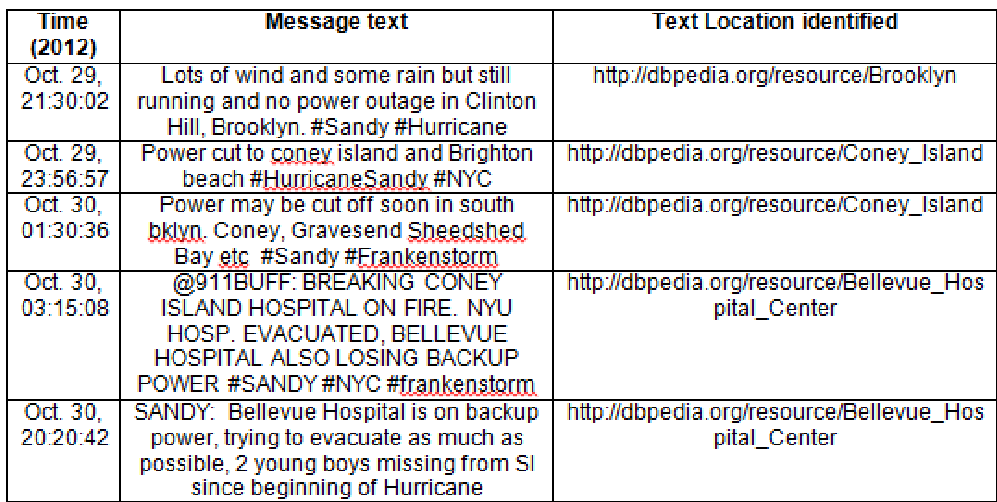 Table 2: A timeline showing blackout reports at 11:56 PM, leading to a critical hospital fire/evacuation report at 3:15 AM—a 3-hour window for proactive response.
The study revealed an unexpected finding: Metadata is often misleading. Many tweets with GPS tags were from "outside" the crisis zone (e.g., people tweeting sympathy from another state), whereas 66% of mentions of locations within the text were semantically relevant to the actual disaster zone.
Critical Analysis & Future Outlook
This work highlights a fundamental shift from Data Extraction to Information Interpretation. While the system showed 88% accuracy in location identification, it struggled with name ambiguity (e.g., "New England" in the USA vs. Australia).
Today, as we move toward Large Language Models (LLMs), the "ontology" approach remains relevant as it provides a verifiable, structure-based logic that prevents the "hallucinations" often seen in purely generative AI. The real future of crisis response lies in combining this structured domain knowledge with the linguistic flexibility of modern AI.
Conclusion
The ability to "read between the lines" using domain models transforms social media from a chaotic stream of noise into a predictive tool for emergency responders. By understanding the functional interdependencies of city infrastructure, we can transition from reactive disaster management to proactive crisis coordination.