
Beyond the Individual: Designing Cooperative HCI for Older Adults
Designing assistive and cooperative HCI for older adults' movement
The paper introduces a Safety Navigation System (SNS) designed to facilitate the outdoor movement and shopping tasks of older adults with memory impairments. It proposes a transition from individual-centric assistive tools to a cooperative Human-Computer Interaction (HCI) framework that synchronizes public services and private caregivers.
TL;DR
This research moves the needle from "self-help" gadgets to a cooperative ecosystem for older adults with memory impairments. By introducing the Safety Navigation System (SNS), the authors demonstrate how wearable hardware (like camera brooches and laser canes) can be integrated into a collaborative network involving family, nurses, and security services to ensure safe outdoor movement.
Background: The Limits of Traditional Assistive Tech
As the global population ages, the demand for assistive technologies (AT) is skyrocketing. However, a critical gap exists: most tools are designed for a single user (the older adult) or a single professional service.
For many seniors with memory problems, a "smart tool" isn't enough if they can't remember how to use it or find themselves in a noisy environment where audio prompts are useless. The authors argue that assistance is inherently social and requires a Human-Computer Interaction (HCI) model that supports cooperation between the public and private sectors.
The Safety Navigation System (SNS)
The SNS is not a single device but a ubiquitous architecture designed to provide remote help during everyday tasks like shopping.
Methodology and Architecture
The system employs a "Home Server" that interfaces with multiple specialized terminals. The design followed three phases:
- Context Studies: Identifying requirements from 32 seniors.
- Iterative Prototyping: Developing modules for navigation and memory support.
- Collaboration Analysis: Confirming how helpers (nurses and family) actually interact with the data.
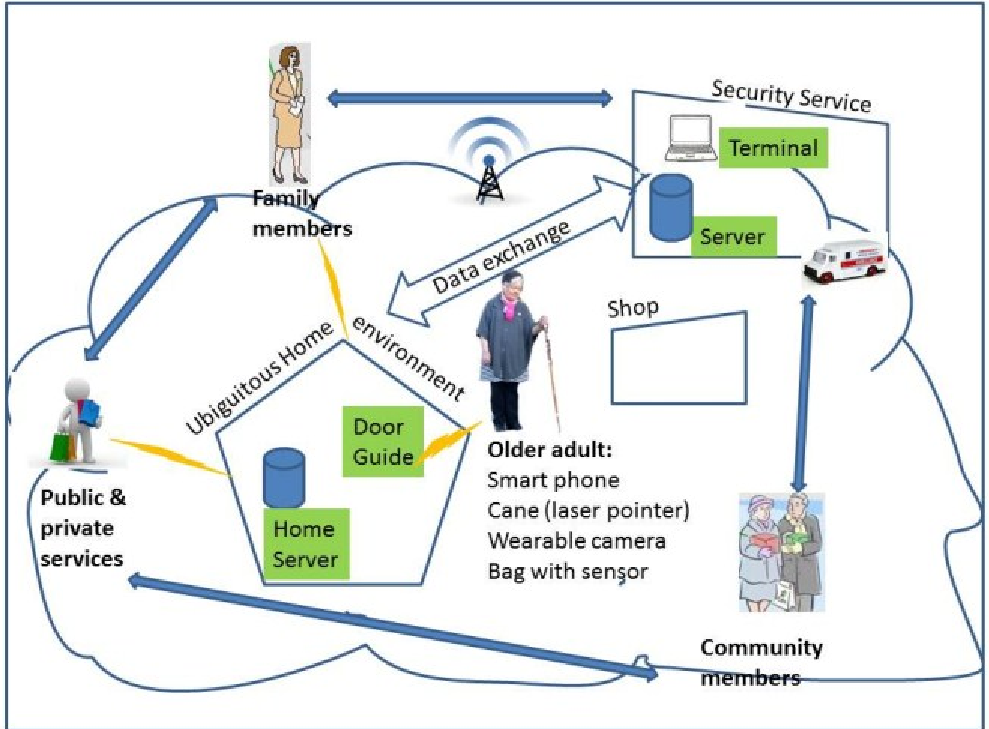
Innovative Hardware Components
- The Door Guide: A home-based interface that allows users to select a destination before leaving.
- The Laser Cane: In noisy environments where audio guide commands are unheard, a helper can remotely activate a laser pointer in the user’s cane to project directional arrows on the ground.
- The Camera Brooch: An "invisible" wearable that sends snapshots to a security center if a user crosses a pre-defined "safety border."
Experimental Insights: Who Helps the Helper?
Through workshops involving geriatrics, design experts, and relatives, the study uncovered that the effectiveness of technology depends on the organization of assistance.
| User Requirement | SNS Function/Module |
|---|---|
| Locating Forgotten Items | Sensor-tagged bags that alert a relative's phone. |
| Adaptation to Noise | Switching from smartphone audio to laser-guided visual cues. |
| Privacy Protection | On/off functions for wearable cameras during social situations. |
The evaluation highlighted that "timely and reliable help" is only possible when the system facilitates mutual awareness among different caregivers. For example, if a senior wanders off-route, the system must decide whether an automated prompt, a family member, or a professional security guard is the most appropriate responder.
Critical Analysis & Conclusion
The value of this work lies in its Value-Led Participatory Design. It recognizes that the "user" of an elderly safety system isn't just the person with memory problems—it's the entire support network.
Limitations
- Ethical Complexity: Real-time tracking and "hidden" cameras raise significant privacy and autonomy concerns (though the authors attempt to address this with on/off functions).
- Infrastructure: The reliance on a ubiquitous home server and high-speed mobile connections was a significant barrier at the time of publication (2014), though 5G and IoT have since mitigated this.
Future Outlook
This paper serves as an early blueprint for what we now call Ambient Assisted Living (AAL). Future research should look into how AI agents can manage the "cooperative" aspect—triaging alerts automatically so that human helpers aren't overwhelmed by false alarms.
Reference: Leinonen, E., Syrjänen, A.-L., & Isomursu, M. (2014). Designing assistive and cooperative HCI for older adults' movement. NordiCHI.