
Mining the DNA of Hobbies: Advanced Association Rules in Social Networks
Association Rule Mining of Personal Hobbies in Social Networks
This paper proposes an enhanced association rule mining scheme tailored for analyzing personal hobbies in social networks. By integrating "ignoring unrelated items," connection, and clipping techniques with a normalized interestingness level, the method effectively identifies high-value hobby correlations from Sina Weibo data.
TL;DR
This research presents an optimized framework for uncovering the hidden connections between personal hobbies in social networks like Sina Weibo. By refining the frequent itemset generation process and introducing a robust Interestingness Level metric, the authors provide a way to cut through the noise of "information overload" to find rules that actually matter for personalized marketing and service delivery.
Problem & Motivation: The "Support-Confidence" Trap
Traditional association rule mining (ARM), pioneered by the Apriori algorithm, relies heavily on Support (frequency) and Confidence (conditional probability). However, in the context of social networks, these metrics often fail:
- Computational Explosion: As the number of hobbies and users grows, the number of potential combinations to check grows exponentially.
- Meaningless Rules: A rule might have high confidence simply because the consequent item (e.g., "watching movies") is globally popular, not because there is a genuine link between the specific items.
The authors' insight is that we need a way to ignore unrelated items early and a filter to ensure the discovered rules are truly "interesting" rather than just common.
Methodology: Pruning and Precision
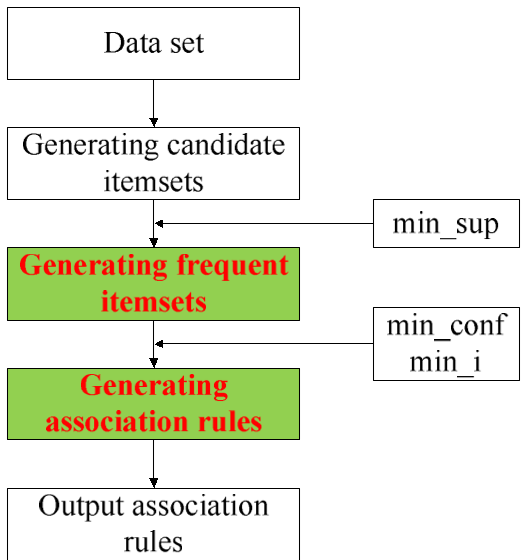
The proposed scheme operates through a sophisticated pipeline designed for efficiency and relevance.
1. The Optimized Frequent Itemset Loop
Instead of brute-forcing all combinations, the model uses a three-tier pruning strategy:
- Ignore Unrelated Items: If an item appears too infrequently in the current set of frequent itemsets, it is purged before the next generation.
- Connection and Clipping: It utilizes set operations to combine itemsets and immediately clips those that fall below the minimum support threshold.
2. The Interestingness Filter
To solve the "popularity bias" in rules, the authors use the following formula for Interestingness (): Where is confidence and is the support of the target hobby. This ensures that a rule is only considered valuable if the antecedent significantly increases the likelihood of the consequent beyond its base popularity.
Experiments & Results: Mapping College Hobbies
The researchers tested their model on data from students at three major Shanghai universities.
- Popularity Trends: Initial mining (L1 set) revealed that "Movie," "Travel," and "Fashion" are the dominant hobbies (appearing in over 90% of profiles), while "Sports" was surprisingly infrequent.
- Deep Rules: The algorithm successfully mined rules up to the 6th level (L6). For instance, students who enjoy "Music, Travel, Freedom, and Constellations" have a 96.81% probability of also being interested in "Movies."
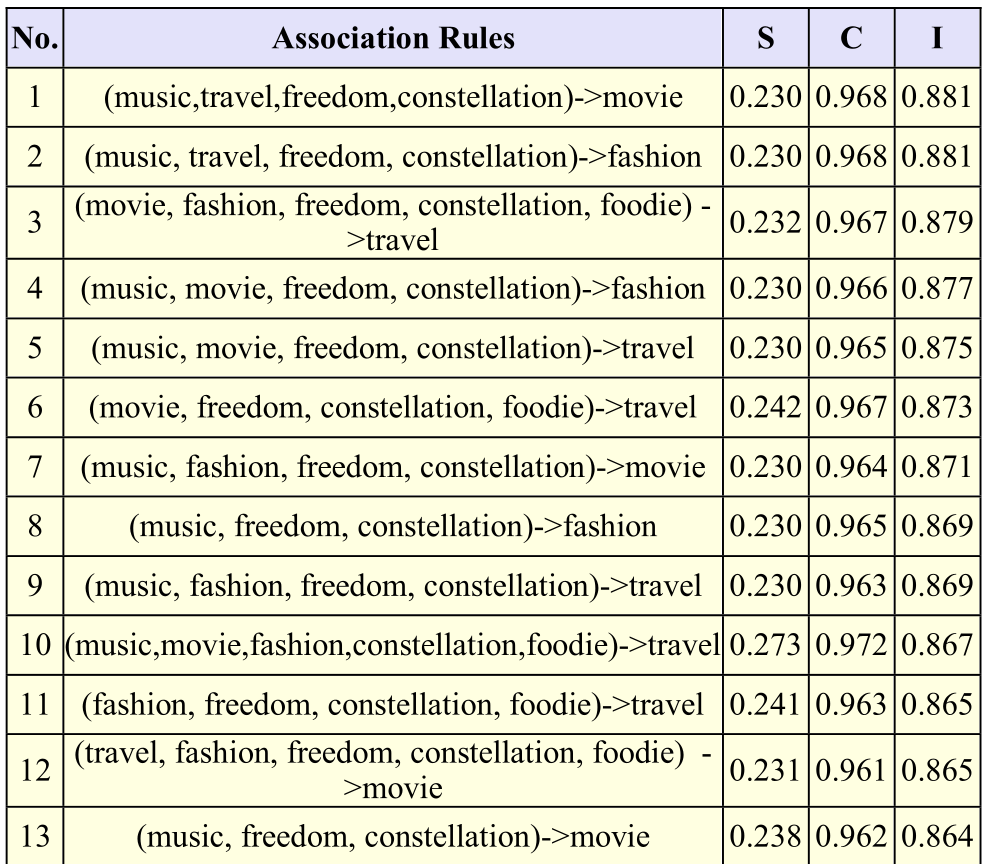
As shown in the table above, the high values (all > 0.86) confirm that these aren't just random coincidences but represent stable behavioral patterns across the social network.
Critical Analysis & Conclusion
Takeaway
The synergy between early-stage pruning (efficiency) and interestingness filtering (quality) makes this approach highly suitable for real-time recommendation engines. It moves beyond simple "people who liked X also liked Y" by verifying the statistical significance of those associations.
Limitations & Future Work
While effective, the current approach relies on static itemsets. Modern social media interests are highly dynamic and time-sensitive. A future extension of this work would be to incorporate "Data Tendency" measures—as hinted in the literature review—to capture how hobby clusters evolve over a semester or a fiscal year. Furthermore, integrating these rules into a graph-based visualization (like Gephi) could help marketers see "hobby islands" within the social sea.
Subject Area: Data Mining / Social Network Analysis (SNA)