
Association Rules in Law: Beyond Black-Box Models for Legal Discovery
An experiment in discovering association rules in the legal domain
This paper investigates the feasibility of applying Association Rule Mining (ARM), specifically a novel P-tree/T-tree algorithm, to the legal domain to discover "hidden" rules from case databases. Using a synthetic dataset representing a fictional welfare benefit with complex conditions, the study demonstrates that association rules can effectively identify legal dependencies and necessary/sufficient conditions for qualification.
TL;DR
This research explores whether algorithms originally designed for supermarket "shopping basket" analysis can find the "real" rules governing legal decisions. By testing a novel single-pass association rule algorithm on a synthesized legal dataset, the authors prove that symbolic rules can be extracted to explain case outcomes, offering a transparent alternative to opaque neural networks.
Background: The Need for Explainable Legal AI
In administrative law, where thousands of similar cases are decided annually, we assume a consistent underlying rule. However, identifying that rule is difficult when:
- The "theory" (legislation) differs from "practice" (systemic bias).
- The domain is highly discretionary.
- We need to verify if officials are actually following the law.
While Neural Networks (NNs) were previously used for such tasks, they fail to provide a "why." This paper shifts the focus to Association Rule Mining (ARM) to produce human-readable "If-Then" statements.
The Problem: From Shopping Baskets to Law Books
Association Rule Mining was born in retail (e.g., "People who buy bread also buy butter"). Applying this to law presents three unique challenges:
- Definitive vs. Probabilistic: Retail rules are "usually" true; legal rules are expected to be "always" true (necessary and sufficient conditions).
- Data Representation: Legal conditions are often continuous (Age > 65) or involve negation (Not Absent), whereas ARM typically only looks for the presence of Boolean attributes.
- Computational Efficiency: Searching for all possible associations in large datasets is exponential.
Methodology: The P-Tree and T-Tree Architecture
The authors implement a three-phase algorithm designed to be more efficient than the classic Apriori approach.
1. The P-Tree (Partial-Support Tree)
Instead of scanning the database multiple times, the algorithm builds a tree in a single pass. Each node represents a unique record or a "dummy" structural node. Because law often has many duplicate case patterns, the P-tree significantly compresses the data.
![Image_Placeholder: Diagram showing the transformation of database records into a P-tree structure]
2. The T-Tree (Total-Support Tree)
After the P-tree is built, the system calculates "Support" (how often a pattern appears) and generates candidate itemsets level-by-level, pruning those that don't meet the threshold.
3. Rule Generation
The final step calculates "Confidence" (how often the antecedent leads to the consequent). For legal discovery, the authors specifically look for rules where the "consequent" is "Qualified for Benefit" or "Not Qualified."
Experimental Analysis: Results and Insights
The experiment used 1200 fictional records with six complex conditions (Boolean, thresholds, and interdependent variables).
Finding the "Hidden" Thresholds
A fascinating result occurred with age thresholds. The actual law required Age > 65. The researchers intentionally mis-categorized it as Age >= 65 in pre-processing. The algorithm didn't just fail; it produced a set of rules with 95% confidence instead of 100%. By analyzing the "missing" 5%, the researchers could mathematically pinpoint the exact threshold where the rule broke down.
The XOR Challenge
The "sixth condition" in the dataset acted as an XOR gate (the benefit depended on being an in-patient or out-patient and the distance).
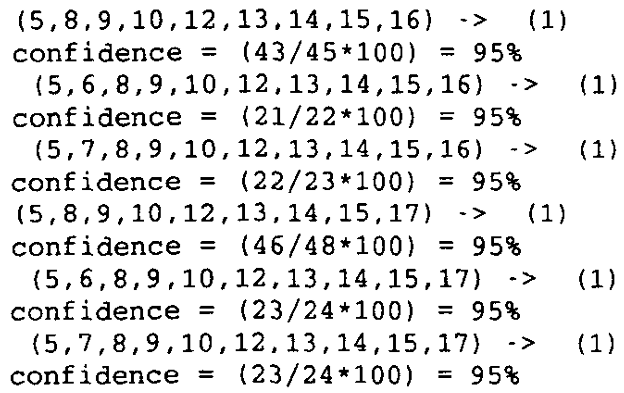 The image above displays the complex rule chains discovered. Note how specific combinations of attributes (4, 7, 8...) lead to the outcome (1) with 100% confidence.
Critical Insight: Successes and Limitations
The Success: Unlike Neural Networks, the ARM output was immediately evaluable by legal experts. It successfully identified that women between 60-65 were a key demographic for the benefit—a rule validly extracted from the data.
The Limitations:
- The "Zero" Problem: Standard ARM only looks for the presence of attributes. In law, the absence of a condition (e.g., "Not having excess capital") is often the deciding factor. The authors suggest "double-coding" attributes (e.g., creating one attribute for "Capital < 3000" and another for "Capital >= 3000").
- Pre-processing Heaviness: The quality of the rules depends heavily on how continuous data is binned.
Conclusion
This paper serves as a foundational "proof of concept" for Symbolic AI in law. By moving away from the black-box nature of connectionist models (NNs) toward the transparency of association rules, the authors paved the way for modern "Explainable AI" (XAI) in the legal industry. For future practitioners, the takeaway is clear: Data mining doesn't just find patterns; it can help us audit justice itself.