
GAAR: Boosting Evolutionary Search with Association Rule Mining
Using association rules to guide evolutionary search in solving constraint satisfaction
The paper introduces GAAR, a hybrid Evolutionary Algorithm that integrates the Apriori association rule mining algorithm to solve Max-Constraint Satisfaction Problems (Max-CSP). By mining patterns from an archive of high-fitness individuals, the algorithm generates rules to guide the search and implements a novel non-rule strategy to escape local optima.
TL;DR
Solving Constraint Satisfaction Problems (CSPs) is notoriously difficult for general-purpose metaheuristics. This paper proposes GAAR (Genetic Algorithm with Association Rules), a hybrid approach that mines its own search history using the Apriori algorithm. By discovering "good" patterns in successful individuals, it guides the evolution toward optimal configurations and uses "non-rules" to break out of stagnant local optima.
The Core Challenge: Blind Evolution
Evolutionary Algorithms (EAs) are powerful but often "blind." They treat variables as somewhat independent units, relying on crossover and mutation to accidentally find the right combinations. In Max-CSP, where the goal is to satisfy the maximum number of constraints, the search space is jagged and full of traps.
The authors' core insight is that the "experience" of an algorithm—the successful individuals it has already found—contains hidden structural clues about the problem. If we can mine these clues (e.g., "whenever Variable A is 0, Variable B should probably be 1"), we can steer the population toward higher fitness much faster.
Methodology: Data Mining in the Loop
The GAAR framework introduces a persistent archive of the best individuals encountered during the run. The process follows a strategic cycle:
- Rule Discovery: Periodically, the Apriori algorithm scans the archive to find frequent itemsets and high-confidence association rules.
- Exploitation (Apply Rules): These rules are applied to the current population. If an individual matches the antecedent (the "If" part) of a rule but not the consequent (the "Then" part), its values are adjusted to match the rule.
- Exploration (Non-rules for Local Optima): If the fitness plateaus, the algorithm generates "non-rules" based on the learned associations, explicitly changing those variables to random values to "forget" the current trap and explore new regions.
 Example of a discovered rule: . This implies that if variable 1 is 0 and variable 4 is 2, variable 3 is likely to be 1 in high-fitness solutions.
Experimental Validation
The authors tested GAAR against a standard GA and the GABR (Genetic Algorithm with Breakout Mechanism).
1. Binary Max-CSP Performance
On dense and tight distributions, GAAR consistently reduced the mean error compared to the standard GA. While the Apriori module adds a computational cost, the percentage of time spent mining remained manageable (typically 20-40% of runtime), and the total execution time was still orders of magnitude faster than exact solvers like ABSCON.
2. Real-World Benchmarks: RLFAP
In the Radio Link Frequency Assignment Problem (RLFAP), GAAR proved its robustness. It solved several instances (subs6-1, subs6-2, subs6-4-20) exactly to the optimum, whereas the baseline GA and GABR often lagged behind.
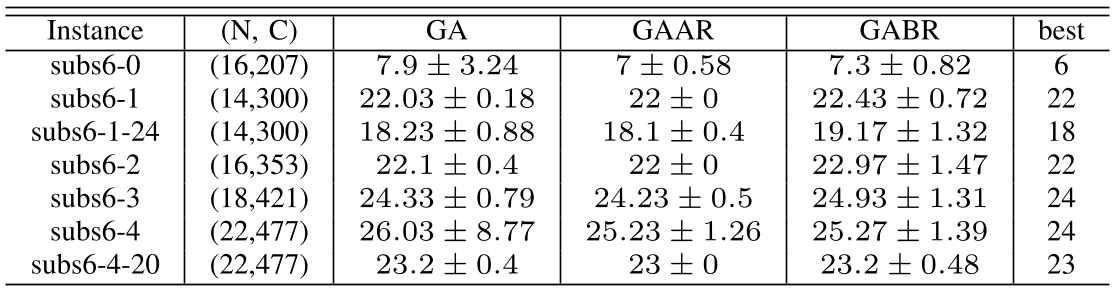 Table: Comparison on RLFAP instances. GAAR achieves the 'best' known value (optimal) in multiple categories.
Critical Insight: The Local Optima Escape
One of the most interesting aspects of this work is the "Learning from Failures" logic. By using association rules to define what the algorithm thinks it knows, and then deliberately breaking those specific associations during a local optimum (non-rules), the authors provide a more surgical escape than standard random restarts.
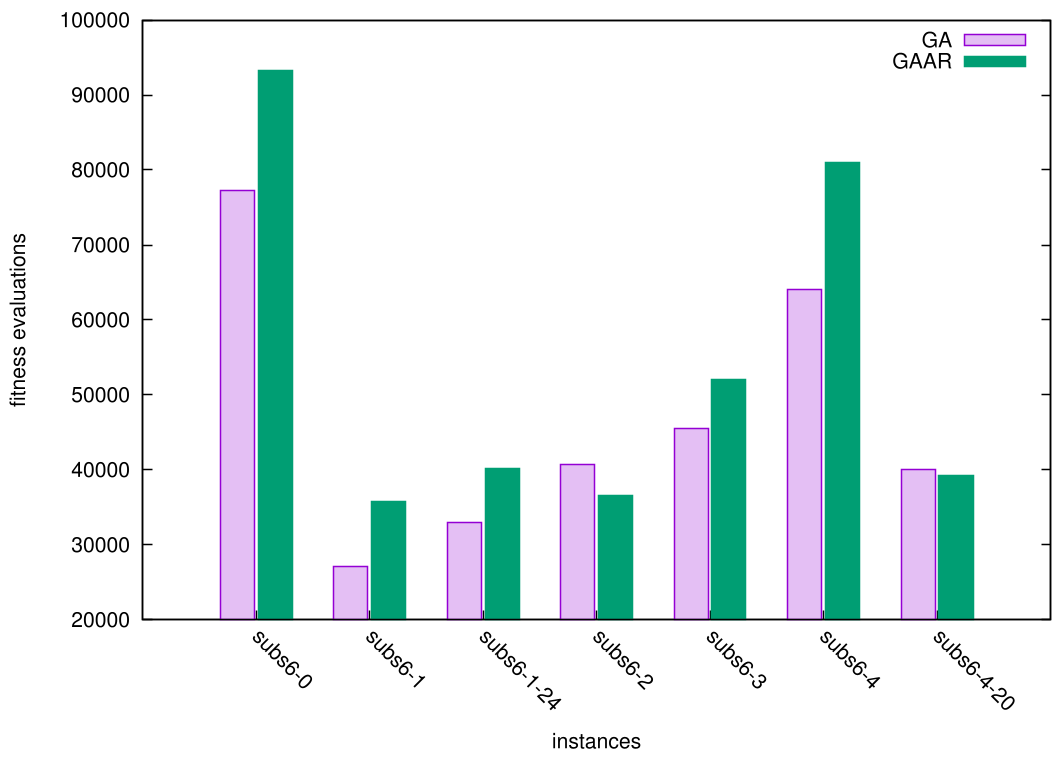 The impact of non-rules: Note how the hybrid approach (GAAR) manages to continue improving after the standard GA plateaus.
Conclusion & Future Directions
GAAR successfully bridges the gap between Inductive Learning (Data Mining) and Stochastic Search (Evolutionary Algorithms).
Key Takeaways:
- Self-Correcting Search: Metaheuristics can benefit from "looking back" at their own successes.
- Dynamic Balance: Using rules for exploitation and "non-rules" for exploration creates a robust search dynamics.
Limitations: The algorithm is sensitive to archive size and rule generation frequency. Future work might involve "online" rule updates that adjust dynamically without needing to pause the evolution for a full Apriori pass, potentially using Reinforcement Learning to manage the meta-parameters.