
Deciphering Order from Chaos: Asymptotically Optimal Decentralized Control for Massive Agent Swarms
14646_Asymptotically Optimal Decentralized Control for Large Population Stochastic Multiagent Systems.
This paper investigates the decentralized control of Large Population Stochastic Multiagent Systems (LPSMAS) with coupled cost functions. It proposes a decentralized control law based on a "Nash Certainty Equivalence" principle and state aggregation, achieving an almost sure asymptotic Nash equilibrium as the number of agents approaches infinity.
Executive Summary
In the realm of Multiagent Systems (MAS), the "Curse of Dimensionality" and the randomness of individual behavior often make centralized optimization impossible. This seminal paper by Li and Zhang tackles Large Population Stochastic Multiagent Systems (LPSMAS).
TL;DR: The authors derive a decentralized control law that allows each agent to act based purely on local data while collectively achieving a Nash Equilibrium as the swarm grows. By leveraging the Nash Certainty Equivalence Principle, they prove that as the number of agents goes to infinity, the collective average behavior becomes deterministic, allowing for "asymptotically optimal" local control.
The Problem: The Gap Between Micro-Randomness and Macro-Objectives
Most prior works in stochastic games use expectation-type costs, which average out the noise before the agent even makes a decision. However, in real-world engineering (like sensor networks or robotics), agents experience specific "sample paths"—the noise they feel is real and immediate.
The challenges identified are:
- Sensing Constraints: Agents cannot know the state of every other agent in a million-member swarm.
- Coupled Objectives: An agent's success often depends on how far it deviates from the population average (Cohesiveness).
- Scale Invariance: Control laws must remain stable whether there are 10 agents or 10,000.
Methodology: The State Aggregation Insight
The core innovation lies in treating the population not as a collection of individuals, but as a continuum. The authors follow a three-step process:
- Tracking as an Anchor: They solve a tracking-like quadratic optimal control problem assuming a deterministic reference signal exists.
- State Aggregation: They define an Infinite Population Mean (IPM) trajectory. This acts as a macroscopic "shadow" of the swarm's average behavior.
- Nash Certainty Equivalence: Each agent operates under the assumption that the actual population average will track this IPM.
Model Architecture
The individual agent dynamics are modeled as linear stochastic differential equations:

The coupling happens in the cost function, where agents try to stay close to the average state :

Proving Stability and Optimality
The paper doesn't just suggest a controller; it provides rigorous proofs using Probability Limit Theory.
- Uniform Stability: They show that the system remains stable regardless of . This means proliferation of agents doesn't lead to "explosive" instabilities.
- Law of Large Numbers (LLN): They prove the "Emergence" property. Even though each agent is pushed by Brownian motion (randomness), the Population State Average (PSA) converges almost surely to the deterministic IPM trajectory.
- Asymptotic Nash Equilibrium: They demonstrate that as increases, the "regret" an agent feels for only having local information drops to zero.
Experimental Validation
Using a social foraging model (simulating animals looking for food), the authors tested their decentralized laws.
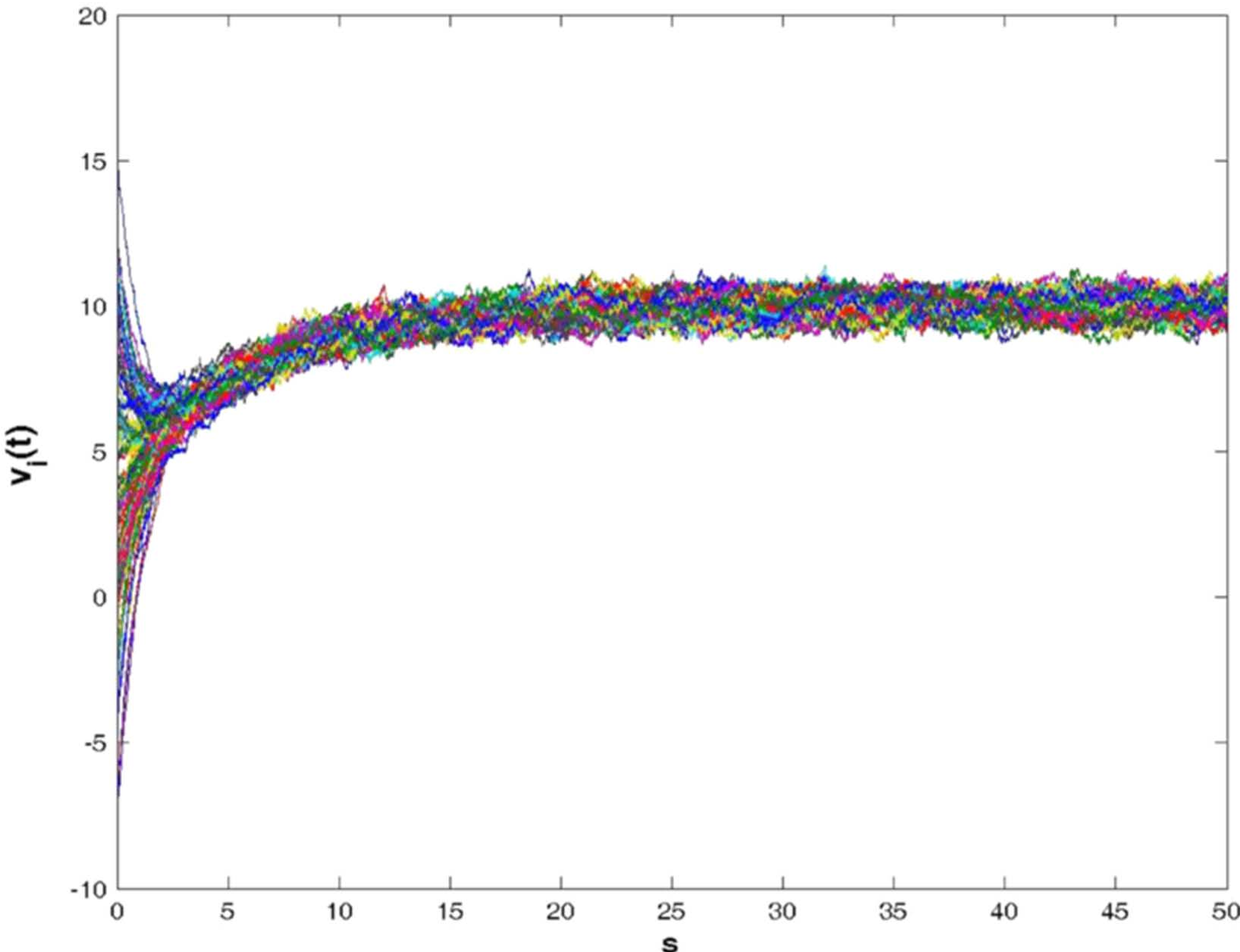 Fig 1. Trajectories show that even with noisy individual inputs, the agents remain cohesive and follow the predicted macroscopic path.
Key experimental results showed that the error in optimality decreases at a rate approximately proportional to , confirming the theoretical asymptotic behavior.
Critical Insight & Future Outlook
The beauty of this work is the transition from Microscopic Uncertainty to Macroscopic Determinacy. It provides a blueprint for "Self-Organizing" systems.
Limitations:
- The current framework assumes Cost Coupling but not Dynamic Coupling (where one agent's movement physically pushes another). Dynamic coupling remains a "hard" open problem because one agent's strategy shift could ripple through the whole network.
- Assumption of a compact support for parameter distributions might be restrictive for certain heterogeneous swarms.
Future Work: Moving toward adaptive decentralized control where agents don't even know their own dynamic parameters would be the next frontier in making these systems truly autonomous.
Conclusion
Li and Zhang have effectively bridged stochastic control and game theory for large-scale systems. This paper is a must-read for researchers in swarm intelligence, distributed optimization, and large-scale network control.