
Atelier: Transforming Gig Work into a Career Ladder through Micro-internships
Atelier: Repurposing Expert Crowdsourcing Tasks as Micro-internships
This paper introduces Atelier, a platform that repurposes existing expert crowdsourcing tasks as micro-internships to facilitate skill development for crowd workers. By connecting novice "interns" with expert "mentors" through a scaffolded workflow, the system achieved successful real-world project completions while providing interns with paid work experience and mentors with teaching opportunities.
TL;DR
The "gig economy" is often a dead-end for professional growth. Atelier changes this by turning standard crowdsourcing tasks (like web dev or design) into micro-internships. By pairing novices with experts who "scaffold" the work, it creates a way for workers to get paid while breaking into new, higher-paying skill domains.
Background Positioning: This work addresses a critical gap in Human-Computer Interaction (HCI) and Computer-Supported Cooperative Work (CSCW): the lack of upward mobility in digital labor markets.
The "Skill Trap" in Modern Crowd Work
Why don't crowd workers just learn new skills? The authors' survey of 96 Upwork freelancers revealed a harsh reality:
- Opportunity Cost: Time spent learning is time spent not earning.
- The "Cold Start" Reputation Problem: Even if you learn Python, nobody will hire you for a Python job if all your 5-star ratings are for data entry.
- The Feedback Void: Unlike traditional offices, crowd work offers no "senior" to guide "juniors." You either do the task perfectly or you get a bad rating.
Atelier’s Core Insight: Mentorship as a Service
The researchers proposed a model where a 150 to a Mentor** (who spends ~5 hours guiding) and $150 to an Intern (who spends ~40 hours learning and doing).
Atelier provides the digital "studio" where this happens:
1. Structural Scaffolding (Milestones)
Mentors don't just say "do it." They use their expert intuition to decompose a vague request into tiny, achievable steps.
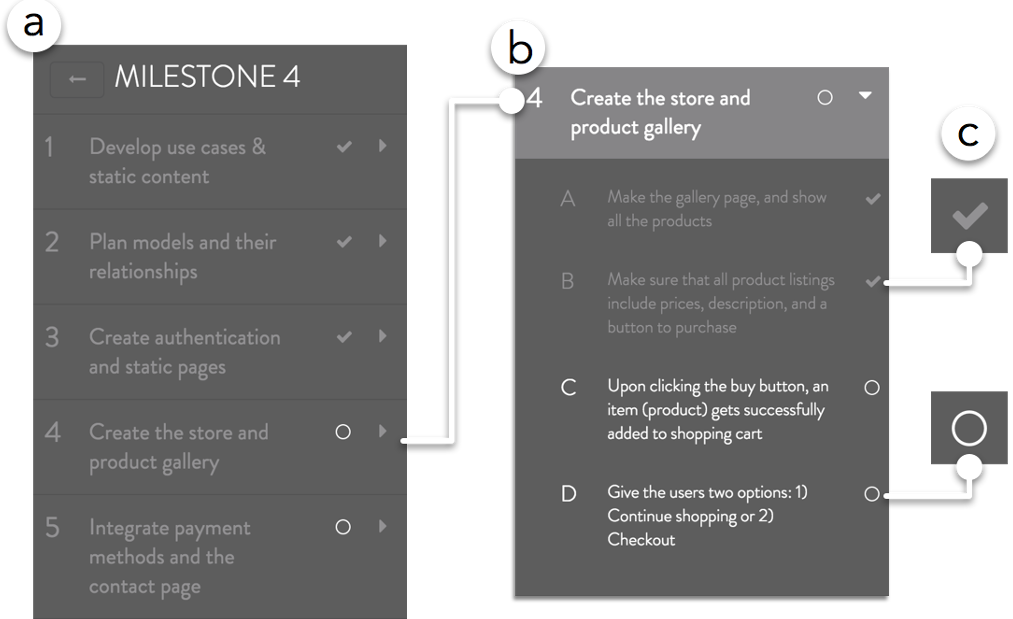 Figure: Mentors break down macro-scale goals into implementation-focused steps.
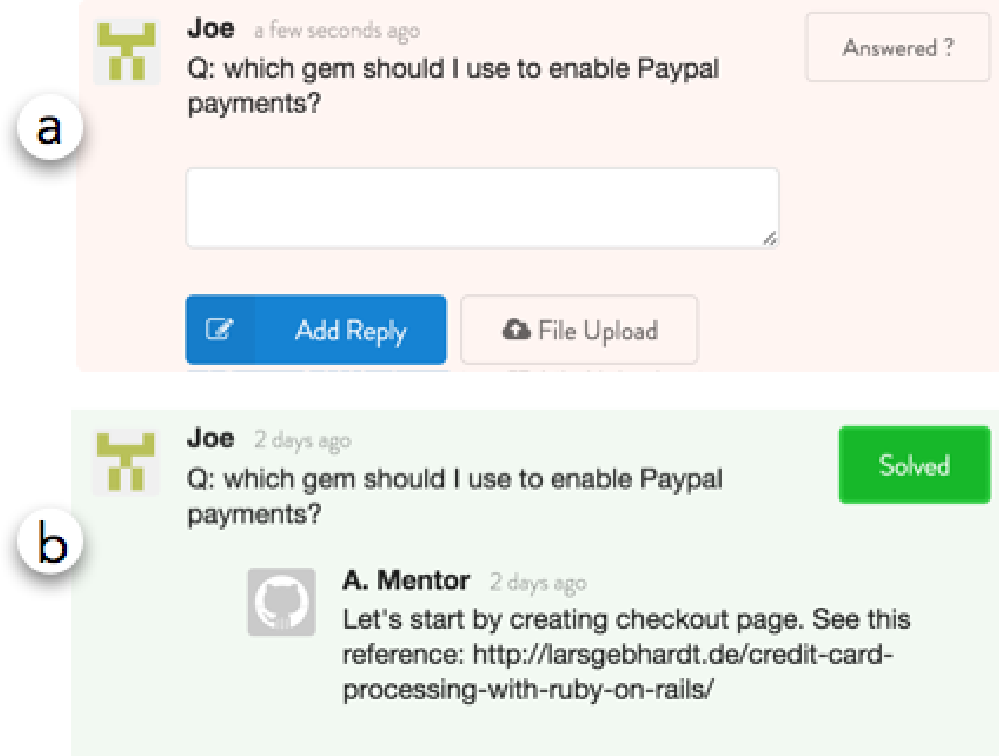
2. Just-in-Time Learning (Threaded Questions)
Instead of getting lost in a messy chat log, questions in Atelier are "first-class citizens." They move to a notification bar until they are resolved, ensuring the intern never stays stuck for long.
Does it actually work?
In a controlled experiment involving a Ruby on Rails e-commerce task, the results were telling:
- The "Expert Touch": Mentors didn't just fix bugs; they taught conventions (e.g., "Use the Braintree gem for checkout because it's industry standard").
- Quality Correlation: There was a strong correlation () between the number of questions asked and the final project's quality ranking.
- Economic Viability: Mentors earned their usual hourly rate ($~30/hr) because their time commitment was low, while interns effectively got a "paid education."
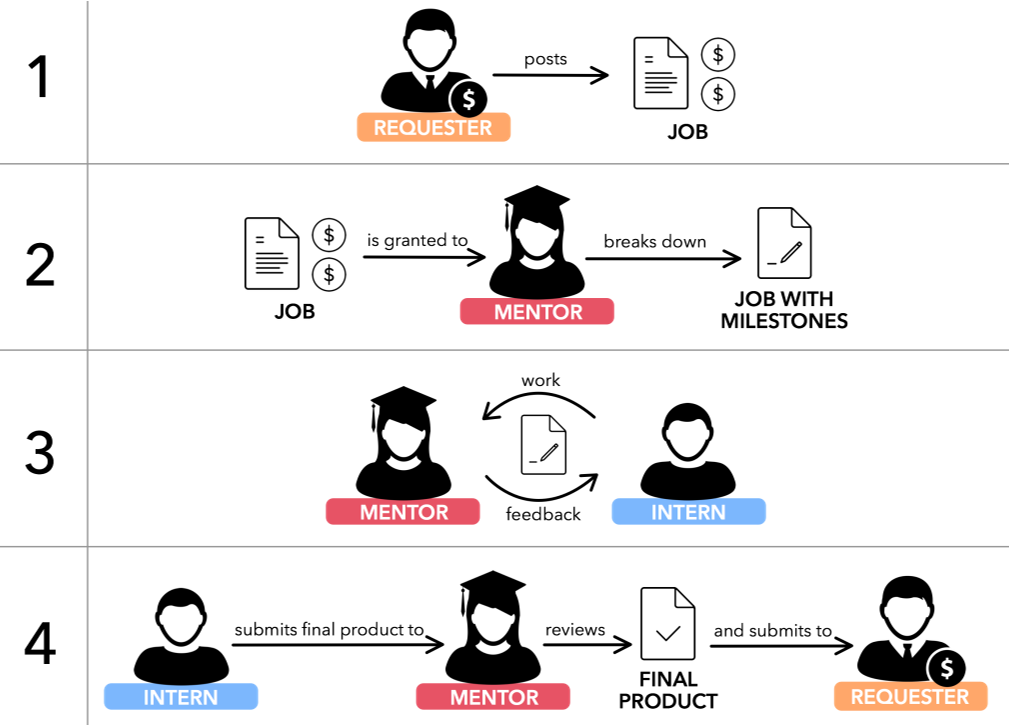 Figure: The process of connecting requesters, mentors, and interns within the marketplace ecosystem.
Critical Insight & Future Outlook
The Takeaway: Atelier proves that expert knowledge can be unbundled from labor. An expert doesn't have to do the work to provide the value—their value lies in the "scaffolding."
Limitations:
- Scalability of Altruism: While mentors felt intrinsically motivated, sustaining this without platform-level incentives (like "Mentor Badges") might be hard.
- Subjectivity: In creative fields like logo design, the authors found mentors focused more on technical tips than creative critique.
The Future: As AI starts automating "entry-level" tasks, the role of human workers may shift entirely toward this "Atelier" model—where humans provide the high-level scaffolding and quality control for both other humans and AI agents.