
Building Digital Fortresses: Trust-Based Collaboration in Wireless Video Social Networks
Attack-Resistant Collaboration in Wireless Video Streaming Social Networks
This paper proposes an attack-resistant cooperation framework for wireless P2P video streaming social networks. By integrating Beta-function-based trust modeling and a dynamic credit-line mechanism, it enables non-malicious users to identify and isolate attackers while maintaining high-quality streaming (SOTA performance in resisting up to 60% attackers).
TL;DR
In the volatile world of wireless P2P streaming, malicious actors often exploit channel instability to hide their attacks. This paper introduces a Trust-based Cooperation Strategy that utilizes collective history and statistical detection to unmask attackers, enabling robust video streaming even when 60% of the network is hostile.
Problem & Motivation: The "Dirty Channel" Excuse
In a wired P2P network, if a peer fails to send a data chunk, it’s usually seen as a sign of selfishness. However, in wireless networks, link quality is naturally unstable. Malicious users exploit this "plausible deniability," mimicking a non-malicious user with a bad connection to perform:
- Incomplete Chunk Attacks: Signing up to send data but only delivering fragments.
- Pollution Attacks: Distributing corrupted video data that spreads through the buffer.
- Handwash Attacks: Discarding a "burned" ID after detection and re-entering the network as a clean "newcomer."
The core challenge is distinguishing between intentional malice and environmental noise.
Methodology: The Anatomy of Trust
The authors move beyond simple "Tit-for-Tat" strategies by introducing a two-layered defense:
1. Statistical Detection
Users maintain counters for successful versus attempted transmissions. By applying a detection threshold (), they use a statistical formula to determine if a peer's failure rate is significantly worse than the expected channel success probability ().
2. Trust-Weighted Credit Lines
Instead of every user learning the hard way, the system uses a Trust Model.
- Direct Trust: Calculated via a Beta-function based on successful unpolluted chunk receipts.
- Collective Defense: If User A trusts User B, and User B has been harmed by Malicious User C, User A automatically reduces the "credit line" for User C.
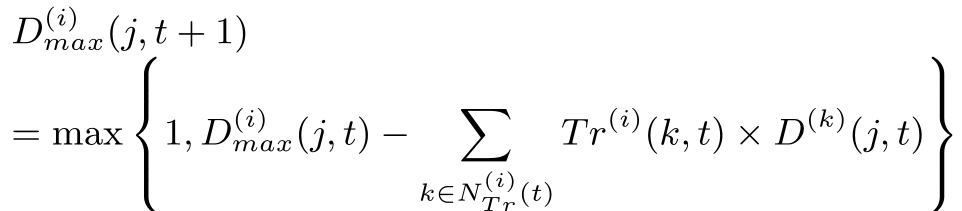 The credit line update rule shows how trust () weights the shared experience of peers to preemptively block attackers.
To prevent Bad-mouthing attacks (where attackers lie about good users), the authors set a "Cost-to-Trust" threshold (). An attacker must actually contribute a significant amount of useful data to the system before their "recommendations" are given weight.
Experiments & Results: Resilience Under Fire
The researchers compared their approach against Payment-based incentive schemes and Resource-Chain models.
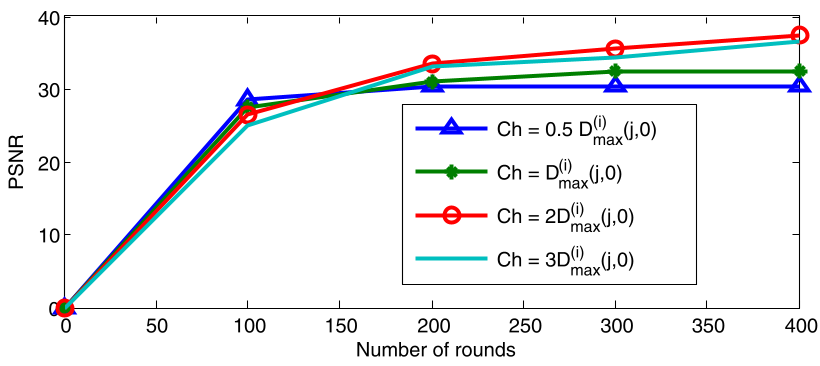 Fig 2: PSNR performance relative to the percentage of attackers.
Key Findings:
- Resilience: While payment-based systems collapse almost immediately under attack, the proposed trust model maintains a high video PSNR (above 35dB) even when 60% of peers are malicious.
- Optimization: There is a "Goldilocks zone" for the trust threshold. Setting too low allows attackers to infiltrate the trust circle; setting it too high makes the system too slow to react to new threats.
Critical Analysis & Conclusion
Takeaway
The genius of this work lies in treating a wireless network not just as a set of links, but as a Social Network. By formalizing "Reputation" into mathematical credit lines, the system effectively raises the "cost of entry" for attackers.
Limitations
The model assumes that users stay in the network for a "reasonably long time." In highly mobile scenarios (e.g., fast-moving vehicles), the time required to build a reliable trust score might exceed the connection duration, potentially leading to a "Cold Start" problem for security.
Future Outlook
This research provides a blueprint for secure decentralized media. As we move toward 6G and decentralized web (Web3) architectures, integrating these trust-based dynamics with cryptographic proofs could create virtually unhackable streaming ecosystems.