
The Social Media Double Standard: Navigating Fair Use in the Age of User-Generated Content
Aitudes About 'Fair Use' and Content Sharing in Social Media Applications
This study investigates user attitudes toward "Fair Use" and content sharing across 48 Social Networking Services (SNS) and messaging apps. By surveying 106 users, the authors identify a significant discrepancy between personal sharing behaviors and the legal/ethical expectations placed on others, specifically regarding attribution and reuse restrictions.
TL;DR
In the modern digital landscape, every user is a publisher, yet few understand the legal ramifications of "fair use." This study uncovers a paradox: social media users demand strict copyright protections and clear attributions from others, while simultaneously neglecting these same standards when sharing their own content. The findings suggest that our digital ethics are dictated more by social "communities of practice" than by actual legal knowledge.
Background: The Democratization of Publishing
The transition from passive consumption to User-Generated Content (UGC) on platforms like Instagram, Facebook, and Snapchat has blurred the lines between private sharing and public distribution. As the role of "gatekeepers" (editors and legal teams) vanishes, the responsibility for navigating U.S. copyright law falls onto the individual. This paper seeks to map the "mental models" users hold regarding these complex legal concepts outside of niche remix communities.
The Psychological Gap: "Do As I Say, Not As I Do"
The research highlights a fascinating psychological tension between Intellectual Integrity (the ethics of not plagiarizing) and Intellectual Property (the legal right to control work).
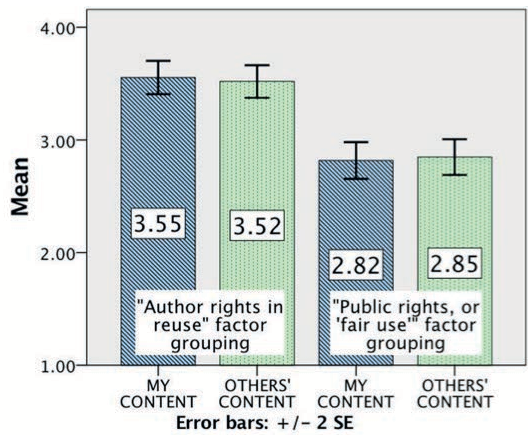
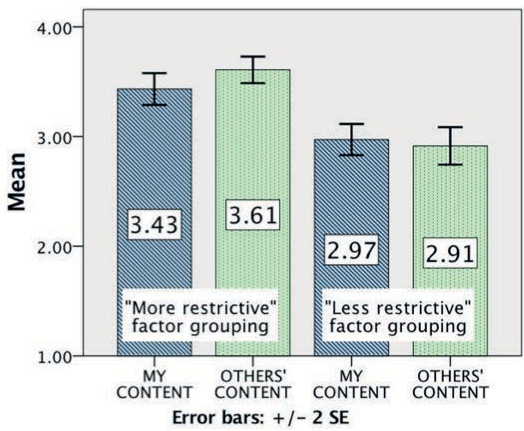
Through a survey of 106 users across 48 platforms, the authors discovered a statistically significant "double standard." Users generally agree that content should be protected, but they are far more likely to demand that other authors provide explicit reuse terms than they are to provide such terms for their own work.
Methodology: Analyzing Latent Attitudes
The researchers used Principal Component Analysis (PCA) to distill 42 different attitude measures into four core factor groupings:
- Restrictive Conditions: High barriers for reuse.
- Less-Restrictive Conditions: Open sharing.
- Author Rights: Protecting the creator.
- Public Rights (Fair Use): Protecting the right to iterate/share.
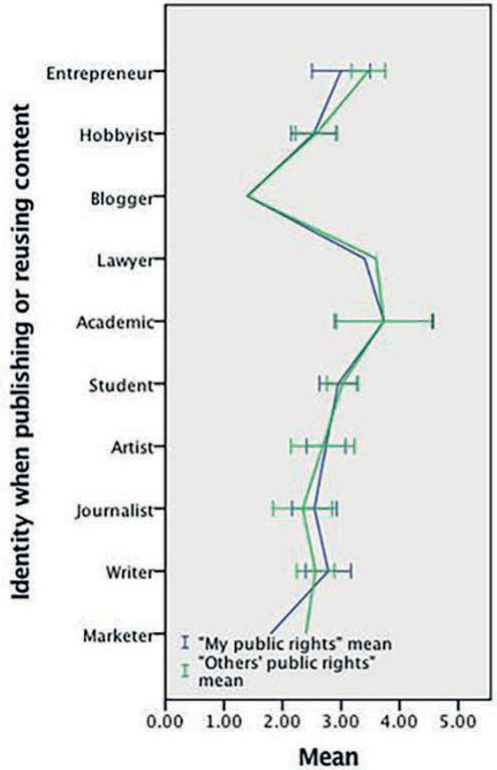
One of the most striking findings was that a user's identity—whether they see themselves as a journalist, student, or hobbyist—significantly dictates their attitude toward public rights. Journalists and students, who often receive formal IP training, showed different normative behaviors compared to the general public.
Key Insights: Sharing vs. Consent
A critical takeaway from the qualitative feedback is the confusion over UI elements. As one participant noted: "The presence of a 'share' button implies consent to 'promote' something, but not necessarily consent to publish or reuse content."
This highlights a massive affordance-legal gap. Platforms design for frictionless sharing, which users interpret as a social green light, even if the legal reality is a red light.
Critical Analysis & Conclusion
This paper serves as a wake-up call for HCI (Human-Computer Interaction) designers. We cannot assume that "social norms" will naturally align with "legal norms."
Limitations: The study relies on a snowball sample of 106 participants, primarily from a specific geographic region (Indiana), which may limit the generalizability of the findings to a global context where copyright laws vary significantly.
Future Outlook: As we move toward a world where AI-generated content further complicates "authorship," the confusion documented here will only intensify. The authors suggest that "contextual inquiries"—observing users in their natural environment—is the necessary next step to solve the friction between how we share and how we protect.