
ACCNN: Harnessing Attribute Cooperation for Fine-Grained Remote Sensing Classification
Attribute-Cooperated Convolutional Neural Network for Remote Sensing Image Classification
The paper introduces the Attribute-Cooperated Convolutional Neural Network (ACCNN), a multi-task learning framework designed for Remote Sensing Image (RSI) classification. By leveraging an auxiliary attribute learning branch and a relationship branch, the model achieves state-of-the-art performance on benchmarks like AC-UCM and AC-Sydney.
Executive Summary
TL;DR: The Attribute-Cooperated Convolutional Neural Network (ACCNN) addresses the challenge of distinguishing visually similar remote sensing scenes (e.g., "Dense Residential" vs. "Medium Residential") by introducing an auxiliary attribute learning task. By balancing hard and soft parameter sharing, it guides the model to learn more discriminative, semantically rich features.
Background: In the landscape of Remote Sensing Image (RSI) classification, we are moving beyond simple deep feature extraction into the realm of multi-task synergy. This work is a pivotal "SOTA challenger" that proves that what a model sees (attributes) is just as important as what it labels (categories).
Problem & Motivation: The "Desert vs. Bare Land" Dilemma
In remote sensing, different categories often share nearly identical visual textures. This "fine-grained" nature makes traditional CNNs, which only care about the final class label, prone to error.
The authors identify two major gaps in current research:
- Information Scarcity: Category labels alone don't explain why a scene is a "Port" (it has water, boats, and docks).
- The Multi-task Trap: Naive multi-task learning (hard-sharing everything) often fails because high-level features for class A might conflict with the requirements for attribute B.
Methodology: The ACCNN Architecture
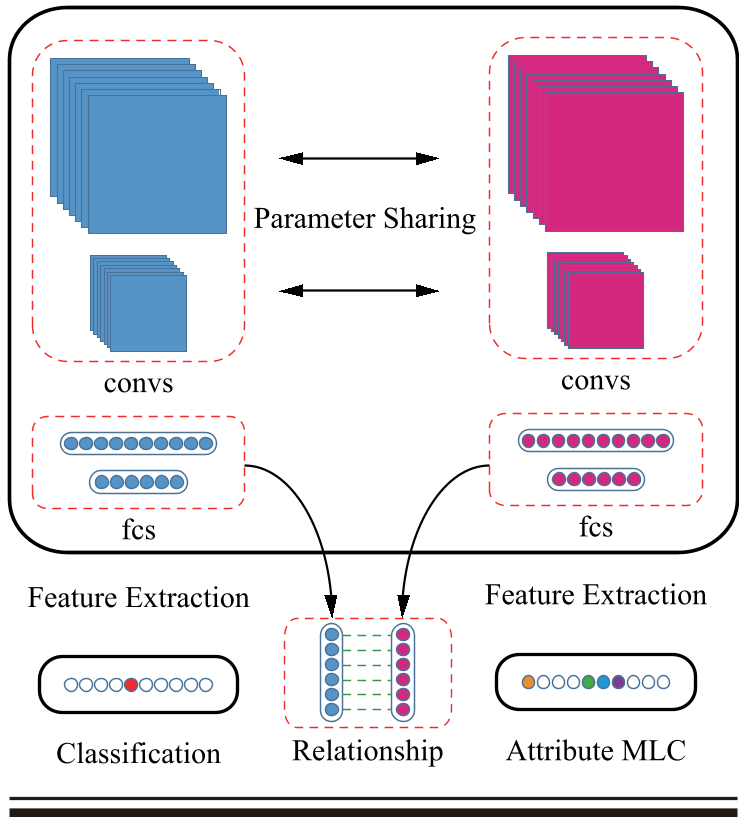
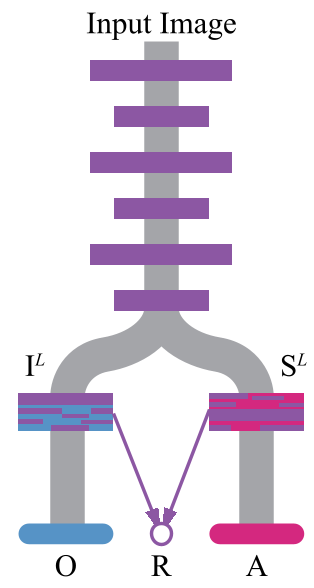
The core innovation lies in the triplet-branch structure and its specific weight-sharing strategy.
1. Dual-Task Learning
- Classification Branch: Standard Softmax cross-entropy for scene labels.
- Attribute Branch: Sigmoid-based multi-label classification to identify sub-features like "trees," "pavement," or "water."
2. The Relationship Branch (Soft Sharing)
Instead of forcing the deep fully connected (FC) layers to be identical, the relationship branch maps high-level features from both tasks into a shared space and applies a distance constraint (L2 norm). This allows the tasks to "communicate" without being "identical."
3. Data Engineering: The Attribute Pipeline
A major contribution is the creation of three new "Attribute Cooperated" datasets: AC-AID, AC-UCM, and AC-Sydney. The authors developed a pipeline to automatically extract stable attribute labels from existing image captions, bypassing the need for manual exhaustive labeling.
Experiments & Results: Proving the Power of Cooperation
The authors validated ACCNN against a suite of SOTA methods, including fusion-based approaches like DCA-Fusion.
Performance Gains
- AC-UCM: Error rate dropped to 4.05%, outperforming the second-best method by over 2%.
- AC-Sydney: Achieved 4.13% error, a significant improvement over the VGG-Net baseline (7.19%).
Ablation Insight
The ablation study revealed that while the attribute branch alone helps, the Relationship Branch (Soft Sharing) provides the final boost needed to reach SOTA. Without it, the model experiences lower efficiency in information transfer between the tasks.
Critical Analysis & Conclusion
Takeaway
ACCNN demonstrates that high-level semantic attributes serve as a powerful regularizer for RSI classification. The success of the "Relationship Branch" suggests that in specialized domains like remote sensing, soft constraints are superior to hard parameter sharing for high-level semantic layers.
Limitations & Future Work
- Scalability: The current attribute extraction relies on existing captions. For datasets without captions, the pipeline is less effective.
- Computational Overhead: Training three branches is more intensive than a single-stream CNN.
- Future Path: Transitioning this attribute-cooperation logic into modern Vision Transformers (ViT) or using Large Language Models (LLMs) to generate even more nuanced attribute labels could be the next frontier.