
Other Times, Other Values: Solving the "Identity Drift" in Social Networks
Other times, other values: leveraging attribute history to link user profiles across online social networks
The paper introduces a novel profile linking framework that leverages "Attribute History" (past values of attributes like usernames) to connect user accounts across multiple Online Social Networks (OSNs). By analyzing the evolution of usernames over time on platforms like Twitter, Facebook, Instagram, and Tumblr, the authors propose a cascaded classification approach that significantly improves the detection of linked profiles when current attribute values appear dissimilar.
TL;DR
Most algorithms trying to "link" your Twitter to your Instagram fail as soon as you change your username. This paper introduces the concept of Attribute History—tracking who you were to prove who you are. By comparing the evolution of usernames over time, researchers boosted profile linking accuracy by 44% over traditional methods that only look at your current handle.
Executive Summary
In the world of Online Social Networks (OSNs), your digital identity is not a static snapshot; it is a moving target. Users evolve their usernames due to privacy concerns, aesthetic trends, or platform-specific niches (e.g., a professional handle on LinkedIn vs. a creative one on Tumblr). This paper identifies this "Evolution Gap" as the primary reason why SOTA profile linking methods fail. The authors shift the paradigm from Static Comparison to Temporal Behavioral Analysis, proving that our habits in changing our identity are just as unique as the identity itself.
The "Evolution Gap": Why Accuracy Struggles
Traditional methods assume that if "User A" on Twitter is the same as "User B" on Facebook, their usernames must be highly similar right now.
The authors conducted a massive tracking study of 8.7 million users and discovered a jarring reality:
- 73.21% of users change their attributes over a two-month period.
- 78% of users have usernames across different platforms with a Jaro similarity of less than 0.7.
Existing algorithms essentially "give up" when they see these dissimilar strings. The authors' insight is simple: Your current Twitter handle might not match your Facebook handle, but it might match a handle you used on Facebook last year.
Methodology: The Power of Behavioral Patterns
The paper proposes a Cascaded Framework to catch what others miss.
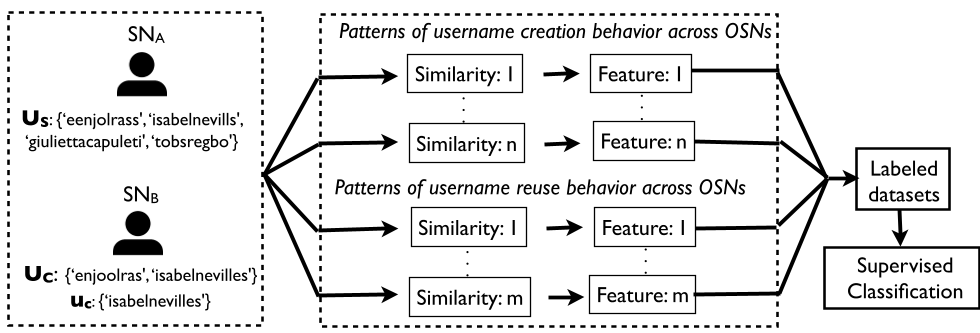
The researchers extracted 26 features categorized into two main behavioral buckets:
1. Username Creation Patterns (Static & Temporal)
Even when we change names, we are creatures of habit. The model analyzes:
- String Properties: Length preferences, character distributions (vowels vs. numbers), and character arrangement (captured via JS Divergence and Jaccard Similarity).
- Temporal Evolution: Using Normalized Cross-Correlation (NCC) to check if the way you change your name (e.g., making it progressively shorter) is consistent across platforms.
2. Username Reuse Patterns
Users often juggle handles between platforms. The model tracks:
- Occasional Reuse: Does an old handle from Platform A suddenly appear as the current handle on Platform B?
- Frequent Reuse: Synchronous updates where a user changes their name to the same new handle across all accounts simultaneously.
Experimental Results & SOTA Performance
The system was tested on a labeled dataset involving Twitter, Instagram, Facebook, and Tumblr.
| Metric | Current Methods (Baselines) | This Work (Cascaded SVM) |
|---|---|---|
| False Negative Rate (FNR) | ~89.3% | ~45.1% |
| Total Accuracy | ~55.4% | ~76.7% |
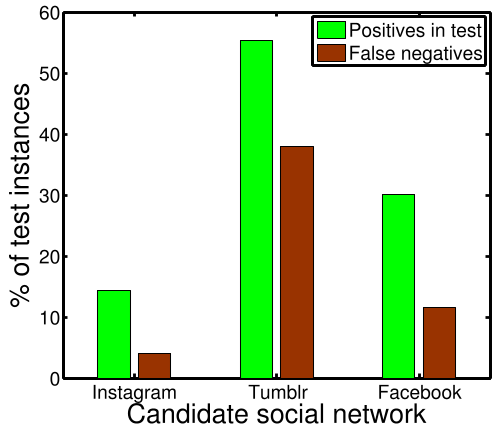
Note: When excluding "noisy" platforms like Tumblr (where users often adopt wildly different persona names), the accuracy jumped to an impressive 91.2%.
The authors found that longest common subsequence (LCSub) similarity and edit distance remained the most powerful features. Interestingly, the longer a user's history, the more effective the model becomes—confirming that "time" is a friend to identity resolution.
Critical Insights & Future Outlook
Takeaway: This paper is a wake-up call for researchers working on "Entity Resolution." Static snapshots are insufficient for active, evolving digital citizens.
Limitations:
- Platform Sensitivity: The model struggles with Tumblr, where the platform's culture encourages "identity play" and total pseudonymity that breaks the behavioral link.
- Data Availability: Finding an "Attribute History" isn't always easy if you aren't already tracking the user. However, the authors suggest querying public datasets or timeline mentions to reconstruct this history retroactively.
The Future: As AI-driven psychographics become more important for marketing and security, "Temporal Identity" will become the new standard for verifying who is standing behind the screen across the fragmented social web.