
Scaling Reach: How LinkedIn's Audience Expansion Redefines Social Advertising
Audience Expansion for Online Social Network Advertising
This paper introduces LinkedIn's Audience Expansion system, which utilizes "Similar-X" recommender algorithms to automatically enlarge advertiser-defined target segments. The system integrates campaign-agnostic attribute expansion and campaign-aware lookalike modeling to achieve SOTA performance in increasing ad reach and platform inventory utilization on social networks.
TL;DR
LinkedIn's Audience Expansion system bridges the gap between narrow demographic targeting and broad market reach. By combining profile-level attribute enrichment with massive-scale lookalike modeling (Similar-X), the system has achieved a 97% increase in impressions for advertisers while doubling the overall value (social welfare) delivered through the platform.
Background & Motivation: The Targeting Dilemma
In the world of professional social networks, targeting is a double-edged sword. While an advertiser can target "Software Engineers in the US with Machine Learning skills," the sheer cardinality of attributes—millions of companies and tens of thousands of skills—means most advertisers leave potential customers on the table.
The authors identify a critical friction point: Keyword/Profile Exhaustion. Advertisers cannot possibly list every synonymous skill or related company. Existing "lookalike" models usually require a pre-existing list of converters, creating a high barrier to entry. LinkedIn's goal was to make expansion as simple as a checkbox, active from the moment a campaign launches.
Methodology: The Two-Pronged Hybrid Approach
The system architecture balances speed and precision through two distinct sub-systems:
1. Campaign-Agnostic Expansion (The "Fast" Path)
This method operates at the user-profile level. Using the Similar-X framework, the system treats entity types (skills, titles, companies) as documents in a Vector Space Model (VSM).
- Logic: If you have "Data Mining" on your profile, the system dynamically treats you as also having "Machine Learning" for ad-matching purposes.
- Personalization: It uses a propensity model to ensure that these expanded attributes are actually relevant to the specific user, preventing "blind" expansion.
2. Campaign-Aware Expansion (The "Precision" Path)
This is a classic Lookalike Modeling problem framed as a nearest-neighbor search.
- The Scale Challenge: With over 400 million members, a brute-force search is impossible.
- The Solution: They utilize Locality Sensitive Hashing (LSH) via an algorithm called Arcos. Members are hashed into clusters; the system only searches for "lookalikes" within the same hash bucket, dramatically reducing compute time.
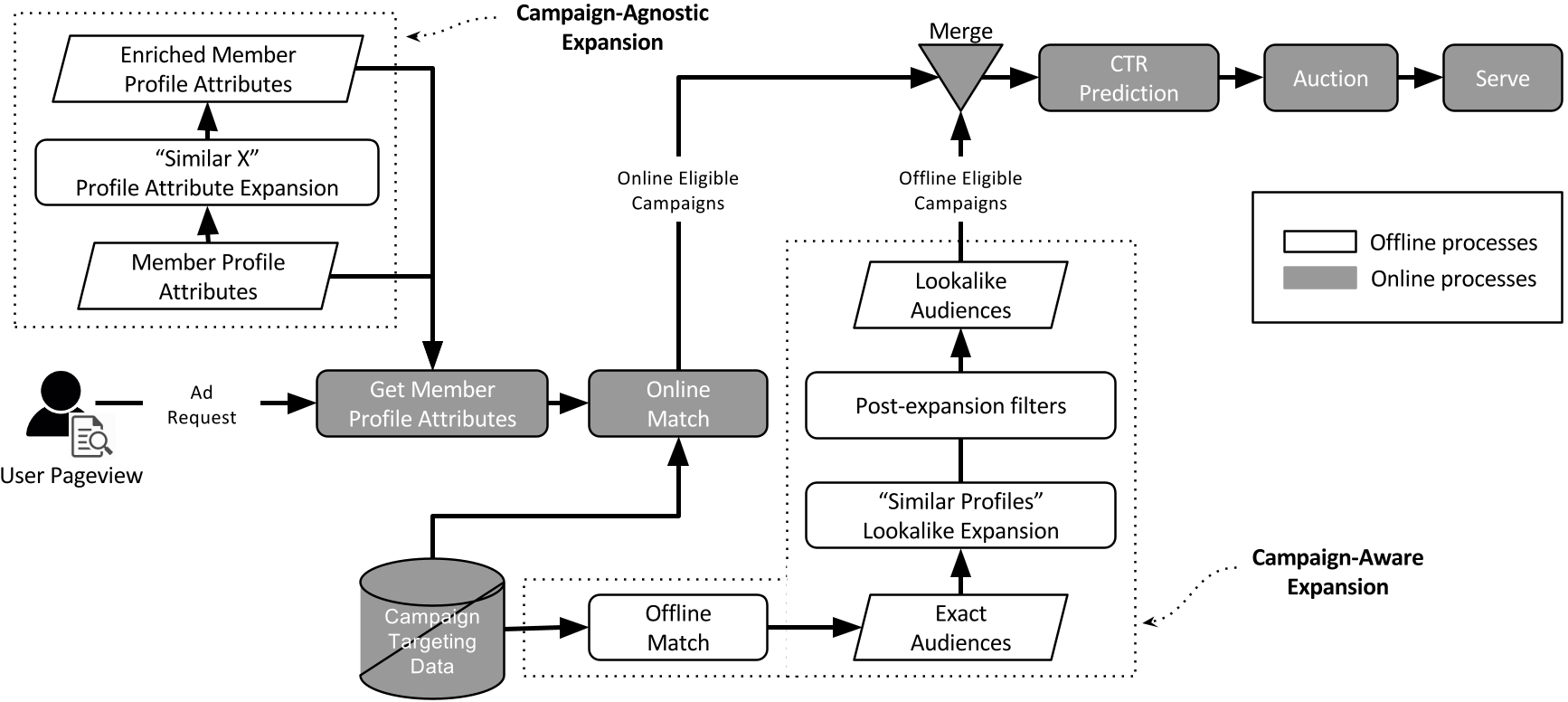 Figure 1: The hybrid ads serving workflow, integrating offline LSH-based expansion with online real-time scoring.
Why It Works: The Physics of Similarity
The secret sauce lies in the Fitness Score (F) between a member and a campaign. Instead of a binary "match," it calculates the sum of similarities between the candidate and the original target audience:
The denominator uses a square root damping factor—a clever engineering trick to ensure that campaigns with huge audiences don't "swallow" all the expansion slots, while still rewarding campaigns that have more "evidence" of what their ideal user looks like.
Experimental Results: High Stakes, High Yield
The researchers conducted extensive A/B testing on live traffic, comparing the hybrid model against a control group.
| Metric | Campaign-Aware | Hybrid |
|---|---|---|
| impressions | +93.85% | +96.97% |
| Revenue | +105.97% | +111.60% |
| Value (Social Welfare) | +100.80% | +106.00% |
Crucially, while impressions nearly doubled, the Dwell Time (the time a user spends on the advertiser's landing page) remained stable. This proves that the expanded audience was just as engaged as the original "exact match" audience.
 Table 4: Significant gains in Reach and Value for expansion-enabled campaigns.
Critical Insight: The "Expensive Member" Filter
One sophisticated addition to the system is the Post-Expansion Filter. By running a regression on historical bids, the system predicts which members are likely to be "expensive" (highly targeted by many advertisers). It intentionally removes the top most expensive members from expanded audiences. This protects advertisers from paying "premium" prices for users who weren't in their original target list, ensuring the expansion remains cost-effective.
Conclusion & The Future
LinkedIn's Audience Expansion is a masterclass in applying academic IR (Information Retrieval) techniques—VSM, LSH, and Logistic Regression—to a massive-scale industrial problem.
Future Outlook: The authors suggest moving toward behavior-based signals (actual ad clicks) rather than just profile similarity. As social networks move toward more implicit signal processing, we can expect these models to rely less on what users say they do (on their profiles) and more on what they demonstrate they want.