
Who is Watching? Audio-Based Demographic Identification for Smart TV Recommendations
13837_Audio-based age and gender identification to enhance the recommendation of TV content.
This paper presents a system for recommending TV content (specifically advertisements) to groups of viewers by identifying their age and gender through audio analysis. It combines a state-of-the-art hybrid acoustic-prosodic classifier with a genetic recommender algorithm and a novel proportional adaptation mechanism to match content to group demographics.
TL;DR
Researchers have developed a system that "listens" to TV viewers to identify their age and gender, using this data to curate personalized advertisement sequences. By combining hybrid audio classifiers with a genetic algorithm and a novel proportional mapping technique, the system significantly improves recommendation relevance for groups, even when the number of viewers doesn't match the number of available content slots.
Problem & Motivation: The Multi-User Dilemma
In the era of smart TVs, personalization is king. However, most systems assume a single user. In a typical household, groups of viewers (families, friends) share the screen, often under a single login. Manually selecting "who is watching" is tedious, and cameras for facial recognition raise privacy concerns.
The authors identify a critical gap: Home audio environments are rich in demographic data. By analyzing speech patterns, a system can implicitly determine the group's composition. The challenge lies in managing the noise of background TV audio and the inherent inaccuracies of state-of-the-art (SOTA) audio classifiers, which historically hover around 50-60% accuracy for multi-class age/gender tasks.
Methodology: From Audio Waves to Genetic Sequences
1. Hybrid Audio Classification
The system doesn't just look at what is said, but how it is said. It uses two subsystems:
- Acoustic Subsystem: Uses GMM-UBM with Mel Frequency Cepstral Coefficients (MFCCs) to capture the spectral envelope of the voice.
- Prosodic Subsystem: Analyzes syllable-level features like pitch, energy, and duration contours, modeled as Legendre polynomials. The fusion of these two provides a probabilistic membership vector for 7 classes (e.g., Child, Adult Male, Senior Female).
2. Proportional Group Profile Adaptation
A major technical hurdle is when the number of viewers () differs from the number of content slots (). If 3 people watch 5 ads, how do you distribute the "attention"? The authors propose the Double Circle Diagram method.
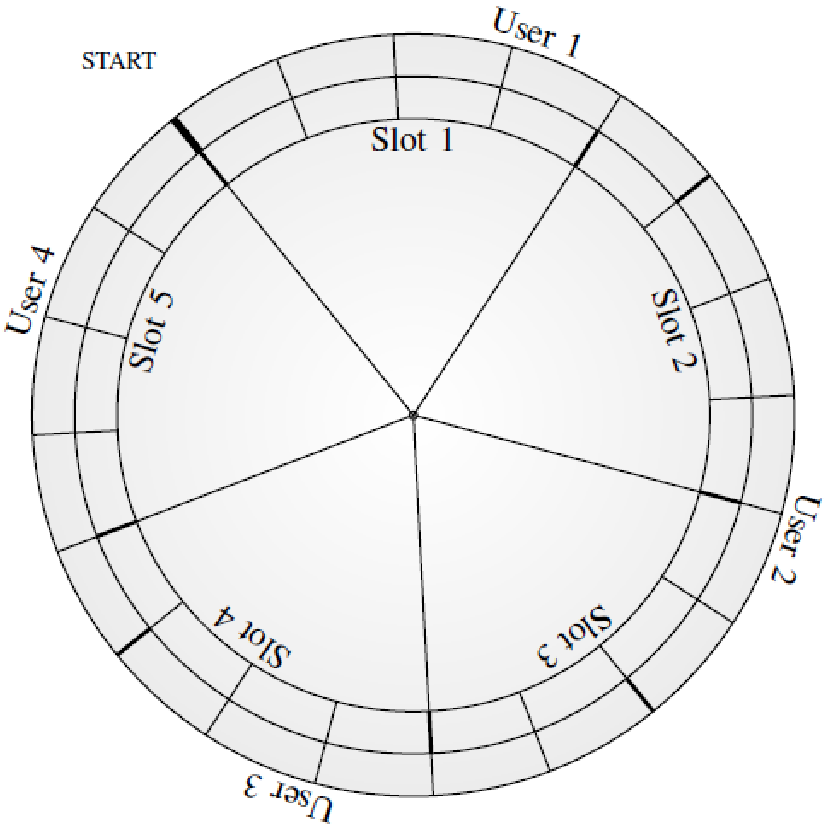
This algorithm treats the group and the slots as two concentric circles divided into bins. By calculating the overlap between "user bins" and "slot bins," it ensures that demographic preferences are represented proportionally in the final content sequence.
3. Genetic Recommender
To find the optimal sequence of advertisements, the system employs a Genetic Algorithm (GA). It treats each potential sequence as a "chromosome" and uses a fitness function based on the trace of the product of the content ratings and the adapted group profile. Through crossover and mutation, the GA converges on a sequence that maximizes group satisfaction.
Experiments & Results: Better than Random, Close to Ideal
The system was tested against 50 different "Group Viewer Configurations" (GVCs) emulating Danish household statistics.
- Predictive Accuracy: While an "Ideal System" (with perfect demographic info) achieved a Cramer's V of 0.44, the audio-derived system reached 0.26. While lower, this still represents a "very strong" statistical association.
- User Satisfaction: In a blind study, users rated the recommended ads at 7.75/10, a massive jump from the 4.25/10 rating given to random sequences.
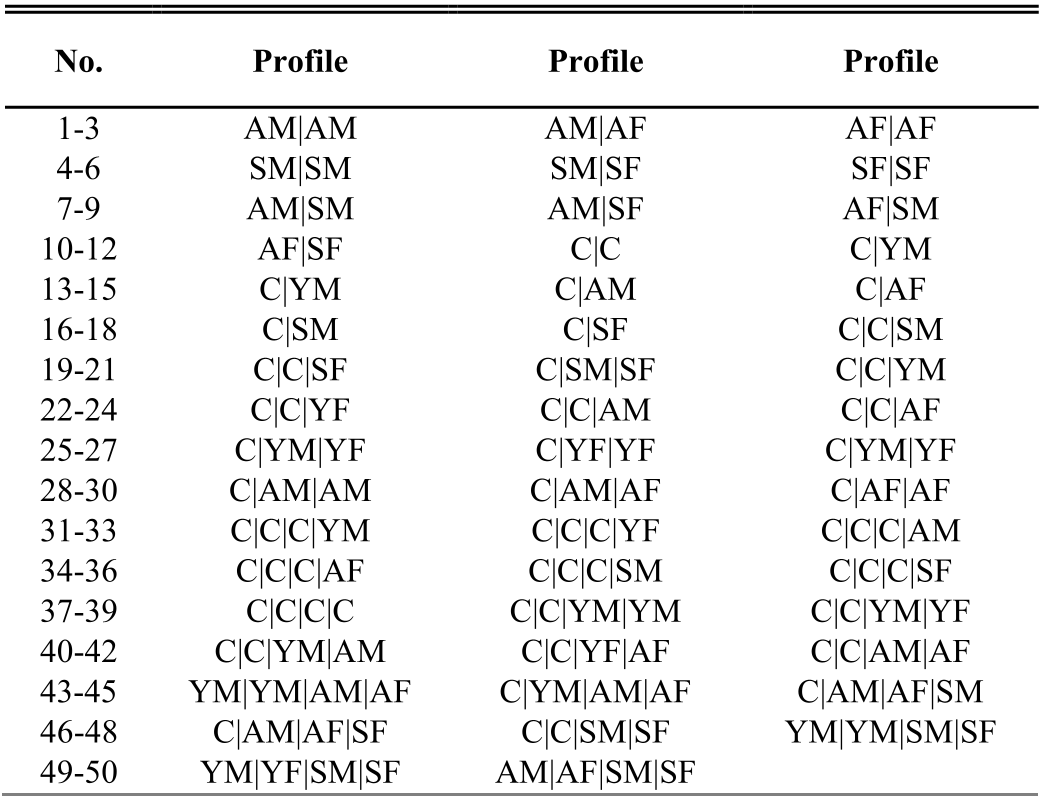 Figure: The diverse GVCs used to validate the system, covering various family structures.
Critical Insight: The Strength of Soft Boundaries
The most profound takeaway is that high-precision classification isn't mandatory for high-value recommendations. The classifier's "confusion" (e.g., mistaking a Young Female for an Adult Female) is often mitigated by the fact that many products (ads) appeal to both categories. These "soft market boundaries" allow the system to remain robust even when the underlying audio analysis is imperfect.
Future Outlook
While this paper lays a solid foundation, future work could integrate Deep Learning (CNNs/LSTMs) to replace GMMs, potentially pushing the classification accuracy closer to the "Ideal" threshold. Furthermore, the inclusion of unobtrusive relevance feedback—listening for positive or negative verbal reactions from the crowd—could create a self-correcting loop, making the TV a truly "attentive" member of the household.