
Audio-Driven Facial Animation: Bridging the Gap Between Speech and Emotion
1018_Audio-driven facial animation by joint end-to-end learning of pose and emotion.
The paper presents a deep convolutional neural network (CNN) for real-time, audio-driven 3D facial animation. By utilizing an end-to-end learning approach, the model maps raw audio waveforms to 3D vertex positions while simultaneously learning a latent "emotion code" to handle facial expressions not captured by audio alone.
TL;DR
NVIDIA researchers have developed a deep learning pipeline that transforms raw audio into expressive 3D facial animation in real-time. By introducing a "latent emotion code," the model overcomes the classic "regression to the mean" problem, allowing a single audio track to drive various emotional states (happy, sad, surprised) without expensive manual labeling.
Academic Positioning: This work is a seminal "End-to-End" SOTA contribution that shifted facial animation from rule-based viseme mapping to data-driven neural regression.
Problem & Motivation: The Ambiguity of Silence and Sound
In computer graphics, the "Uncanny Valley" is the enemy. Traditional systems rely on Visemes (the visual counterpart of phonemes), but human speech is far more complex due to Coarticulation—the way the previous and next sounds affect the current mouth shape.
The fundamental technical hurdle is ambiguity. For example:
- You can say "Hello" while smiling or while angry.
- You can be silent with a neutral face or a terrified one.
If a standard Neural Network sees these conflicting examples, it averages them out, resulting in a "mushy," expressionless face. The authors realized they needed a system that understands both what is being said (audio) and how it is being said (emotion).
Methodology: The Core Architecture
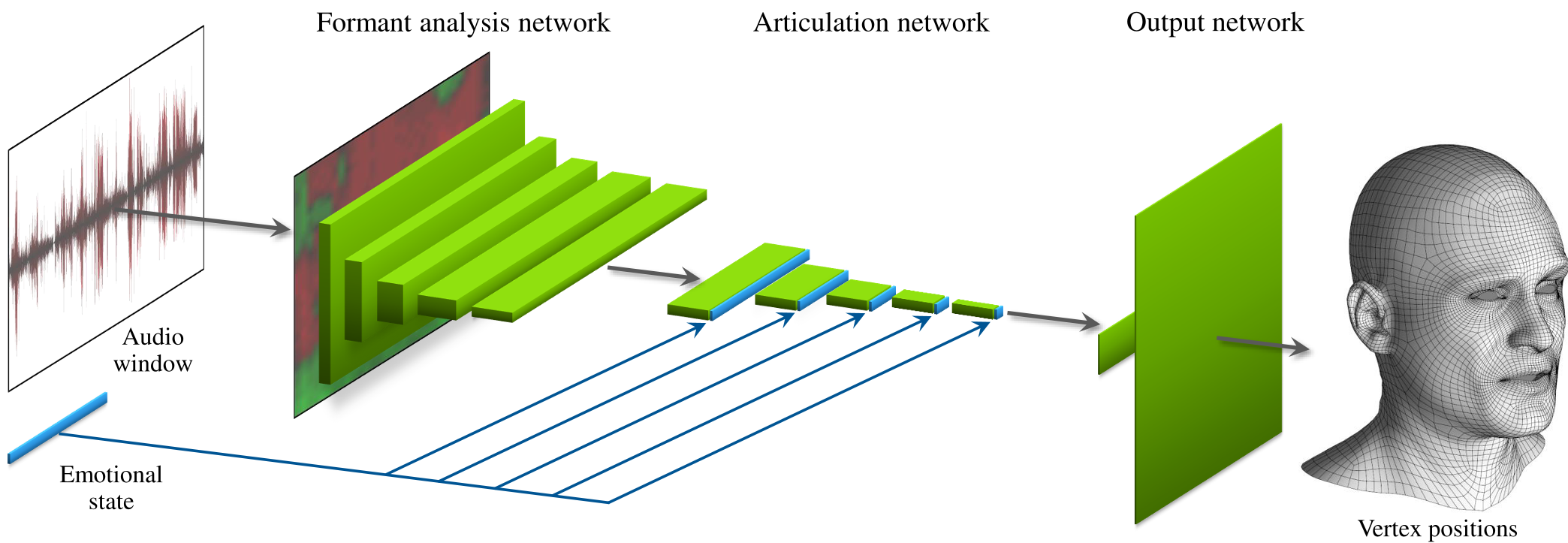
The authors propose an end-to-end CNN architecture divided into three specific stages:
- Formant Analysis Network: Instead of complex phonetic transcripts, the model uses an Autocorrelation Layer. This extracts resonance frequencies (formants) from the waveform, which are the physical fingerprints of speech sounds.
- Articulation Network with Latent Emotion: This is the "secret sauce." The network takes an -dimensional vector (Latent Code) from an "Emotion Database." This code acts as a secondary input that disambiguates the expression. During training, the network learns these codes automatically via backpropagation—no manual "happy/sad" labels required.
- Output Network: To remain agnostic to specific rigs, the model outputs raw 3D vertex positions for a fixed-topology mesh.
The Three-Way Loss Function
To ensure the animation doesn't jitter and stays "in character," the loss function is a weighted balance of:
- Position Term (): Accuracy of vertex placement.
- Motion Term (): Ensures the velocity of vertices matches the ground truth (vital for lip-sync).
- Regularization Term (): Forces the emotion code to change slowly, preventing the model from "cheating" by hiding speech information in the emotion vector.
Experiments & Results
The model was trained on only 3–5 minutes of high-quality vision-captured data per actor.
Key Findings:
- Cross-Speaker Generalization: Even when trained on a specific actor, the model performed remarkably well on novel voices, different genders, and even foreign languages (Spanish, Italian, German).
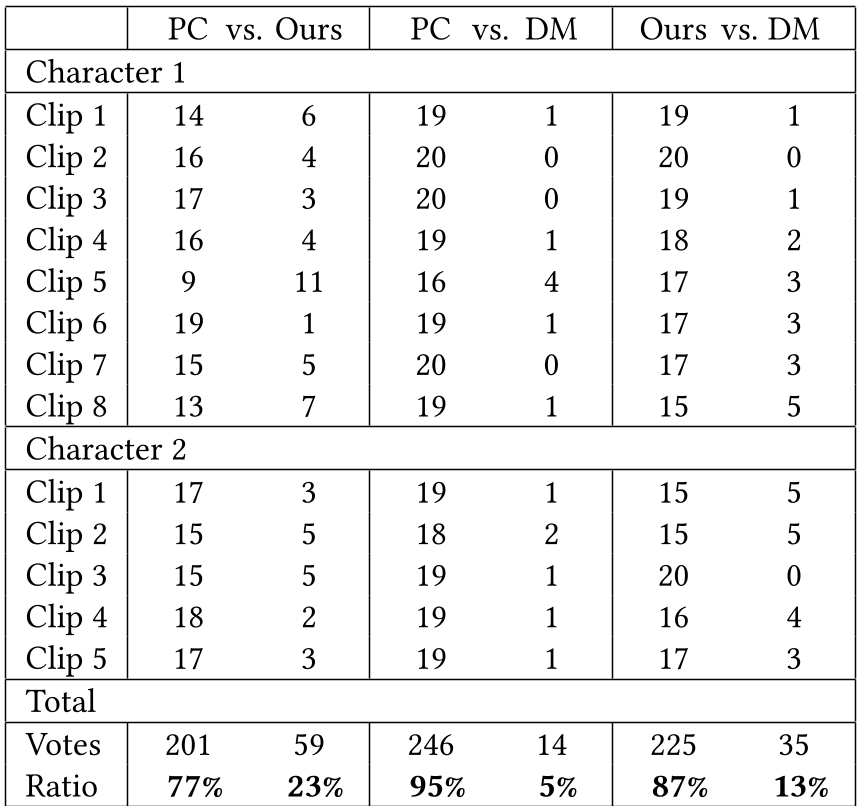
- User Preference: In a blind test, "Ours" was preferred over the industry-standard Dominance Model 87% of the time.
Emotion Control
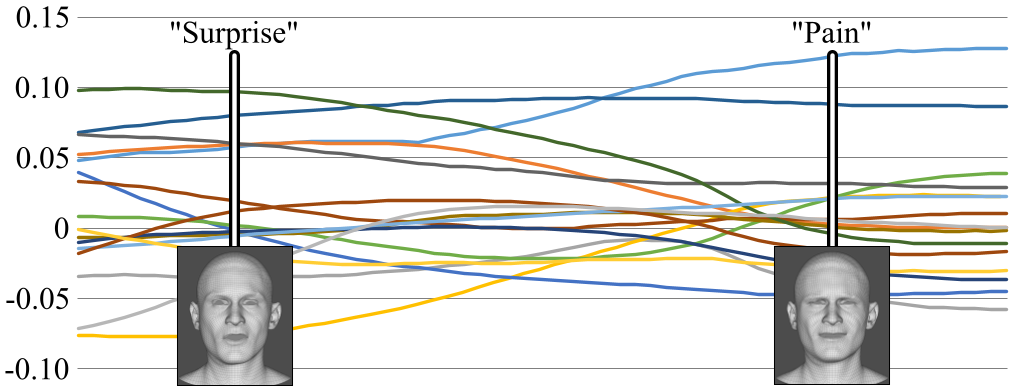
Because the emotion vectors are learned in a continuous latent space, users can manually "mine" these vectors to find a "Happy" or "Angry" state and even interpolate between them smoothly during a live performance.
Critical Analysis & Conclusion
Takeaway: This paper proves that high-fidelity facial animation doesn't require massive datasets of labeled emotions. By treating emotion as a latent "disentangled" variable, we can achieve far more natural results than viseme-based systems.
Limitations:
- Fine Detail: The model struggles with micro-expressions like wrinkles or tongue movements (which wasn't visible in the vision-capture training data).
- Latency: While ~100ms is "real-time," it might still be noticeable in high-speed competitive VR environments.
Future Outlook: This framework paves the way for modern "Audio-to-Face" tech. The next step, as hinted by the authors, involves using Generative Adversarial Networks (GANs) or Transformers to synthesize the high-frequency skin details that this CNN-based approach currently misses.