
Emotion Recognition in the 5G Era: Scaling Affective Computing with Big Data and Hadoop
Audio-Visual Emotion Recognition Using Big Data Towards 5G
This paper proposes a bimodal audio-visual emotion recognition framework integrated with 5G and cloud computing technologies to handle big data. It utilizes Multi-Directional Regression (MDR) for speech and Weber Local Descriptor (WLD) for facial features, achieving a SOTA accuracy of 83.10% on the eNTERFACE'05 database.
TL;DR
As we transition into high-bandwidth, low-latency 5G environments, the demand for personalized, emotionally-aware mobile services is skyrocketing. This paper presents a robust infrastructure that combines audio-visual bimodal emotion recognition with Hadoop-based cloud computing. By leveraging MDR (Multi-Directional Regression) and WLD (Weber Local Descriptor) features, the system achieves 83.10% accuracy and demonstrates a massive 22x speedup in processing large-scale emotional data.
Problem & Motivation: The Bottleneck of Affective Computing
Existing emotion recognition methods often operate in isolation—focusing either on a single modality (just speech or just video) or ignoring the computational overhead required to process "Big Data" in real-time. In the context of 5G, where billions of devices generate continuous streams of multimedia data, the challenges are two-fold:
- Accuracy Gap: Single-modality systems often confuse similar emotions (e.g., fear vs. disgust).
- Scalability Gap: Processing high-resolution video and audio data for thousands of users simultaneously on a single server is computationally impossible.
The authors' insight is to bridge this by creating a distributed, "emotion-aware" cloud layer that can provide instant feedback to alleviate negative user emotions (sadness, anger) in smart home or health monitoring applications.
Methodology: Feature Engineering and Cloud Architecture
1. Bimodal Feature Extraction
The core of the recognition engine relies on two distinct descriptors:
- Audio (MDR): The system treats Mel-spectrograms as images and applies directional regressions (0°, 45°, 90°, 135°) to capture temporal and frequency-based emotional nuances in speech.
- Visual (WLD): Instead of raw pixels, the authors use the Weber Local Descriptor. Based on Weber's Law (human perception depends on stimulus intensity ratios), WLD captures "Difference Excitation" and "Gradient Orientation," making it highly robust to lighting changes.
2. Distributed Cloud Strategy
To handle the "Big Data" aspect, the paper employs a Hadoop Distributed File System (HDFS) and MapReduce. By chunking video data into blocks (optimally 256MB–512MB), the system parallelizes face tracking and feature extraction across multiple computational nodes.
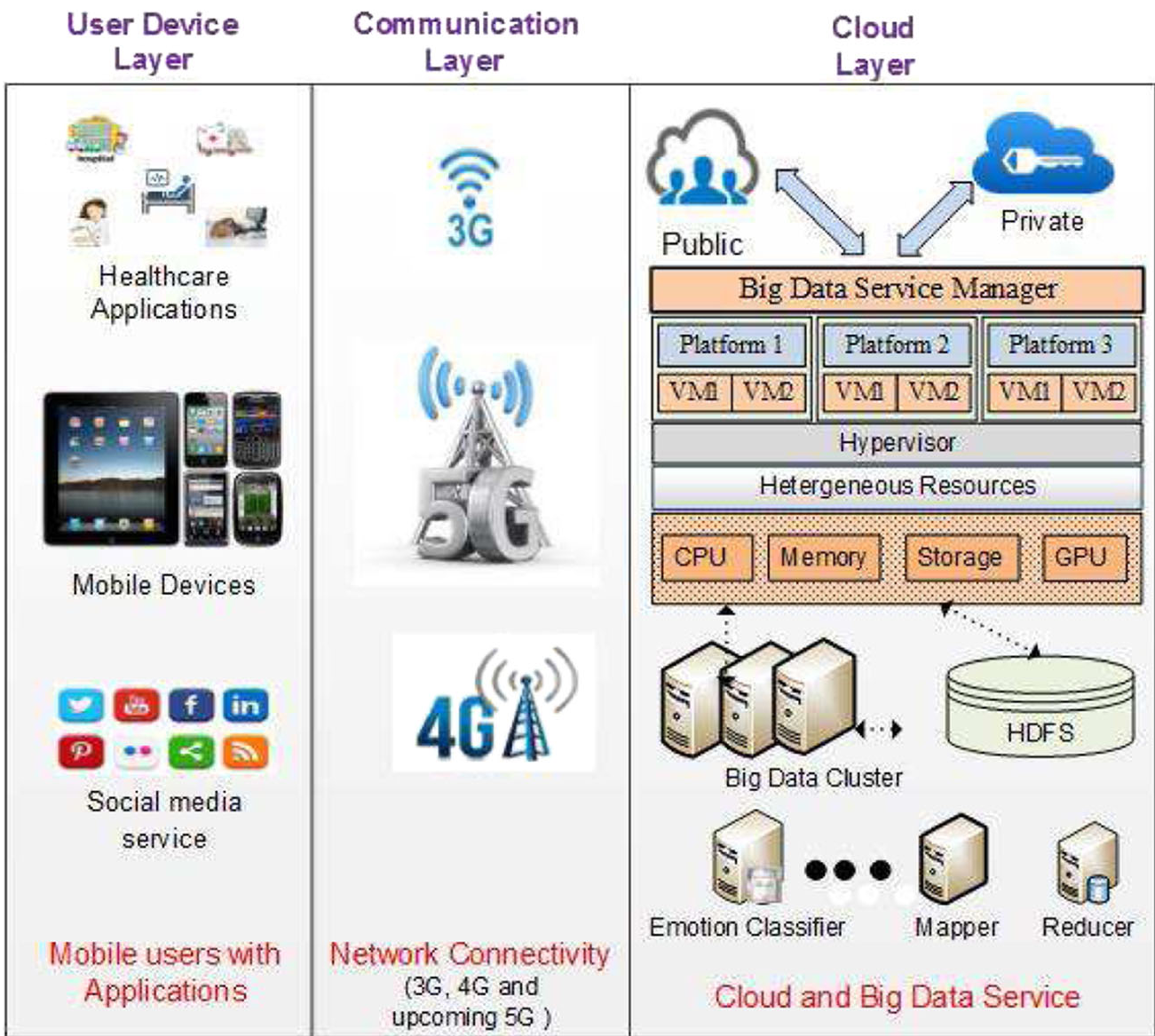 Fig 1: The proposed 5G-enabled cloud architecture for emotion recognition.
Experiments & Scalability Results
Recognition Performance
The system was validated on several benchmarks:
- eNTERFACE'05: Achieved 83.10% accuracy. Bimodal fusion significantly boosted results, particularly for "Sad" (97.30%) and "Anger" (85.67%).
- Berlin/Kanade-Cohn: Proved that the MDR and WLD features generalize well across different languages and acted facial expressions.
Distributed Processing Efficiency
The most striking results came from the Hadoop cluster tests. For a 50 GB dataset:
- 1 Node: ~7.4 hours.
- 24 Nodes: ~20 minutes.
The Speedup Factor increased linearly with the number of nodes, especially for larger datasets, proving that the infrastructure is truly "Big Data ready."
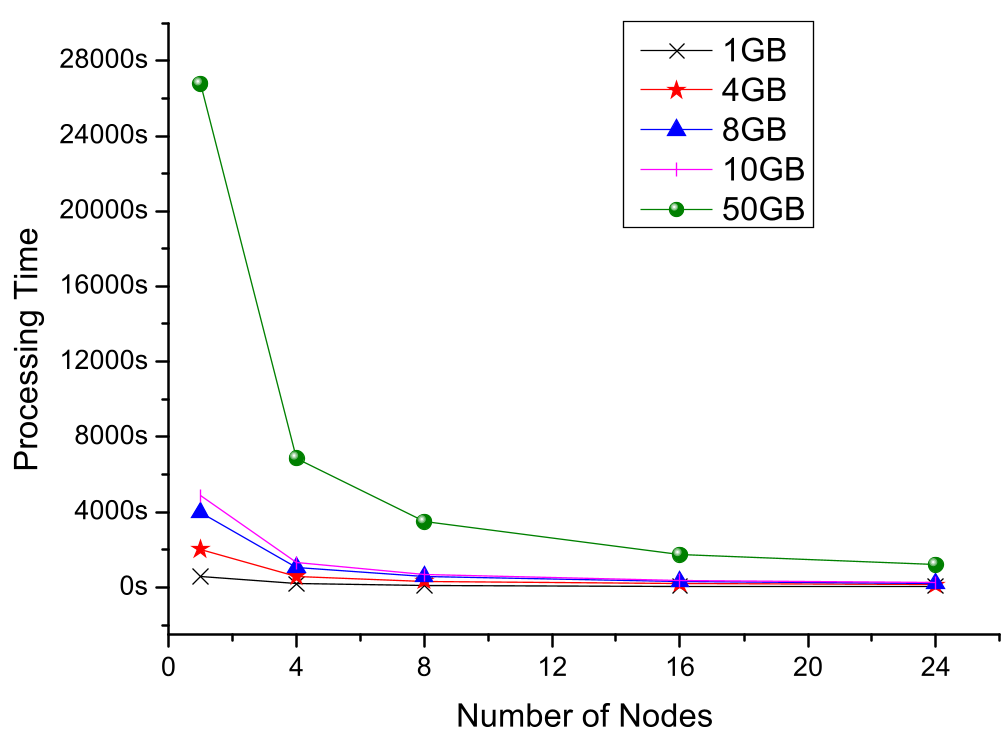 Fig 2: Processing time vs. Cluster size for different data loads.
Critical Analysis & Conclusion
Takeaway
The paper successfully demonstrates that bimodal fusion is no longer just a "nice-to-have" for accuracy; when combined with distributed frameworks like Hadoop, it becomes a feasible solution for mass-market 5G applications.
Limitations & Future Work
- Legacy Framework: While Hadoop was SOTA at the time of publication, modern implementations would likely favor Apache Spark or Ray for in-memory processing to further reduce latency.
- Real-world Noise: The experimental sets utilized acted databases (eNTERFACE). Performance might degrade in "in-the-wild" 5G scenarios with significant background noise or occlusion.
Ultimately, this work serves as an essential blueprint for building emotionally-intelligent infrastructure in the hyper-connected 5G ecosystem.