
Fast-and-Frugal Trees: Augmenting Clinical Competence Without the Black Box
Augmenting Decision Competence in Healthcare Using AI-based Cognitive Models
This paper presents an "intrinsically transparent" cognitive model for post-operative risk stratification in healthcare, specifically using Fast-and-Frugal Trees (FFTs). It demonstrates that ultra-simple, three-node heuristic models can achieve a high predictive performance (AUC 0.91) comparable to complex machine learning models like Random Forests and SVMs.
TL;DR
In the rush to implement complex AI in healthcare, we have often sacrificed transparency for a perceived (but often nonexistent) boost in accuracy. This paper challenges the "accuracy-transparency trade-off" by demonstrating that Fast-and-Frugal Trees (FFTs)—simple cognitive models—can predict post-operative mortality with an AUC of 0.91, rivaling complex machine learning models while remaining simple enough to fit on a laminated pocket card.
The "Explainability" Trap
The current AI landscape is obsessed with Explainable AI (XAI) tools like SHAP and LIME. However, the authors argue these are "post-hoc" approximations—essentially, a second model trying to guess what the first "black box" model is doing. This creates a dangerous "infinite regress" where physicians must trust an approximation of a process they don't understand.
The paper highlights a chilling example of a neural network that "successfully" diagnosed pneumonia by detecting the word "portable" on X-rays. It hadn't learned medicine; it had learned that patients too sick to walk to the radiology department (hence needing a "portable" machine) were higher risk. In a black-box system, such flaws remain hidden until a catastrophe occurs.
Methodology: The Power of Cognitive Heuristics
Instead of building a bigger black box, the researchers looked toward Cognitive Science. They utilized Fast-and-Frugal Trees (FFTs), which are binary classifiers that provide a clear exit path at every node.
Why FFTs work:
- Limited Search: They don't process all variables; they stop as soon as a cue is sufficient.
- Robustness: By ignoring "noise" and focusing on a few core cues, they often generalize better to new hospitals than complex models.
- Human-in-the-loop: A physician can "debug" an FFT instantly if a specific cue is unavailable or clinical context changes.
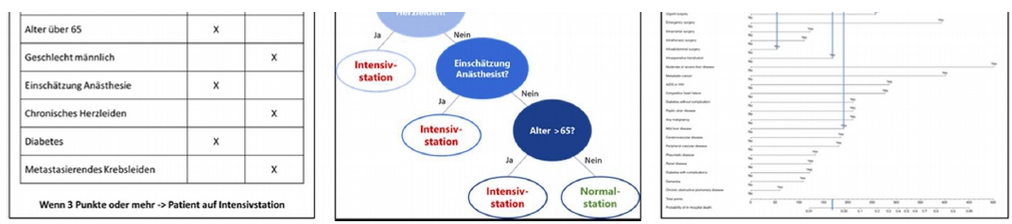 Visualizing simple cognitive models vs. statistical nomograms.
Comparing Performance: Simple vs. Complex
The study analyzed a massive dataset of 130,238 patients from the Ko-Moskau study. They compared the FFT approach against Random Forests, Support Vector Machines (SVM), and standard Logistic Regression.
Key Findings:
- Logistic Regression (LR): Highest AUC (0.98).
- Fast-and-Frugal Tree (FFT): High AUC (0.91) using only 3 questions.
- Random Forest (RF): Median AUC (0.93)—only 2% better than the transparent 3-node tree.
- Physician Intuition (ASA): AUC (0.83)—the trees actually outperformed the raw expert assessment.
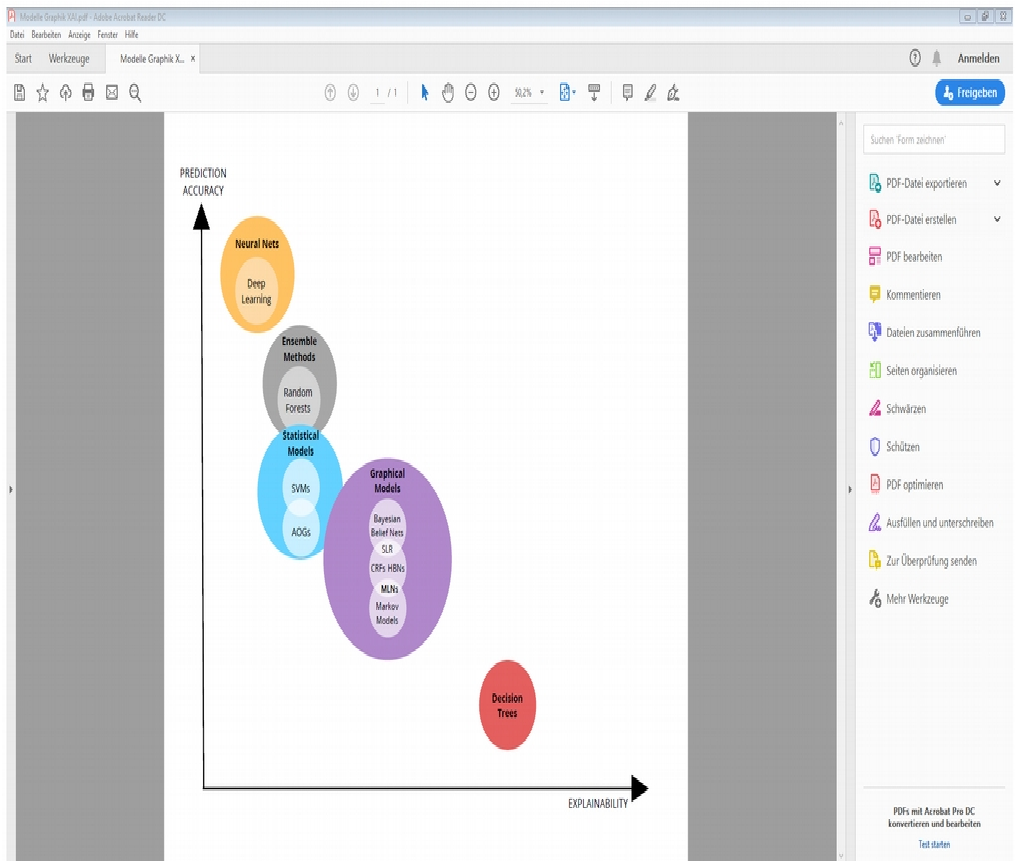 The classic "effort-accuracy trade-off" curve which this paper partially debunks for healthcare.
Deep Insight: Augmentation, Not Replacement
The brilliance of the FFT approach lies in its Implementation. Because the model is just a series of 3-5 "Yes/No" questions, it can be distributed as a laminated pocket card.
Unlike a Neural Network that requires a GPU server and a digital interface, an FFT empowers the doctor to perform the calculation in their head or on the fly. This Augmented Intelligence approach ensures that the doctor remains the primary decision-maker, using the tool as a mental check rather than a cryptic oracle.
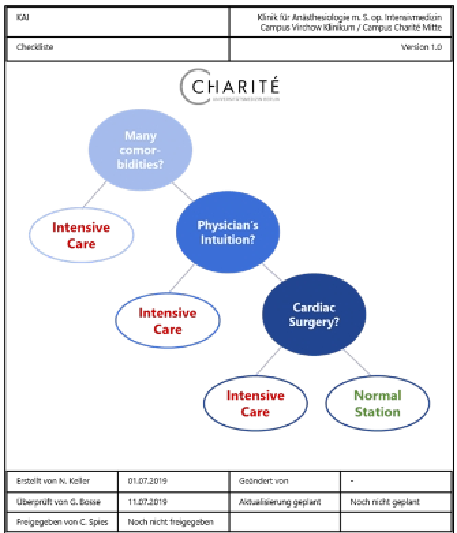 An example of the FFT as a bedside decision support tool.
Critical Analysis & Conclusion
While the FFT was slightly less accurate than Logistic Regression in a "static" data setting, the authors argue its real-world performance is likely higher. Why? Because a model that people understand is a model people will actually use—and one they can correct when they see it failing.
Limitations: The study focused on pre-operative planning. It did not account for real-time intra-operative changes (like unexpected bleeding), though the authors suggest FFTs could easily be "updated" at the bedside for such events.
Final Takeaway: Transparency is not a "luxury" or a "roadblock" to accuracy; it is a prerequisite for safety in high-stakes human systems. Sometimes, the most "advanced" solution is the simplest one.