
Decoding Digitized Dialects: High-Accuracy Gender Identification in Arabic YouTube Comments
Author Gender Identification from Arabic Youtube Comments
This paper presents a machine learning-based framework for Gender Identification (GI) in Arabic YouTube comments. By leveraging a novel automated annotation strategy and a Naive Bayes Multinomial classifier, the method achieves a high accuracy of 92% and an average precision of 98% across various Arabic dialects.
TL;DR
Researchers have developed a robust machine learning system capable of identifying the gender of Arabic YouTube commenters with 92% accuracy. By moving beyond formal Modern Standard Arabic (MSA) and focusing on the rich, messy reality of dialectal YouTube comments, this work sets a new benchmark for Authorship Profiling (AP) in one of the world's most morphologically complex languages.
The Challenge: Beyond Formal Arabic
Authorship Profiling—the art of determining an author's characteristics from their writing—is exceptionally difficult in Arabic. The language is a mosaic of Modern Standard Arabic (MSA) used in news and local dialects used in daily life (Levantine, Maghrebi, Gulf, Egyptian).
Previous state-of-the-art (SOTA) methods suffered from two fatal flaws:
- Domain Mismatch: Training on formal articles (MSA) which don't reflect how people actually talk on social media.
- Geographic Bias: Training on localized datasets (like Jordanian tweets) that fail to recognize the linguistic markers of other Arab regions.
Methodology: Taming the YouTube Data Stream
The authors recognized that YouTube is the "town square" of the Arab world, with 50% of young Arabs engaging with it daily. They collected over 50,000 comments, providing a richer text length (up to 500 characters) compared to the restrictive 140-character limit of legacy Twitter datasets.
1. The Multi-Service Annotation Strategy
To solve the labeling bottleneck, the team used a consensus-based approach. They compared results from two major name-inference services: Genderize and NamSor. Only names where both services agreed were kept, ensuring a high-fidelity ground truth for the "Female" and "Male" labels.
2. Model Architecture
The core of the system is a Naive Bayes Multinomial classifier. Before feeding the data into the model, the authors merged the author's name with the comment text—a clever move that captures both nominal and stylistic cues.
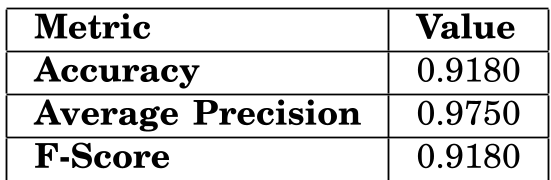 Table: The final model performance parameters showing exceptional Precision and F-Score.
Key Insights: How Men and Women Write Differently in Arabic
The research uncovered fascinating stylometric markers:
- The Emoji Gap: Female authors use nearly 70% more emojis on average than male authors (0.076 vs 0.044).
- Vocabulary Breadth: Male authors tended to have a higher "Distinct Word Count," suggesting a broader, perhaps more varied vocabulary in the context of YouTube debates.
- Text length: Males wrote slightly longer words and more words per comment than females.
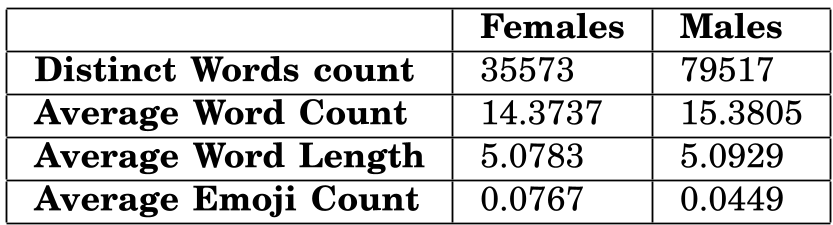 Table: Comparative linguistic characteristics between genders in the training set.
Results and Performance
The Naive Bayes approach, while mathematically simpler than modern Neural Networks, proved highly effective. The ROC curve (Receiver Operating Characteristic) showcased an Area Under the Curve (AUC) that signals a nearly perfect ability to distinguish between classes.
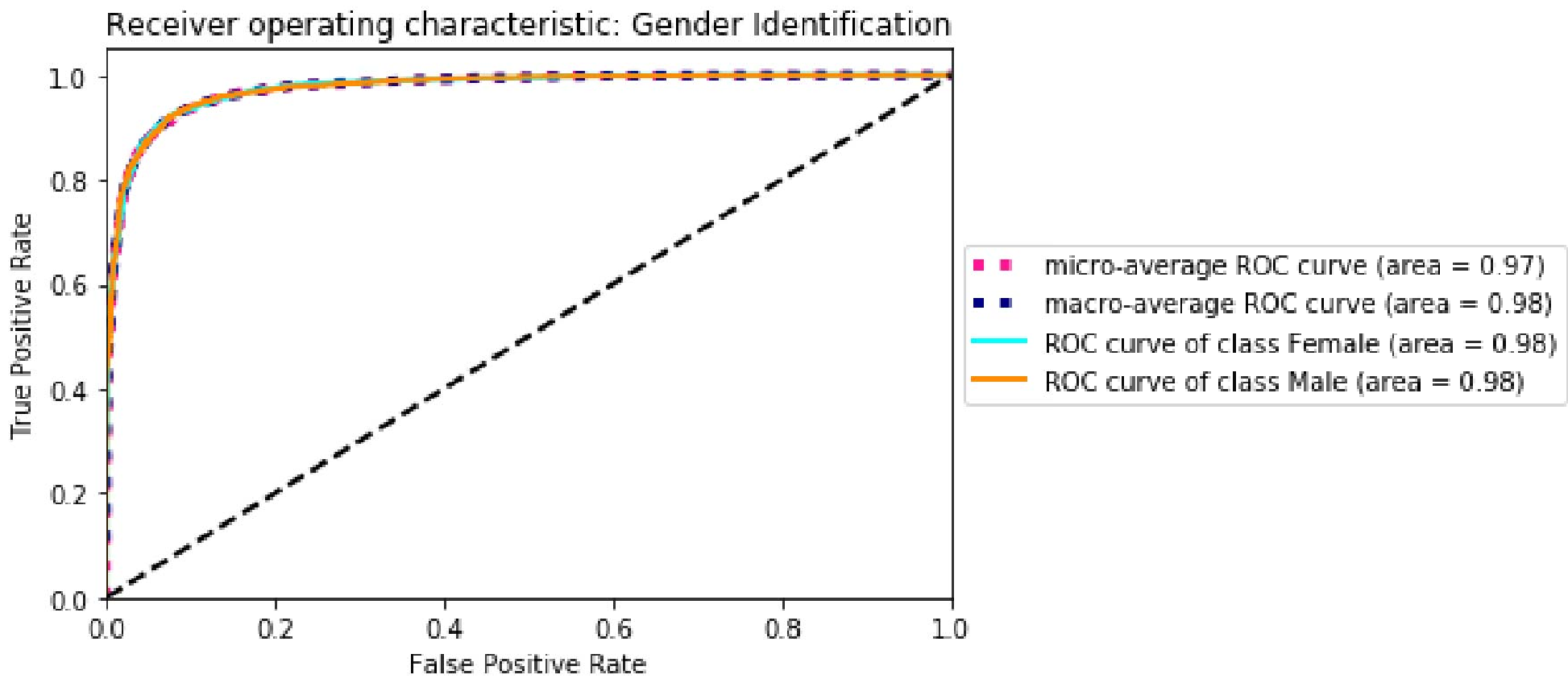 The model demonstrates high sensitivity and specificity in gender classification.
Critical Perspective & Future Work
While the 92% accuracy is impressive, the study acknowledges that adding features like word length and count didn't significantly boost performance beyond the TF-IDF unigram model. This suggests that in short-text Arabic social media, the choice of words (lexical choice) is a much stronger indicator of gender than structural metrics.
Future Outlook: The next logical step is moving from "Shallow" Machine Learning to Deep Learning. Models like BERT (specifically AraBERT) could potentially capture the syntactic nuances of different dialects even more effectively, perhaps finally closing the gap to 100% accuracy.
Conclusion
This paper proves that by selecting a data source that truly reflects the linguistic diversity of a population, even traditional algorithms can outperform specialized MSA-based models. It provides a blueprint for gender-disaggregated opinion analysis that could be invaluable for public policy and targeted marketing in the MENA region.