
Deciphering the Digital Persona: Psycho-Linguistic Gender Identification in Cyber-Forensics
Author gender identification from text 5
This paper introduces a robust framework for identifying an author's gender from short, multi-genre Internet texts using a high-dimensional psycho-linguistic feature space. By leveraging Support Vector Machines (SVM), Bayesian Logistic Regression, and AdaBoost, the authors achieve a state-of-the-art accuracy of 85.1% on diverse datasets including Enron emails and Reuters news.
TL;DR
Can a machine tell if you are a man or a woman based solely on a short email? This seminal paper demonstrates that by using a specialized set of 545 psycho-linguistic features, researchers can identify an author's gender with up to 85.1% accuracy. Utilizing the Enron email and Reuters news corpora, the study proves that deep-seated linguistic habits—often invisible to the naked eye—serve as reliable forensic markers in the anonymous wild west of the Internet.
Background: Beyond Simple Authorship
In the world of digital forensics, knowing who wrote a message is often secondary to knowing what kind of person wrote it. While traditional "Authorship Attribution" focuses on matching a text to a specific individual (like identifying a disputed Shakespeare play), Gender Identification operates at a higher level of abstraction. It is particularly vital in cases of "cyber-faking," where predators or fraudsters adopt false personas.
The authors argue that gender is a social construct reflected in language. Even when we try to be neutral, our "state of mind" leaks through our choice of function words, punctuation habits, and structural layouts.
Methodology: The 545-Dimension Linguistic Mirror
The authors didn't just look at what was said (content), but how it was said (style). They categorized 545 features into five critical domains:
- Character-based: Frequency of special characters, digits, and capital letters.
- Word-based: Vocabulary richness metrics (Yule’s K, Simpson’s D) and LIWC (Linguistic Inquiry and Word Count) cues which track emotional categories like "Anxiety" or "Certainty."
- Syntactic: Use of punctuation, specifically looking for "multiple marks" (e.g., !!! or ???) often found in informal female communication.
- Structural: Paragraph length, the use of greetings/farewells, and sentence-start patterns.
- Function Words: The "glue" of language—pronouns (I vs. We), auxiliary verbs, and gender-specific intensive adverbs (e.g., "really," "quite").
The Pipeline
The process follows a classic supervised learning workflow:
Corpus Collection -> Feature Extraction -> Normalization -> Classification (SVM/AdaBoost/Bayesian Logistic Regression)
Experiments and Results
The study utilized two contrasting datasets:
- Reuters Newsgroup: Neutral, objective, and professional.
- Enron Email: Personal, corporate, and often informal.
Key Insights:
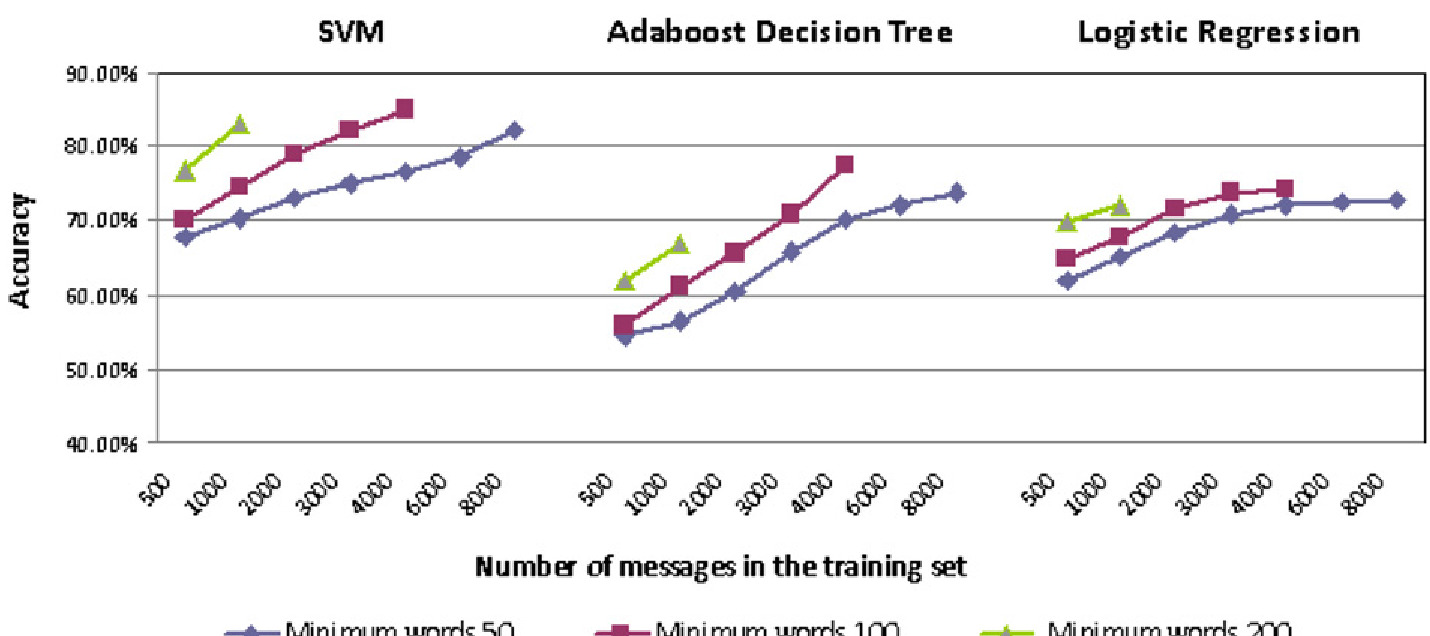
- SVM Reigns Supreme: Support Vector Machines with a Radial Basis Function (RBF) kernel consistently outperformed both AdaBoost and Bayesian Logistic Regression across all datasets.
- Length Matters: The accuracy jumped significantly when messages were longer. For emails with over 200 words, the classifier became much more robust.
- Function Words are Key: Interestingly, using only function words yielded a 74.8% accuracy—nearly as good as using the entire character/word set combined.
Critical Analysis: Why This Works
The success of this method lies in its focus on content-free features. While a man and a woman might both write about a "business contract," the woman might use more hedges ("perhaps," "maybe") or polite forms, while the man might use more directive language and first-person singular pronouns.
However, the paper acknowledges a crucial distinction: Sex vs. Gender. The study identifies gendered language style (socially constructed), not biological sex. This means a masculine-writing female might be identified as male by the system—a limitation that reflects the fluidity of human expression.
Conclusion and Future Outlook
This work provides a foundational framework for modern social media forensics. By achieving 85% accuracy on short, noisy data like the Enron corpus, the authors proved that our "stylistic tendency" is a persistent digital fingerprint.
Future Work in this domain is now shifting toward Deep Learning (Transformers) and Multi-modal analysis, but the core psycho-linguistic features identified here remain the standard for interpretable forensic linguistics.
Editor's Note: This paper remains a cornerstone for understanding the intersection of psychology and machine learning in text mining.